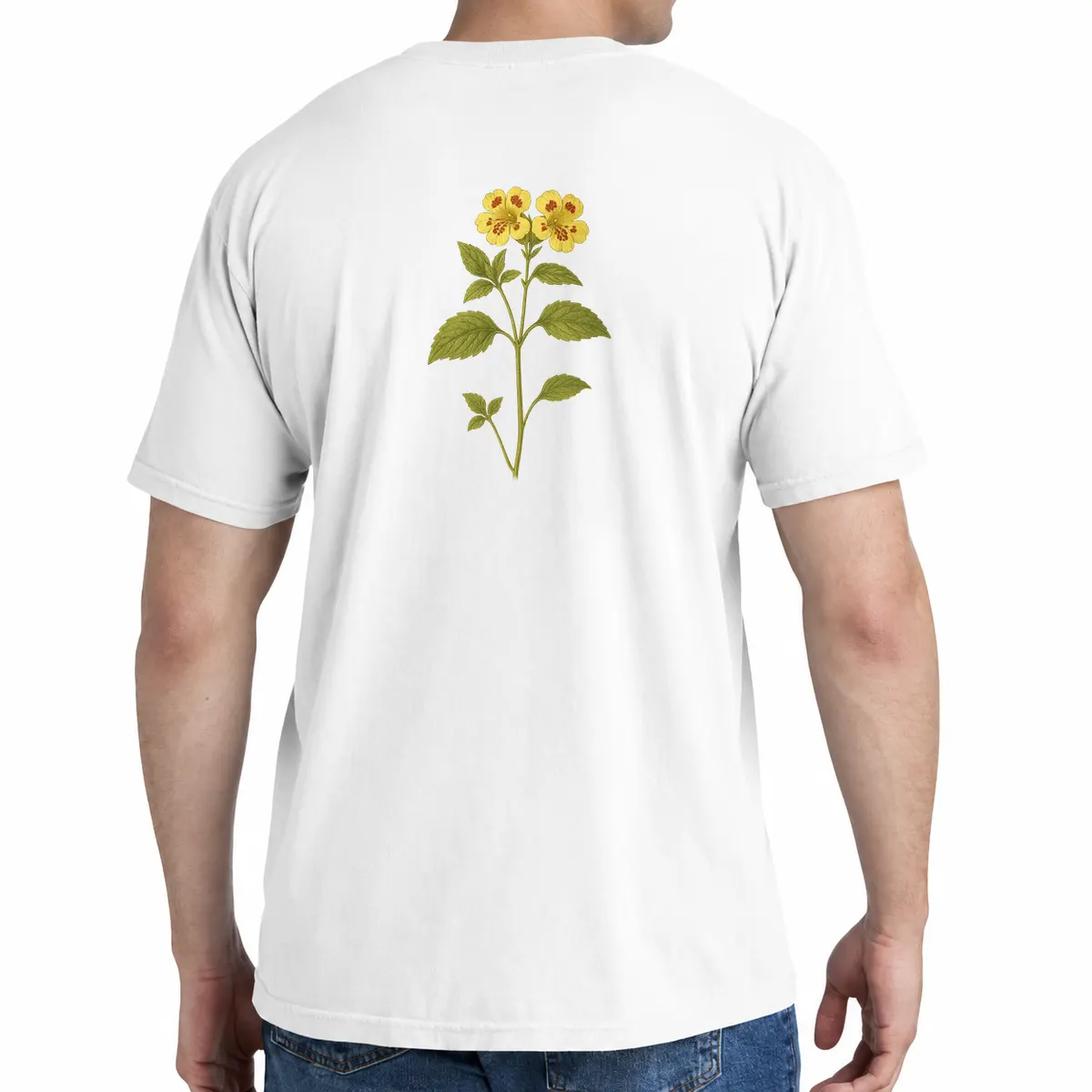
Mapleleaf Oak
$40.00 USD
Created in the tradition of 19th-century botanical plates, then reviewed by hand before it goes anywhere near a shirt. Yours is printed fresh when you order it.
Style: Short Sleeve
Description
This women's tee is made from 6.1 oz 100% ring-spun US cotton in a boxy, slightly cropped mid-length cut. It features a topstitched ribbed collar, shoulder-to-shoulder twill tape, a seamless body, and a double-needle bottom hem. Dyed with OEKO-TEX certified low-impact dyes in a WRAP-certified facility, using a salt-free clean pigment process that uses about half the water of conventional pigment dyeing. Boxy fit, sizes S–2XL — it runs close to the body, so size up for a looser drape. Slight shade variation between garments is normal.
Size Chart
Garment measurements in inches, laid flat.
| Size | Body length | Body width |
|---|---|---|
| S | 20" | 18 1/4" |
| M | 21" | 20 1/4" |
| L | 22" | 22" |
| XL | 23" | 24" |
| 2XL | 24" | 26" |
The blank
Shipping
Returns
Meet mapleleaf oak
Quercus acerifolia (E.J.Palmer) Stoynoff & W.J.Hess ex R.J.Jensen
Mapleleaf oak is an Arkansas tree whose broad, deeply lobed leaves recall those of a maple. In its native uplands it often grows as a small tree or large shrub. Open woodland, rocky ledges, steep slopes, and glades provide its characteristic setting. Morton Arboretum: Conservation Gap Analysis of Native U.S. Oaks, Quercus acerifolia
Seasonal development
Arkansas
Flora of North America records spring flowering; the acorns mature in their second year. Flora of North America 3:465: Quercus acerifolia
Native range
The established native populations occur around Magazine, Sugarloaf, Pryor, and Porter mountains in western Arkansas. Trees typically occupy dry, thin, rocky soils. A Morton Arboretum conservation assessment notes that suppression of fire at Magazine Mountain has reduced the open-canopied habitat this oak favors. Morton Arboretum: Conservation Gap Analysis of Native U.S. Oaks, Quercus acerifolia
Explore this plant's botanical story