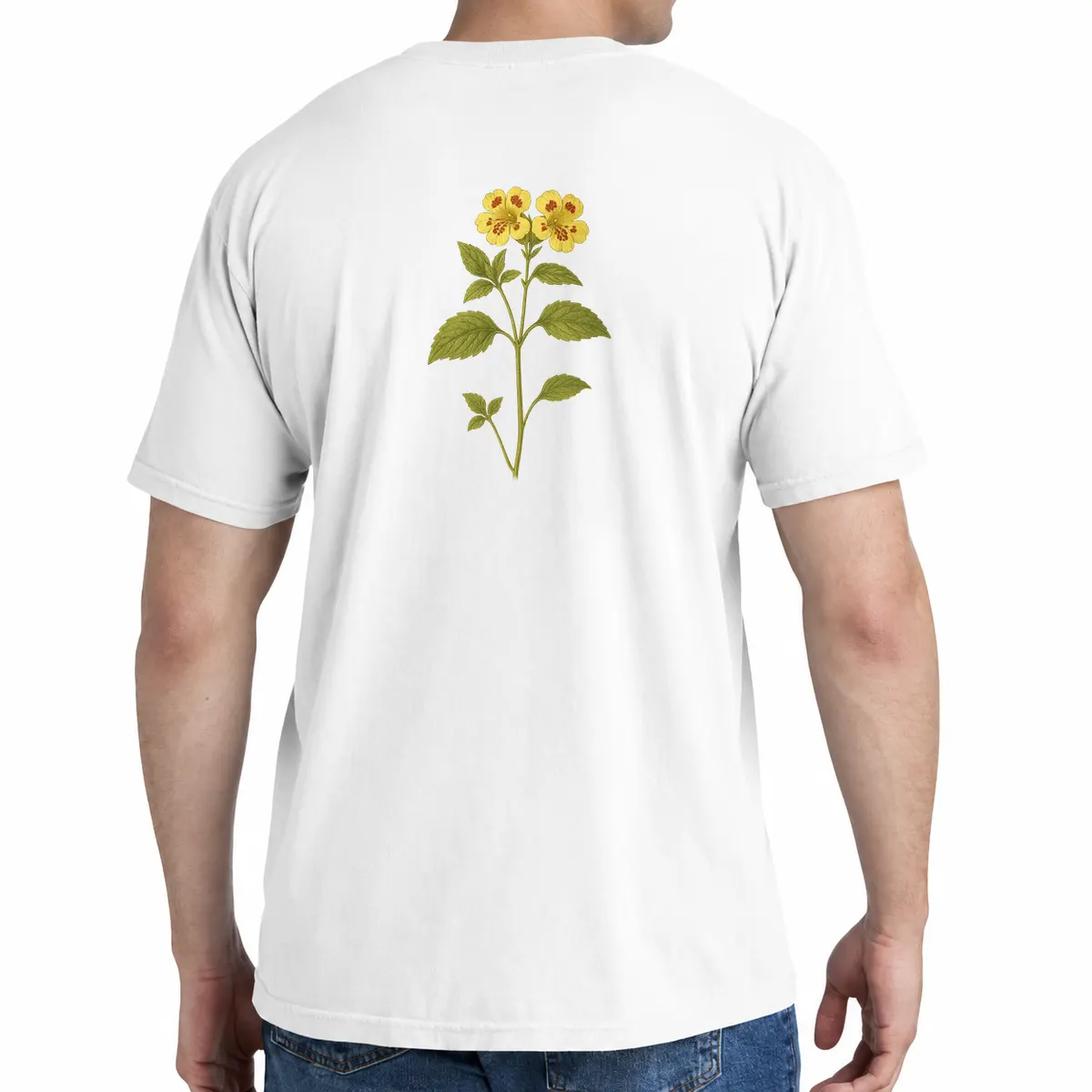
Yerba De Peo
$40.00 USD
Created in the tradition of 19th-century botanical plates, then reviewed by hand before it goes anywhere near a shirt. Yours is printed fresh when you order it.
Style: Short Sleeve
Description
This women's tee is made from 6.1 oz 100% ring-spun US cotton in a boxy, slightly cropped mid-length cut. It features a topstitched ribbed collar, shoulder-to-shoulder twill tape, a seamless body, and a double-needle bottom hem. Dyed with OEKO-TEX certified low-impact dyes in a WRAP-certified facility, using a salt-free clean pigment process that uses about half the water of conventional pigment dyeing. Boxy fit, sizes S–2XL — it runs close to the body, so size up for a looser drape. Slight shade variation between garments is normal.
Size Chart
Garment measurements in inches, laid flat.
| Size | Body length | Body width |
|---|---|---|
| S | 20" | 18 1/4" |
| M | 21" | 20 1/4" |
| L | 22" | 22" |
| XL | 23" | 24" |
| 2XL | 24" | 26" |
The blank
Shipping
Returns
Meet yerba de peo
Porophyllum leiocarpum (Urb.) Rydb.
Yerba de peo has a distinctive combination of broad, thin leaves and elongated flower heads. Johnson’s monograph describes an upright annual that branches above, with smooth green or purplish stems that may have a bluish bloom. The leaves can be opposite or alternate, and each is carried on a visible stalk. R. R. Johnson, 1969: Monograph of Porophyllum
Bloom window
Puerto Rico and South American populations treated by Johnson
The monograph reports flowering throughout the year across its treatment area. R. R. Johnson, 1969: Monograph of Porophyllum
Native range
Kew currently lists Puerto Rico, Venezuela and southeastern Brazil, specifically São Paulo, as native areas, chiefly in seasonally dry tropical conditions. Johnson’s older monograph interpreted the South American coastal populations as introduced; the current native-range statement here follows Kew. Kew POWO: Porophyllum leiocarpumR. R. Johnson, 1969: Monograph of Porophyllum
Explore this plant's botanical story