African olive
Olea europaea subsp. cuspidata (Wall. ex G.Don) Cif.
This wild olive belongs to the same species as the cultivated olive, but represents a distinct subspecies. In Oman it is an evergreen tree or large shrub, sometimes reaching ten metres, with rough grey bark. In Oman it occurs at high elevations and in summit grassland. Shahina Ghazanfar, Flora of Oman volume3, via Kew
Botanical name
Kew accepts the catalog’s subspecies cuspidata. Its current treatment separates African subsp. africana, reinstated following a 2024 revision; the catalog common name “African olive” reflects older usage, not the current native range. Kew POWO: Olea europaea subsp. cuspidataKew POWO: Olea europaea subsp. africana
Recognizing the plant
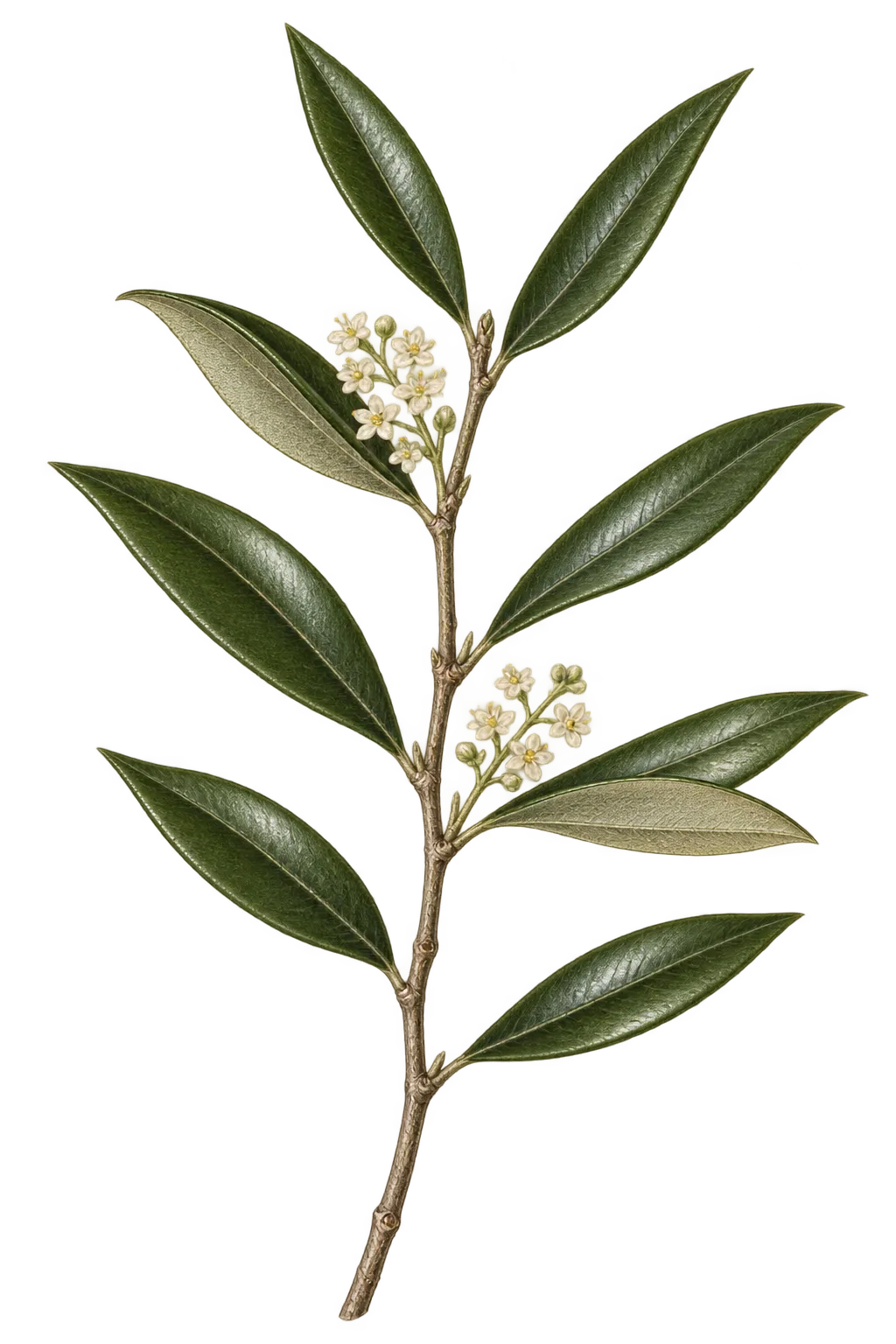
The leathery leaves grow in opposite pairs. They are lance-shaped to elliptic, with smooth margins, pointed tips and wedge-shaped bases. Their upper surfaces are shiny green; shield-shaped scales cover the brownish-green undersides. Small fragrant flowers occur in short clusters at shoot tips or leaf axils. Each has a four-lobed white or cream corolla and two projecting stamens. Ellipsoid fruits ripen blue-black around a single seed. Shahina Ghazanfar, Flora of Oman volume3, via Kew
Seasonal development
Oman
The regional flora records flowering and early fruiting in May and June, with fruits maturing in August. Shahina Ghazanfar, Flora of Oman volume3, via Kew
Native range
Under Kew’s current circumscription, the native range runs from the Arabian Peninsula through Iran, Afghanistan, Pakistan and the Himalaya to Yunnan in China. In Oman, it occurs in the Hajar and Dhofar mountains. Kew POWO: Olea europaea subsp. cuspidataShahina Ghazanfar, Flora of Oman volume3, via Kew
Botanical sources
- Kew POWO: Olea europaea subsp. cuspidata
- Kew POWO: Olea europaea subsp. africana
- Shahina Ghazanfar, Flora of Oman volume3, via Kew
Reviewed 2026-10-11. Seasonal development varies with location and growing conditions.