Alabama phlox
Phlox pulchra (Wherry) Wherry
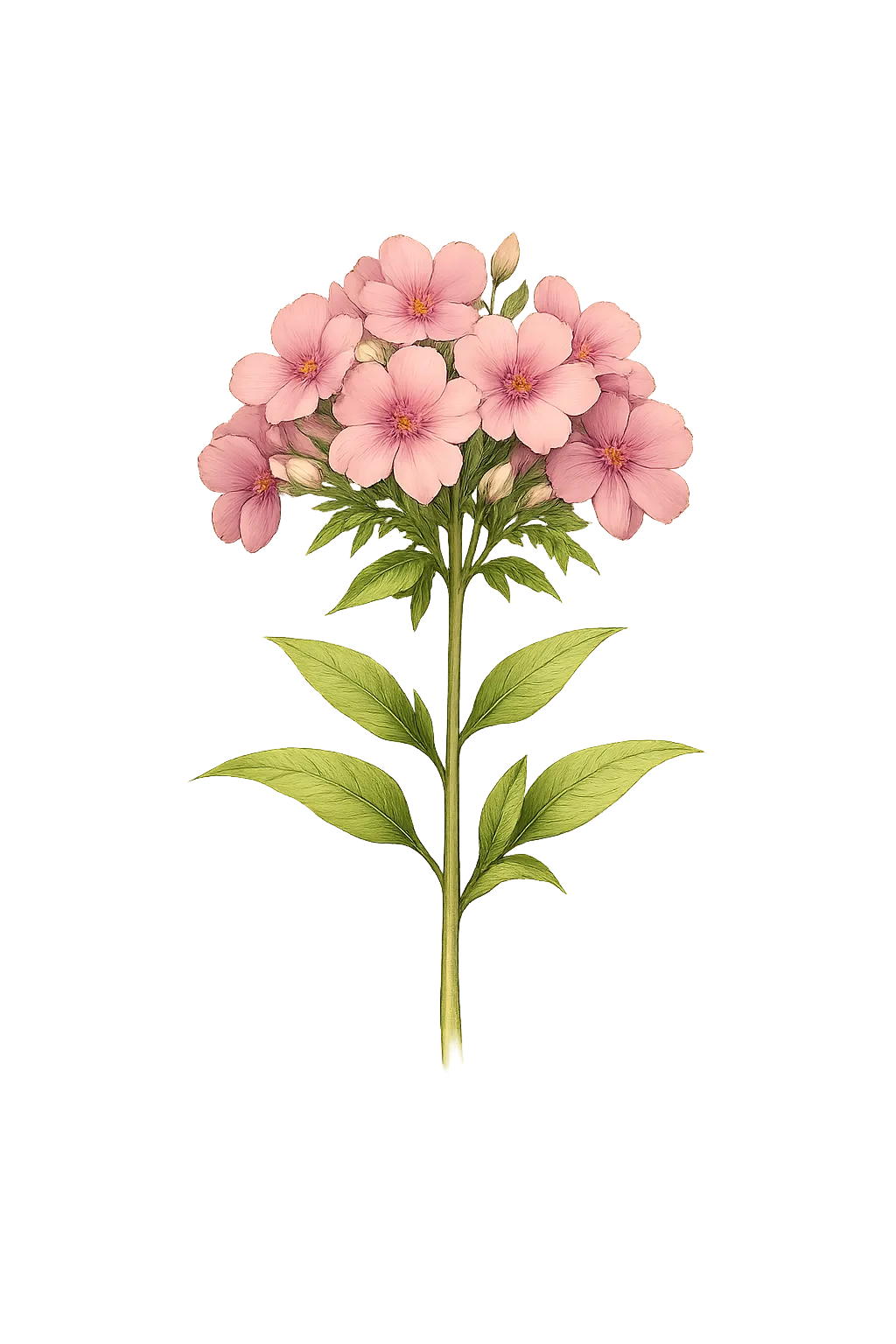
Alabama phlox brings unusually soft colors to a genus often associated with vivid magenta. Writing in 1935, Edgar Wherry singled out Walker County plants for generous clusters of relatively large flowers in rose, pink and near-white shades. He then treated them as a variety of Phlox ovata; they are now recognized as a separate species. USDA GRIN Taxonomy: Phlox pulchraWherry (1935), Our Native Phloxes and Their Horticultural Derivatives
Botanical name
USDA GRIN accepts Phlox pulchra (Wherry) Wherry. Its basionym is Phlox ovata var. pulchra Wherry; the supplied author citation omits the parenthetical author. USDA GRIN Taxonomy: Phlox pulchra
Recognizing the plant
Flowering shoots rise from stems that recline near the ground. Nonflowering shoots are elongated, and the flowering stems typically have five to seven leaf-bearing nodes below the flower cluster. Leaf margins are smooth or only slightly rough. The lateral veins are inconspicuous and do not join into a prominent vein running alongside the leaf edge, unlike the strongly veined leaves of garden phlox. Weakley (2012), Flora of the Southern and Mid-Atlantic States
Bloom window
Shelby County, Alabama, 2020 field observation
That riverbank population was flowering on 23 May 2020; the observation establishes late-spring bloom locally without defining the entire season. Barger et al. (2023), New and noteworthy vascular plant records for Alabama
Native range
This rare species is endemic to Alabama. Documented occurrences are scattered among several counties. A 2020 field record found plants in thin, gravelly soil on a steep, exposed sandstone bank beside the Cahaba River. Barger et al. (2023), New and noteworthy vascular plant records for Alabama
Botanical sources
- USDA GRIN Taxonomy: Phlox pulchra
- Wherry (1935), Our Native Phloxes and Their Horticultural Derivatives
- Weakley (2012), Flora of the Southern and Mid-Atlantic States
- Barger et al. (2023), New and noteworthy vascular plant records for Alabama
Reviewed 2026-10-11. Seasonal development varies with location and growing conditions.