Alaska blueberry
Vaccinium ovalifolium Sm.
Alaska blueberry is a deciduous shrub of damp northwestern forests, usually about 0.5–2 m tall. Its branches spread outward, with yellow-green young growth contrasting with older gray bark. Shallow roots and rhizomes support its understory growth, and seedlings can establish on decaying logs within the forest. E-Flora BC: Vaccinium alaskaenseUS Forest Service FEIS: Vaccinium alaskaense
Botanical name
USDA GRIN includes Vaccinium alaskaense Howell in V. ovalifolium Sm. This profile retains British Columbia’s narrower Alaska-blueberry concept. USDA GRIN Taxonomy: Vaccinium ovalifoliumE-Flora BC: Vaccinium alaskaense
Recognizing the plant
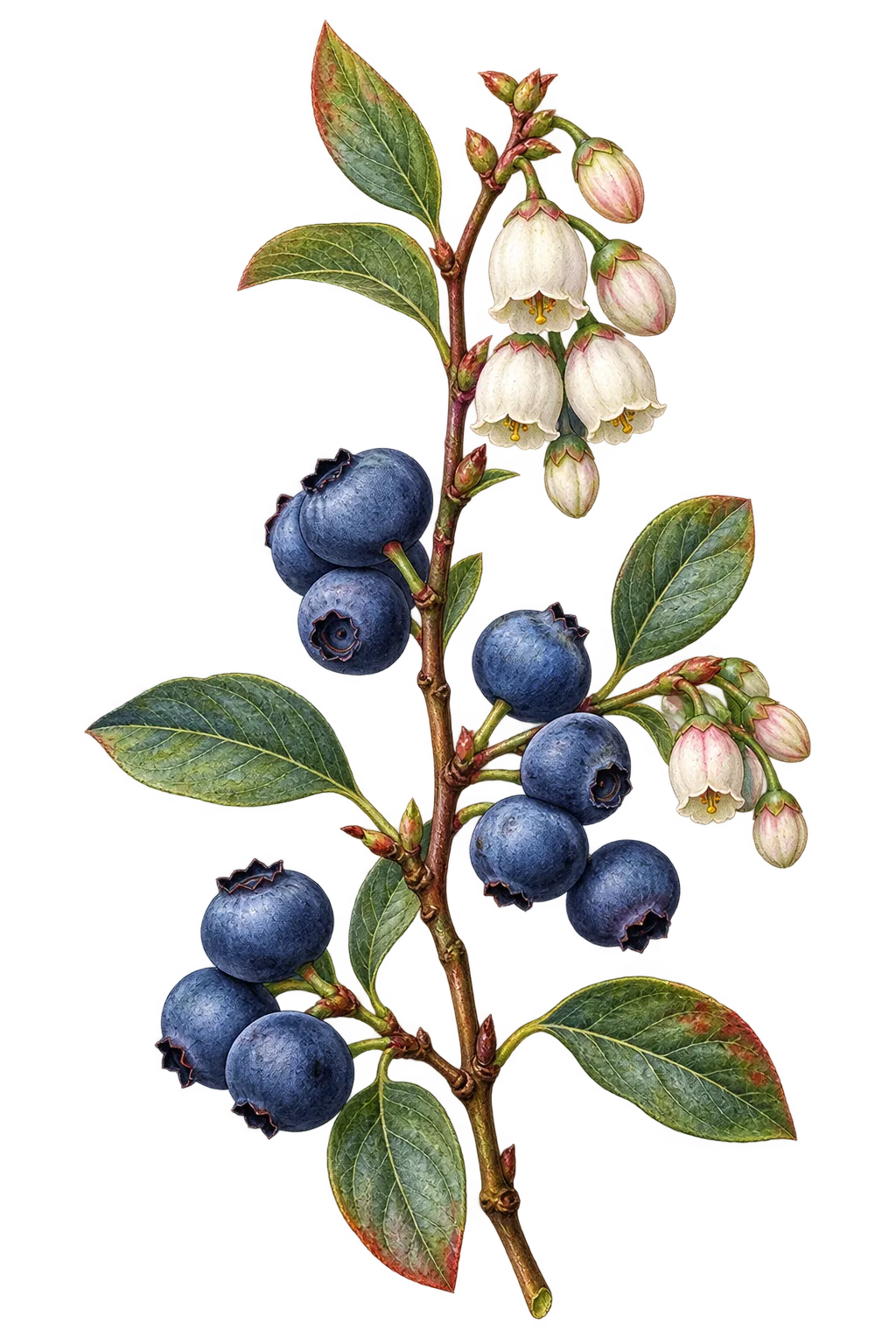
In the British Columbia treatment, leaves are oval to egg-shaped, about 2–7 cm long, with paler undersides and tiny teeth that may be confined to the lower half. Stiff, sometimes glandular hairs occur along the lower midrib. Solitary pink to bronze flowers hang from the leaf axils; their rounded, urnlike shape is about as broad as it is long. The dark blue-purple to black berries are described there as lacking a pale waxy bloom. E-Flora BC: Vaccinium alaskaense
Bloom window
Pacific Northwest, narrow Vaccinium alaskaense concept
Pacific Northwest accounts record flowering in April–May and berry ripening from mid-July to mid-August. US Forest Service FEIS: Vaccinium alaskaense
Native range
This regional Alaska-blueberry concept ranges from southern Alaska through coastal British Columbia and Washington to northwestern Oregon. It grows in moist forest and openings from low elevations into mountain and subalpine settings. E-Flora BC: Vaccinium alaskaense
Botanical sources
- USDA GRIN Taxonomy: Vaccinium ovalifolium
- E-Flora BC: Vaccinium alaskaense
- US Forest Service FEIS: Vaccinium alaskaense
Reviewed 2026-10-11. Seasonal development varies with location and growing conditions.