aloe yucca
Yucca aloifolia L.
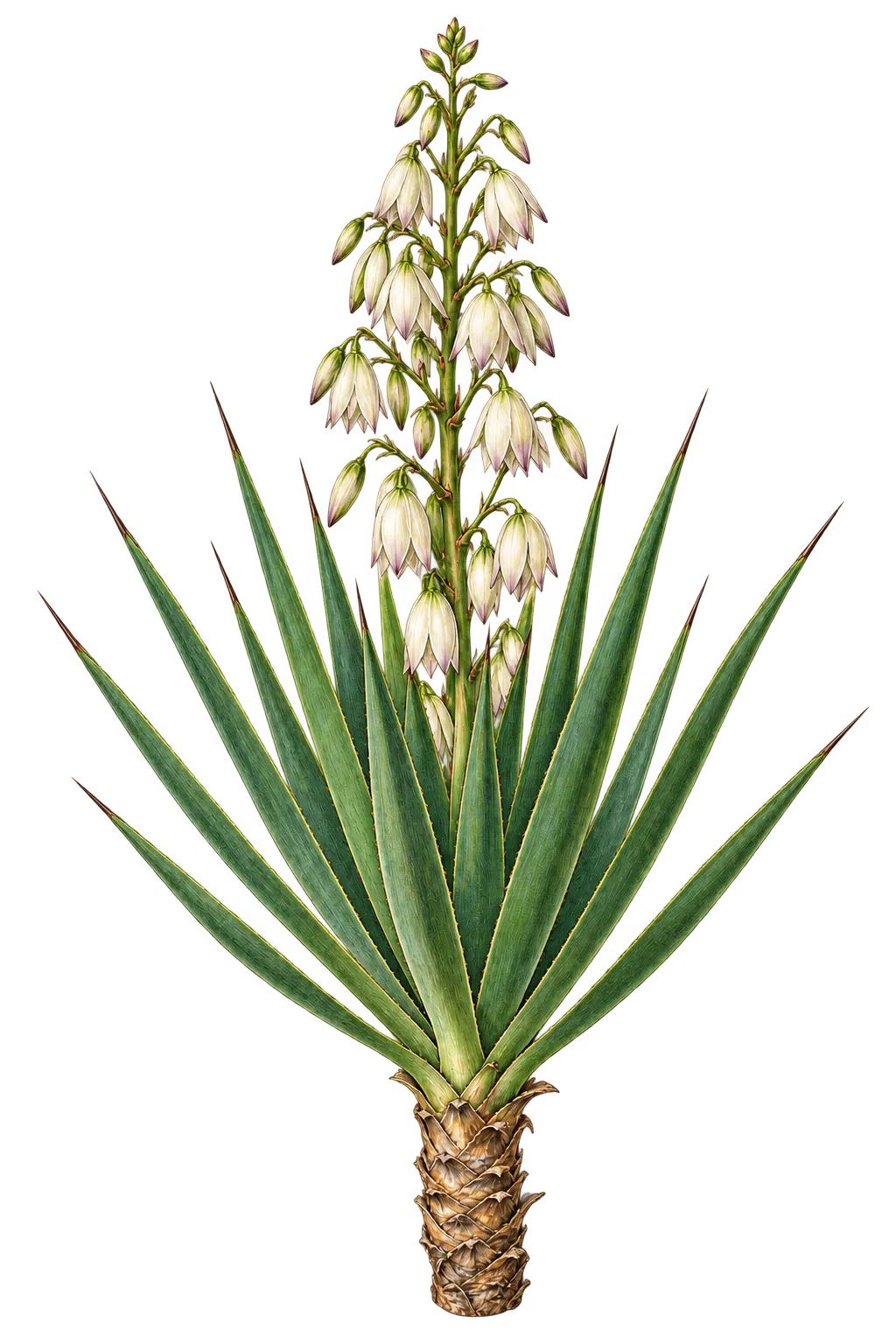
Aloe yucca forms upright trunks crowned by stiff, sword-shaped leaves. New shoots arising near the base can produce a cluster of stems, and fallen stems may root and continue growing. Each leaf ends in a very sharp point, while its edges lack the loose threads found on some other yuccas. NC State Extension: Yucca aloifolia
Botanical name
Kew accepts Yucca aloifolia L. in Asparagaceae, matching the catalog’s species identity. Kew POWO: Yucca aloifolia
Recognizing the plant
The Cayman Islands flora describes shrubs or small trees reaching about four metres. Dark green leaves are usually thirty to sixty centimetres long. A compact upright flower cluster carries numerous nodding, creamy-white bells, sometimes tinged purple. The fleshy fruits remain closed when ripe and contain dark purple pulp around flattened seeds. Proctor, Flora of the Cayman Islands, via Kew: Yucca aloifolia
Bloom window
North Carolina extension account
Flowering can occur from spring into late summer, varying between years. NC State Extension: Yucca aloifolia
Native range
Kew records a native range from southeastern Texas across the southeastern United States, with Bermuda and central and southern Mexico also included. In North Carolina it inhabits coastal sands and dunes, tolerating drought and salt spray. Kew POWO: Yucca aloifoliaNC State Extension: Yucca aloifolia
Ecological relationships
A 2014 experiment demonstrated effective pollination by European honeybees, showing that this yucca is not invariably dependent on specialised yucca moths. Rentsch and Leebens-Mack, 2014: Yucca aloifolia opts out of an obligate pollination mutualism
Botanical sources
- Kew POWO: Yucca aloifolia
- NC State Extension: Yucca aloifolia
- Proctor, Flora of the Cayman Islands, via Kew: Yucca aloifolia
- Rentsch and Leebens-Mack, 2014: Yucca aloifolia opts out of an obligate pollination mutualism
Reviewed 2026-10-11. Seasonal development varies with location and growing conditions.