alpine pussytoes
Antennaria alpina (L.) Gaertn.
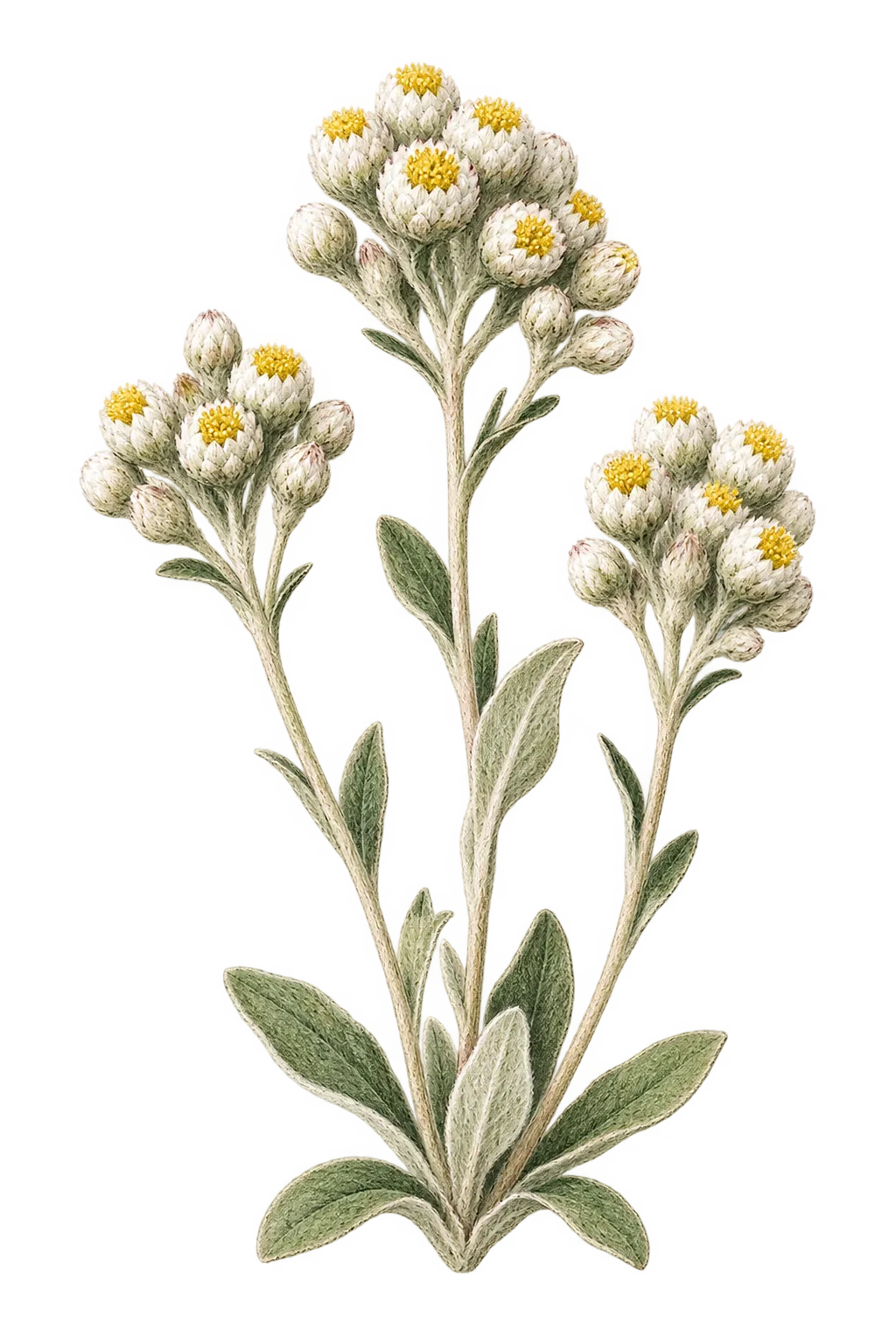
Alpine pussytoes lives close to the ground, spreading by short runners and bearing compact clusters of flower heads. Flora of North America treats it as a broad, variable complex whose plants stand roughly three to eighteen centimetres tall. Many of its lineages reproduce by apomixis, producing seeds without fertilisation; male-flowered plants are uncommon in the flora’s treatment. Flora of North America: Antennaria alpina
Botanical name
Kew accepts Antennaria alpina (L.) Gaertn. Morphology follows Flora of North America’s broad complex, which discusses apomictic lineages and differing boundaries with Antennaria media. Flora of North America: Antennaria alpinaKew Plants of the World Online: Antennaria alpina
Recognizing the plant
The basal leaves are spoon-shaped to narrowly widest above the middle, with woolly undersides and greener to gray-hairy upper surfaces. Narrow leaves also occur along the flowering stems. Two to five heads form a small, nearly level-topped cluster. Dark brown, olive or nearly black bracts surround the heads. The tiny dry fruits measure about one to two millimetres, with a tuft of longer bristles. Flora of North America: Antennaria alpina
Bloom window
North American alpine tundra
In the North American alpine-tundra treatment, flowering occurs in mid to late summer. Flora of North America: Antennaria alpina
Native range
The species occurs across parts of North America, Greenland and northern Eurasia. Flora of North America records dry to moist alpine tundra as habitat. Its broad treatment includes several northern and mountain populations that other botanical treatments have sometimes separated. Flora of North America: Antennaria alpinaKew Plants of the World Online: Antennaria alpina
Botanical sources
Reviewed 2026-10-11. Seasonal development varies with location and growing conditions.