Amazon water-lily
Victoria amazonica (Poepp.) Klotzsch
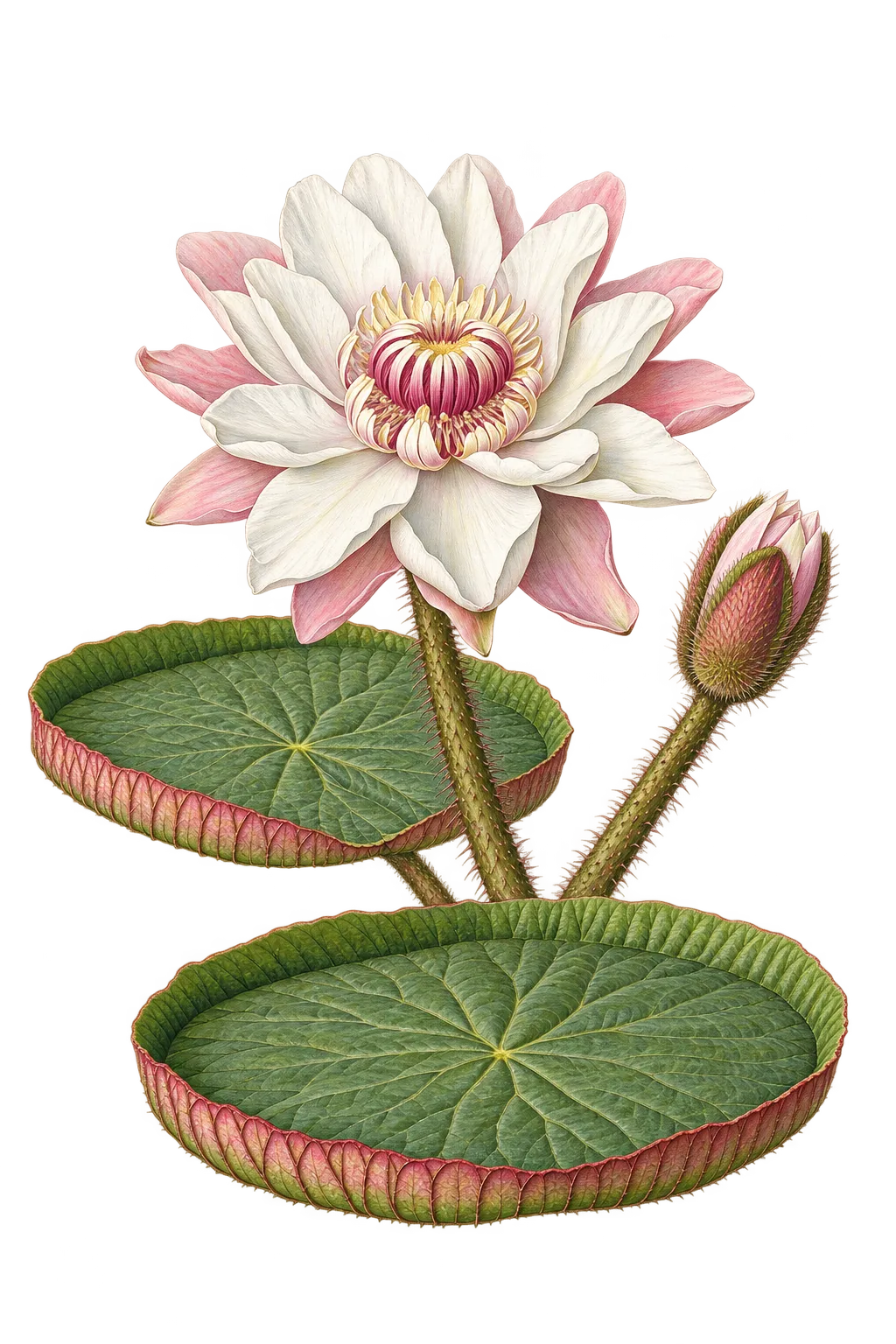
Amazon water-lily spreads enormous circular leaves across freshwater lakes and backwaters. Their upturned rims and waxy upper surfaces give each floating blade a tray-like outline. Beneath, a strong network of ribs encloses air spaces that help keep the leaf buoyant. Long underwater stalks connect the leaves to the submerged plant. Royal Botanic Gardens, Kew: Giant waterlily
Botanical name
Kew accepts Victoria amazonica (Poepp.) Klotzsch. The catalog’s Sowerby author attribution refers to the same named waterlily; the accepted combination is based on Euryale amazonica Poepp. Kew POWO: Victoria amazonica
Recognizing the plant
The lower leaf surface is often purplish red and armed with sharp spines. Large flowers open at night and are short-lived. They begin white, then turn pink during their two-night flowering cycle. This colour change accompanies a shift in the flower’s role, from receiving pollen to releasing it. Royal Botanic Gardens, Kew: Giant waterlily
Bloom window
Kew Gardens, London, heated Waterlily House cultivation
Kew’s cultivated plants begin producing flower buds from July. Royal Botanic Gardens, Kew: Giant waterlily
Native range
Kew places its native distribution in tropical South America, from southeastern Colombia to northern and eastern Bolivia, including Guyana. Its characteristic habitat is still or slow-moving freshwater in the Amazon basin. Kew POWO: Victoria amazonicaRoyal Botanic Gardens, Kew: Giant waterlily
Ecological relationships
Fragrance and warmth attract beetles. The flower briefly traps them, then releases them on its second night carrying pollen to another flower. Royal Botanic Gardens, Kew: Giant waterlily
Botanical sources
Reviewed 2026-10-11. Seasonal development varies with location and growing conditions.