American bellflower
Campanulastrum americanum (L.) Small
American bellflower stretches the idea of a bell. Its blue to violet corolla spreads into a shallow, five-lobed star or saucer, with a pale ring near the centre. A long, curved style projects well beyond it. Flowers appear along the upper part of a tall, mostly unbranched stem, giving a succession of small faces rather than one broad flower head. Missouri Department of Conservation: Tall Bellflower
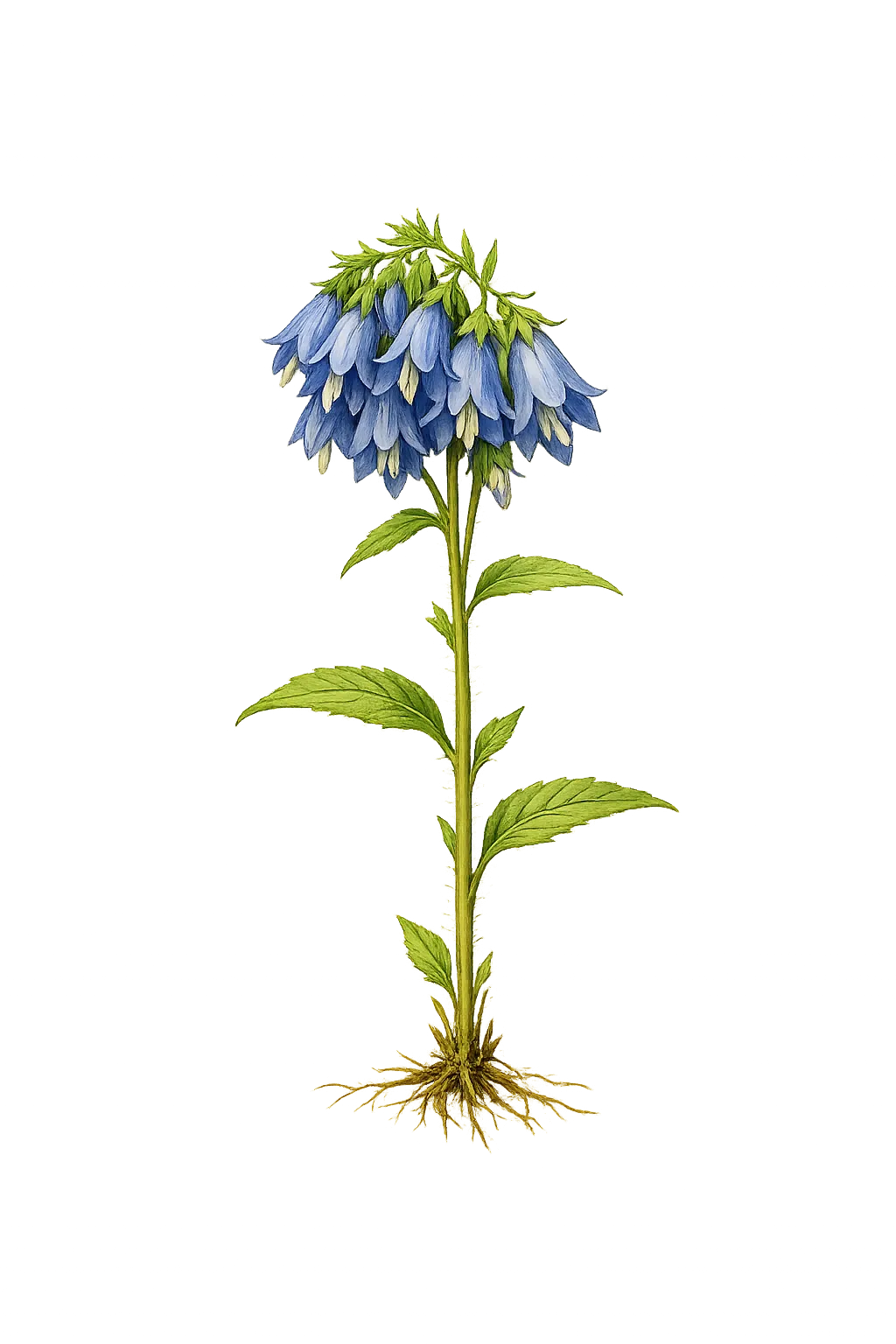
Botanical name
Campanulastrum americanum (L.) Small is accepted in the cited taxonomic treatment. The supplied database name identifies the same species. Kew POWO: Campanulastrum americanum
Recognizing the plant
The plant can be annual or biennial. In the biennial pattern, it begins as a low rosette, then sends up its flowering stem in the following growing season. Individual blossoms are brief, but more continue to open. Older references often use Campanula americana, a name Kew treats as a synonym. Whether encountered as a first-year rosette or a tall flowering plant, it remains the same species at a different stage of its short life. Missouri Department of Conservation: Tall BellflowerNC State Extension: American BellflowerKew POWO: Campanulastrum americanum
Bloom window
Missouri, United States
In Missouri, the main flowering period is described as July to September. Missouri Department of Conservation: Tall Bellflower
Native range
Campanulastrum americanum is native from eastern Canada through much of the central and eastern United States. Moist woodland edges, open woods and streamside places are characteristic settings. Missouri Department of Conservation: Tall BellflowerKew POWO: Campanulastrum americanum
Ecological relationships
The Missouri account identifies long-tongued bees, including bumblebees and leaf-cutting bees, as pollinators. Missouri Department of Conservation: Tall Bellflower
Botanical sources
- Missouri Department of Conservation: Tall Bellflower
- NC State Extension: American Bellflower
- Kew POWO: Campanulastrum americanum
Reviewed 2026-10-11. Seasonal development varies with location and growing conditions.