American dodder
Cuscuta americana L.
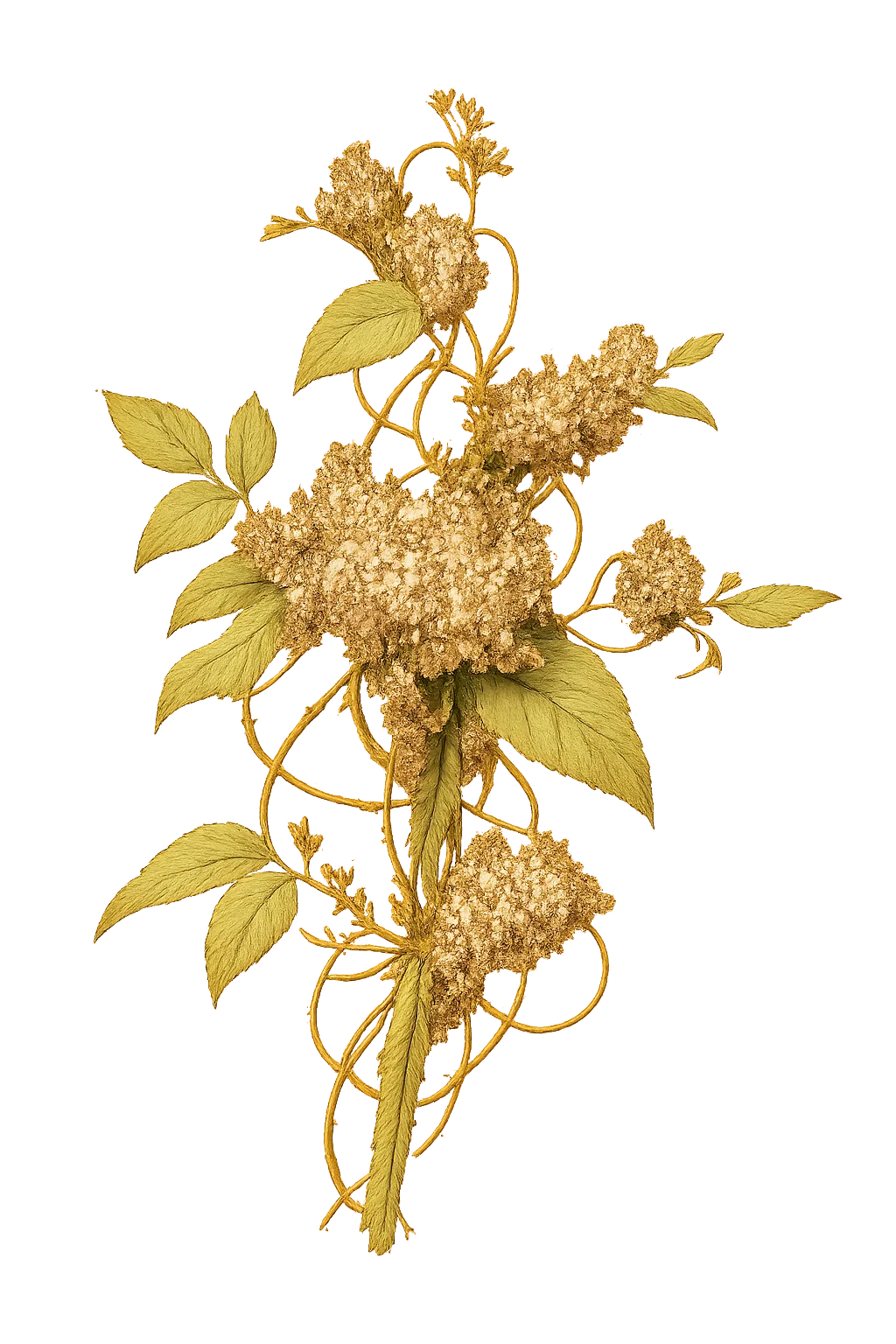
American dodder has a very different way of life from an ordinary leafy garden vine. Kew identifies it as a holoparasitic annual: a plant dependent on a host for its nourishment. It nevertheless produces its own flowers and seeds, with much of its identifying detail concentrated in those small reproductive structures. Kew POWO: Cuscuta americanaeFloraMex: Cuscuta americana
Botanical name
Cuscuta americana L. is accepted by Kew in Convolvulaceae, matching the catalog species. Kew POWO: Cuscuta americana
Recognizing the plant
The Mexican flora describes dense, rounded clusters of numerous flowers, each only about two to three-and-a-half millimetres long. Individual flowers sit on extremely short stalks. Both the calyx and corolla are cylindrical, with short, rounded lobes. Slender styles end in head-like stigmas. The rounded to egg-shaped capsule remains covered by the persistent corolla and opens around its circumference. Seeds are about one-and-a-half millimetres long, with the account usually recording one in each capsule. eFloraMex: Cuscuta americana
Native range
Its native range covers tropical and subtropical America. Kew lists Florida, Mexico, many Caribbean islands and countries across northern and central South America, extending into northwestern Argentina. It is associated chiefly with the seasonally dry tropical biome. Kew POWO: Cuscuta americana
Botanical sources
Reviewed 2026-10-11. Seasonal development varies with location and growing conditions.