annual rush
Juncus pelocarpus E.Mey.
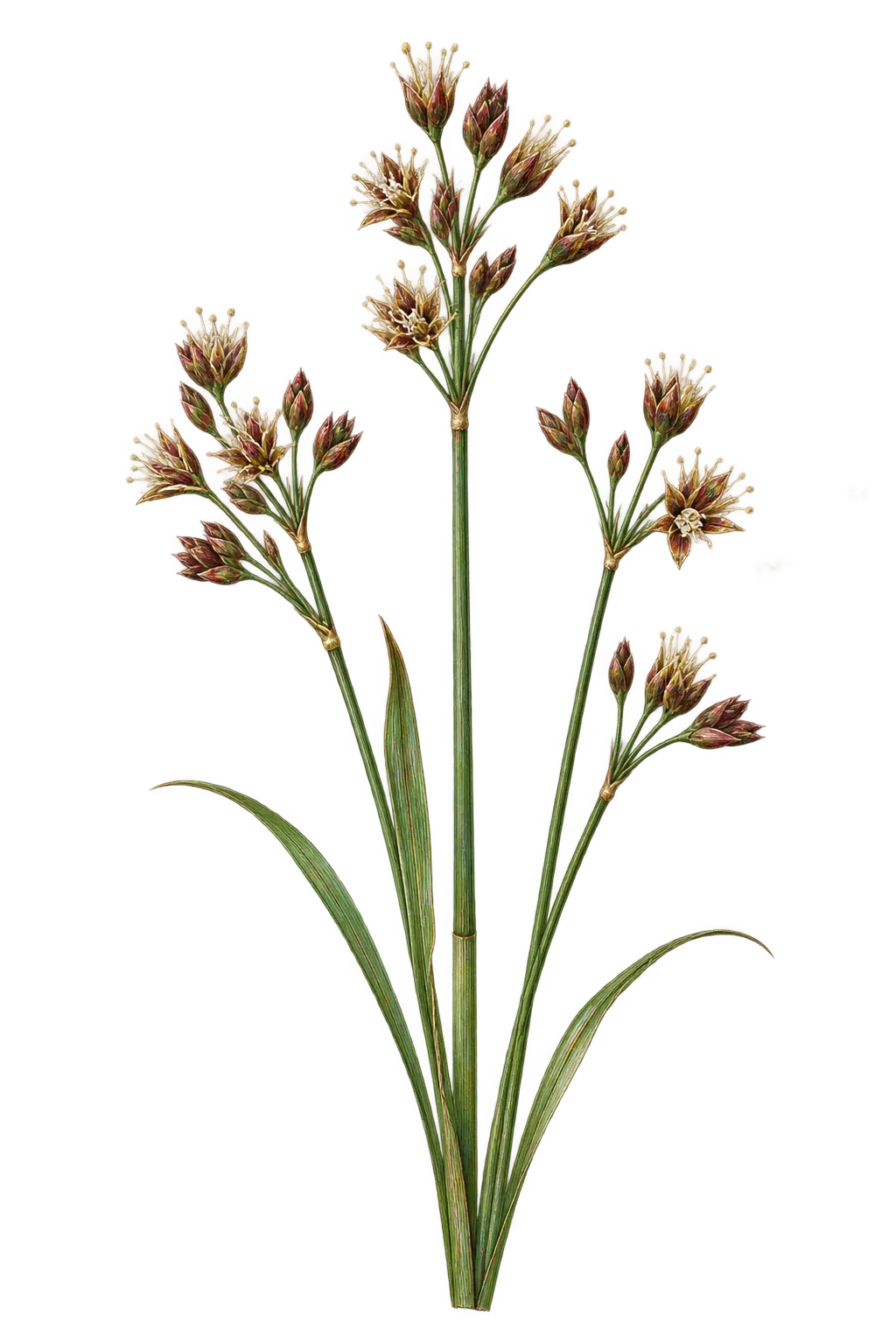
The plant once named Juncus abortivus is a small perennial rush that spreads by slender underground rhizomes. Its flowers are distributed individually or in pairs along the branches of an airy terminal cluster, rather than gathered into conspicuous dense heads. Fine tufts of short, hairlike leaves can also appear on its stems and rhizomes. Burke Herbarium: Juncus pelocarpus, with Flora of North America description
Botanical name
Kew explicitly places Juncus abortivus Chapm. in synonymy with Juncus pelocarpus E.Mey. The retained database common name “annual rush” does not describe its perennial life cycle. Kew POWO: Juncus pelocarpus
Recognizing the plant
Plants range from about 3 to 70 cm tall. The smooth, upright stems are round in cross-section, as are the narrow leaf blades. Tiny flowers have straw-coloured tepals and six stamens. The fruit becomes chestnut brown: a narrow, pointed capsule ending in a short beak. At maturity its valves separate to release minute, yellow-brown seeds without tails. The capsule’s seed-bearing region is concentrated toward its lower half. Burke Herbarium: Juncus pelocarpus, with Flora of North America description
Bloom window
Washington, United States
In Washington, flowering is recorded from June through August. Burke Herbarium: Juncus pelocarpus, with Flora of North America description
Native range
Kew places the native range in Canada and the north-central and eastern United States. In Washington, where it is introduced, the Burke Herbarium records it along sandy or peaty shores and in coastal ditches, sometimes near cranberry farms. Kew POWO: Juncus pelocarpusBurke Herbarium: Juncus pelocarpus, with Flora of North America description
Botanical sources
- Kew POWO: Juncus pelocarpus
- Burke Herbarium: Juncus pelocarpus, with Flora of North America description
Reviewed 2026-10-11. Seasonal development varies with location and growing conditions.