Armenian grape hyacinth
Muscari armeniacum H.J.Veitch
Armenian grape hyacinth follows a seasonal rhythm centered on its underground bulb. Narrow leaves can emerge in autumn and remain through winter and spring, while the plant becomes dormant in summer. Offsets allow established bulbs to build a cluster of neighboring shoots over time. NC State Extension: Muscari armeniacum
Botanical name
A 2025 nomenclatural study establishes Veitch’s 1872 publication as earlier than the later Leichtlin ex Baker attribution used in the database. Both refer to Armenian grape hyacinth; Kew accepts the Veitch authorship. Kew: Muscari armeniacumBöhnert: Typification of three iconic Muscari species
Recognizing the plant
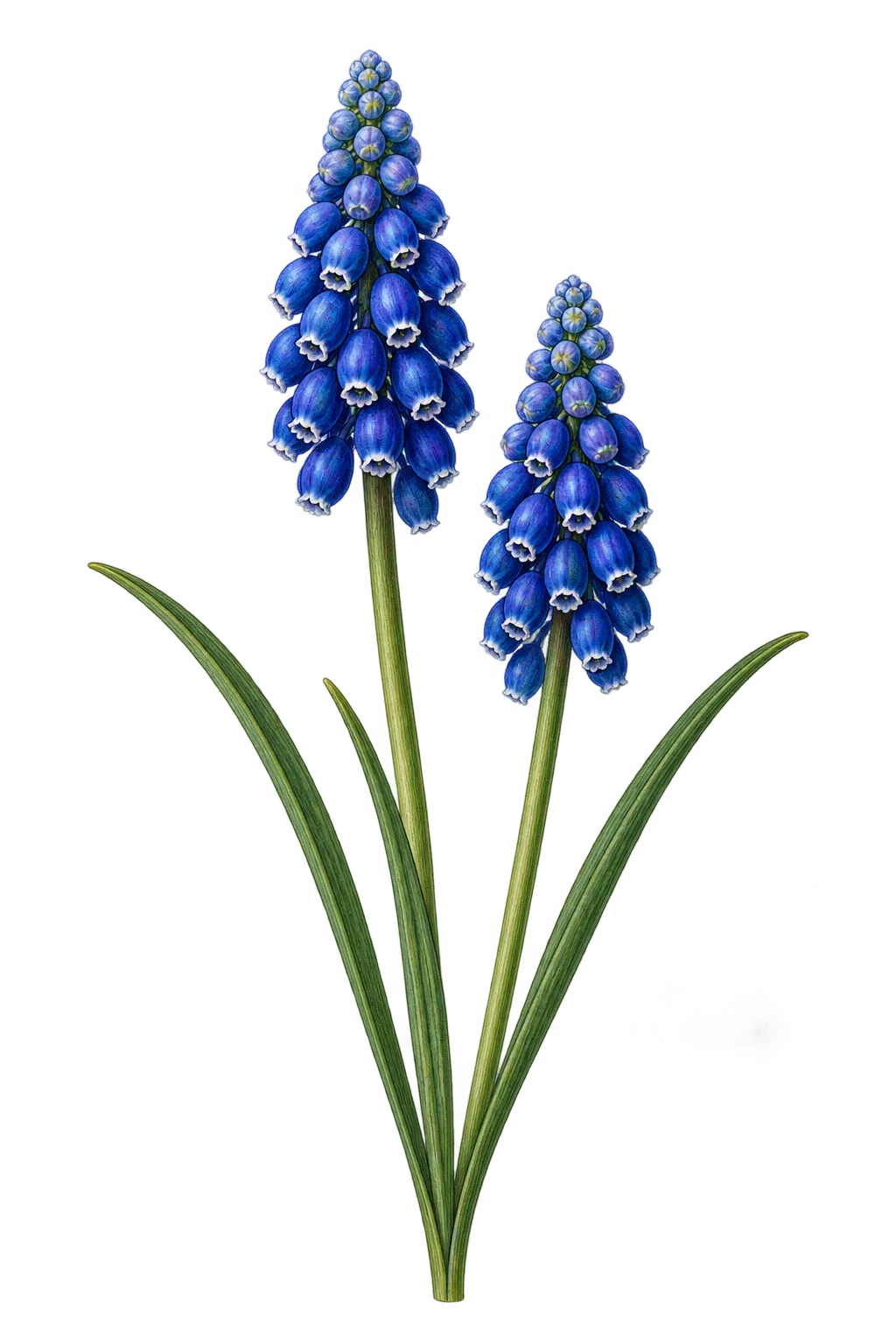
The flower stalk rises about six to nine inches and carries a dense cluster of small, slightly fragrant blossoms. Each blue flower is shaped like a tiny urn or bell, with a pale rim around its narrowed mouth. The uppermost flowers can be smaller, paler and sterile. Fleshy, grasslike leaves arise from the base and often extend beyond the flowering stalk; their surfaces are slightly cupped. Fertile flowers develop into three-lobed capsules that change from green to brown and contain rounded black seeds. NC State Extension: Muscari armeniacum
Bloom window
North Carolina cultivation
In North Carolina cultivation, flowering is in spring, commonly April and May. NC State Extension: Muscari armeniacum
Native range
Its native range extends from southeastern Europe toward the Caucasus. Garden cultivation has taken it well beyond this original range, and the familiar spring displays elsewhere often consist of planted bulbs or their descendants. Kew: Muscari armeniacumNC State Extension: Muscari armeniacum
Ecological relationships
The flowers attract visiting bees. NC State Extension: Muscari armeniacum
Botanical sources
- Kew: Muscari armeniacum
- Böhnert: Typification of three iconic Muscari species
- NC State Extension: Muscari armeniacum
Reviewed 2026-10-11. Seasonal development varies with location and growing conditions.