banana
Musa balbisiana Colla
Musa balbisiana is one of the wild ancestors that contributed to cultivated bananas and plantains. Its own fruits retain numerous substantial seeds. Alongside its importance to crop history, living populations preserve genetic variation that seed banks and banana collections seek to conserve. Kallow and colleagues: Genetic representation in wild banana seed collections
Botanical name
Musa balbisiana is an accepted wild banana species in Musaceae, distinct from the many cultivated hybrids that carry part of its ancestry. Kew: Musa balbisiana
Recognizing the plant
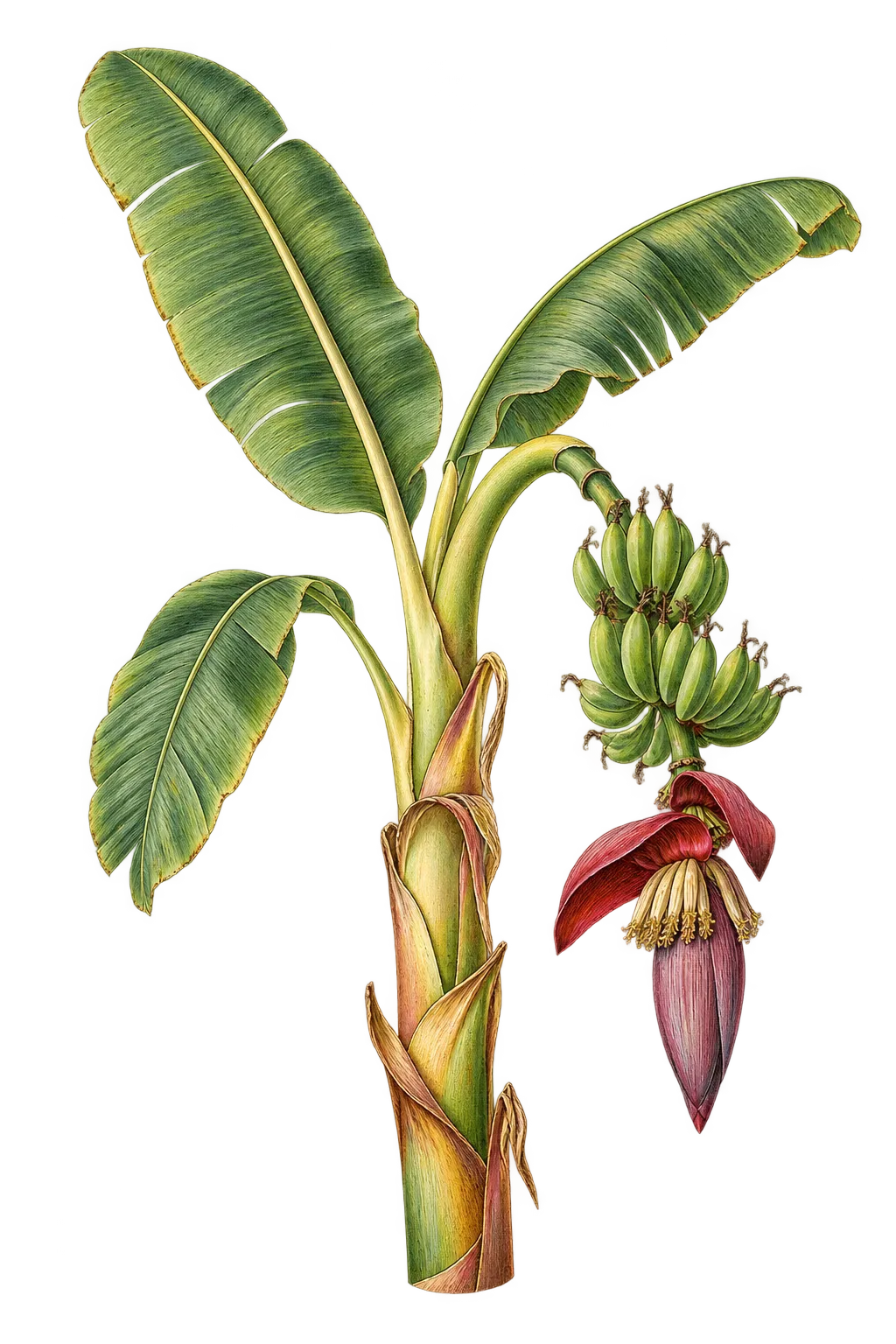
The plant forms clumps of pseudostems that can reach about six meters. Broad, oblong leaves may approach three meters long, with an uneven base and a stout stalk. A long inflorescence hangs below the foliage. Purple-red bracts curl back to expose the flowers, with female flowers toward the base and male flowers farther along the axis. The angular berries occur in rows, and their pulp contains flattened brown seeds with a conspicuously warty surface. Flora of China: Musa balbisiana
Native range
The species belongs to tropical and subtropical Asia. Its original distribution is complicated by human movement and feral populations; northeastern India, Myanmar, southern China and mainland Southeast Asia form a core region. Forests, ravines and farm edges are characteristic habitats. Musa species in mainland Southeast Asia: From wild to domesticateKallow and colleagues: Genetic representation in wild banana seed collections
Ecological relationships
A comparative study lists fruit bats and bumblebees among its observed pollinators. Kallow and colleagues: Genetic representation in wild banana seed collections
Botanical sources
- Kew: Musa balbisiana
- Flora of China: Musa balbisiana
- Musa species in mainland Southeast Asia: From wild to domesticate
- Kallow and colleagues: Genetic representation in wild banana seed collections
Reviewed 2026-10-11. Seasonal development varies with location and growing conditions.