Barberton daisy
Gerbera jamesonii Adlam
Barberton daisy is one of the wild foundations of the modern florist’s gerbera. Crosses with Gerbera viridifolia began in the late nineteenth century, providing the ancestry of many cultivated forms. The species is a perennial herb whose flowering stalks rise from a leafy crown. SANBI PlantZAfrica: Gerbera jamesonii
Botanical name
Kew accepts Gerbera jamesonii Adlam. SANBI identifies Adlam’s earlier publication as the reason for replacing Hooker’s authorship. Plants of the World Online: Gerbera jamesoniiSANBI PlantZAfrica: Gerbera jamesonii
Recognizing the plant
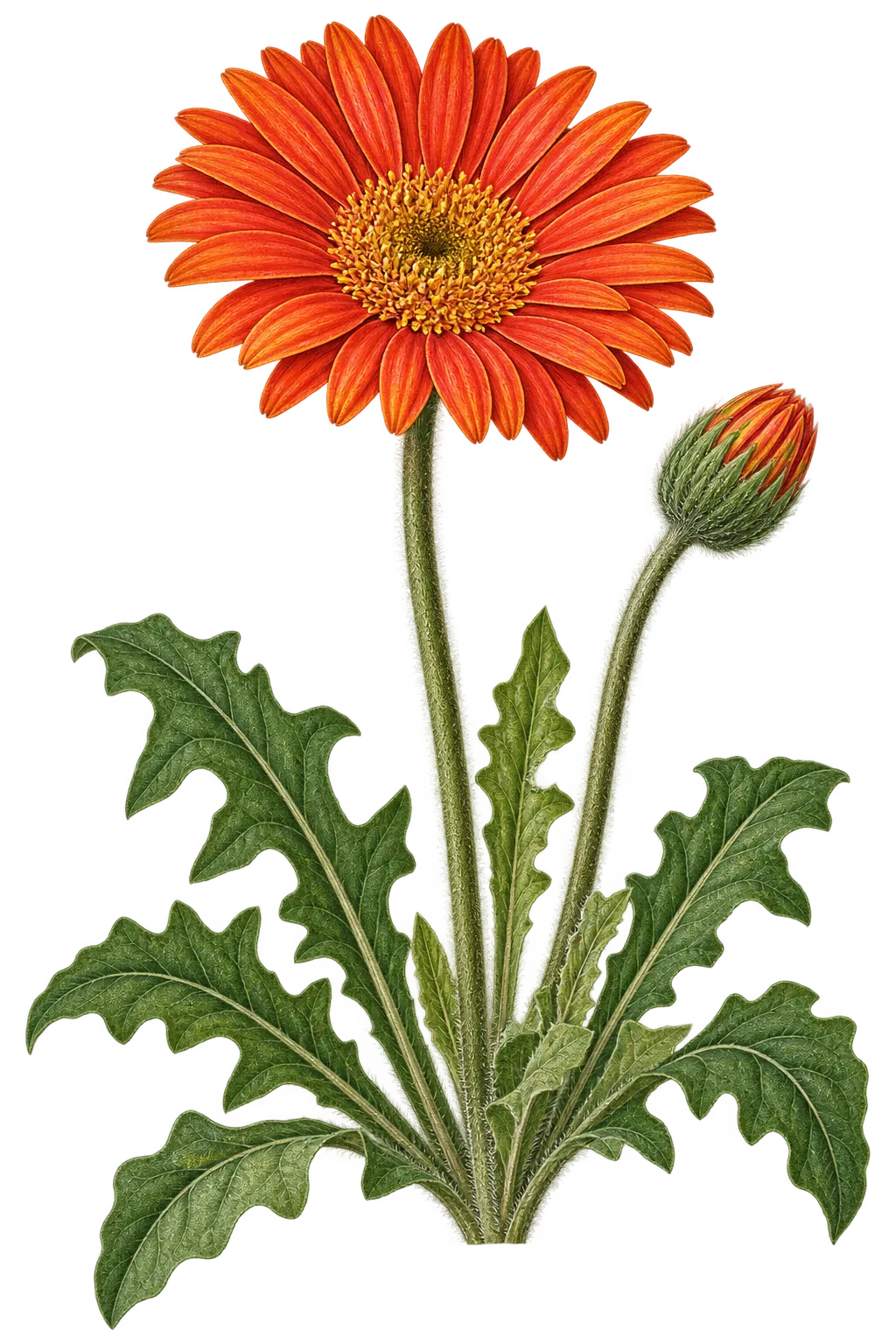
Its deeply lobed leaves are covered with silky hairs. Each long stalk supports a flower head made of two kinds of floret: broad outer rays and smaller central disc flowers. The rays may be cream, red, orange or pink, while the disc flowers are cream in SANBI’s account. The small fruits carry a tuft of bristles, forming a light structure suited to wind dispersal. SANBI PlantZAfrica: Gerbera jamesonii
Bloom window
South Africa
SANBI records flowering in spring to early summer and again in autumn. SANBI PlantZAfrica: Gerbera jamesonii
Native range
Kew places its native range in northeastern South Africa and Eswatini. SANBI records natural populations in Gauteng, Limpopo and Mpumalanga, where they occupy grassland on sandy, well-drained soils. Plants of the World Online: Gerbera jamesoniiSANBI PlantZAfrica: Gerbera jamesonii
Ecological relationships
Bees and other visiting insects pollinate the flower heads. SANBI PlantZAfrica: Gerbera jamesonii
Botanical sources
Reviewed 2026-10-11. Seasonal development varies with location and growing conditions.