black cherry
Prunus serotina Ehrh.
Black cherry combines a conspicuous spring display with a substantial role in woodland food webs. Its small white flowers gather in long clusters, followed by dark fruits. Mature trees develop a scaly, flaky bark pattern, while the reddish-brown wood is valued for furniture, cabinetry and musical instruments. NC State Extension: Prunus serotina
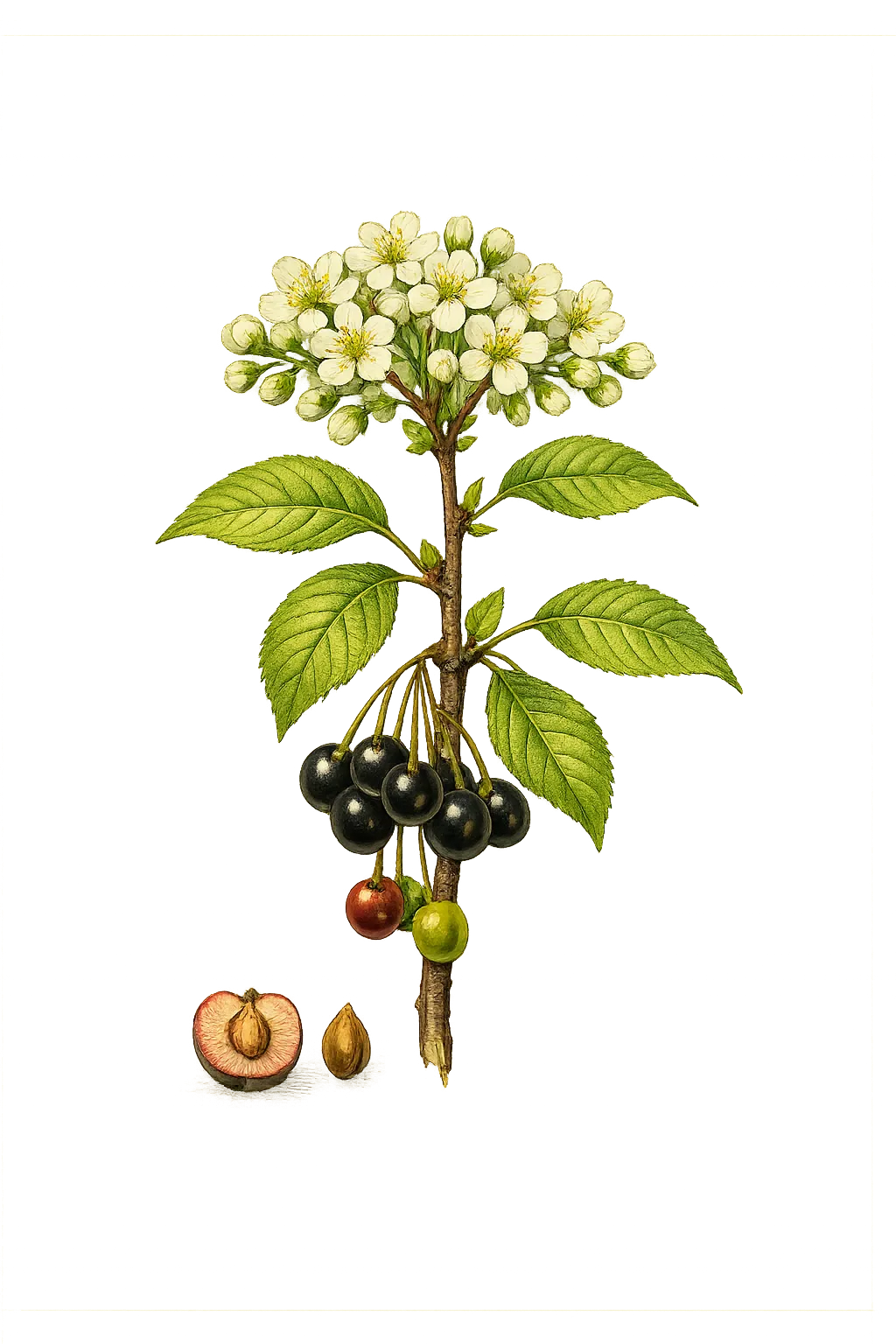
Botanical name
Prunus serotina Ehrh. is accepted by Kew in Rosaceae, matching the catalog’s identity. Kew POWO: Prunus serotina
Recognizing the plant
The leaves are alternate, elongated and finely toothed, turning yellow or orange in autumn. Young twigs are reddish brown. Each fragrant flower has five petals, and the flower clusters can reach roughly eight to fifteen centimetres long. The small cherries hang in clusters and become purple-black as they ripen. Trees commonly reach eighteen to twenty-four metres in the extension account. NC State Extension: Prunus serotina
Seasonal development
North Carolina
The extension account records flowering in late April–May and fruit ripening in late summer. NC State Extension: Prunus serotina
Native range
Kew records a native range from western Canada into the northwestern United States and from eastern Canada south through Mexico into Central America. The species also has introduced populations across much of Europe. Kew POWO: Prunus serotina
Ecological relationships
Its foliage supports caterpillars including eastern tiger swallowtail and red-spotted purple butterflies. NC State Extension: Prunus serotina
Songbirds, wild turkeys, quail and small mammals eat the fruits. NC State Extension: Prunus serotina
Botanical sources
Reviewed 2026-10-11. Seasonal development varies with location and growing conditions.