black mulberry
Morus nigra L.
Black mulberry develops a broad crown and can be long-lived, but is relatively slow to begin fruiting. Its dark crop is a multiple fruit: the closely packed flowers of a female cluster contribute to the ripening structure. The small greenish flowers themselves are much less conspicuous than the later fruit. Flora of China: Morus nigraRoyal Horticultural Society: Morus nigraRoyal Horticultural Society: Growing mulberries
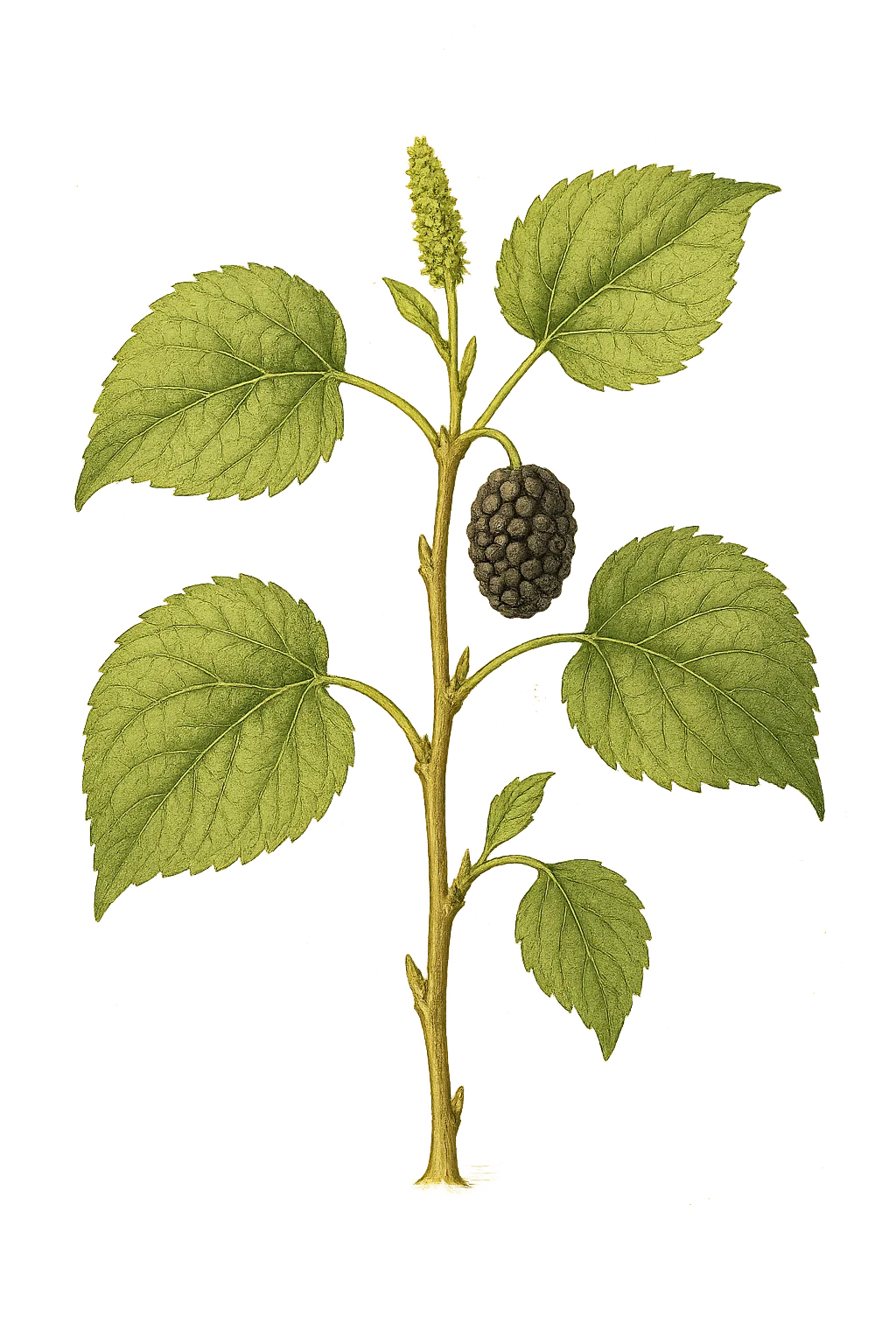
Botanical name
Morus nigra is the accepted black mulberry species. Its longstanding cultivation far beyond Iran should not be confused with its native distribution. Kew: Morus nigra
Recognizing the plant
Trees can reach about ten meters tall. The bark is dark brown, and young branches are pale and hairy. Broad, thick leaves have a heart-shaped base, coarse teeth and a pointed tip. Their upper surface is rough to the touch, while the underside is paler and hairy. Male flowers occur in slender catkins, whereas female clusters are shorter and more oval. A tree may bear both flower sexes or only one. The mature fruit is blackish purple and commonly around two centimeters long. Flora of China: Morus nigra
Seasonal development
United Kingdom, cultivated trees
In British cultivation, black mulberries generally ripen during August and September. Royal Horticultural Society: Growing mulberries
Native range
Kew places the native range in western and southwestern Iran. Cultivation has carried the tree widely into other parts of Asia and Europe; Chinese flora accounts describe it as cultivated there. Kew: Morus nigraFlora of China: Morus nigra
Botanical sources
- Kew: Morus nigra
- Flora of China: Morus nigra
- Royal Horticultural Society: Morus nigra
- Royal Horticultural Society: Growing mulberries
Reviewed 2026-10-11. Seasonal development varies with location and growing conditions.