bougainvillea
Bougainvillea ×buttiana Holttum & Standl.
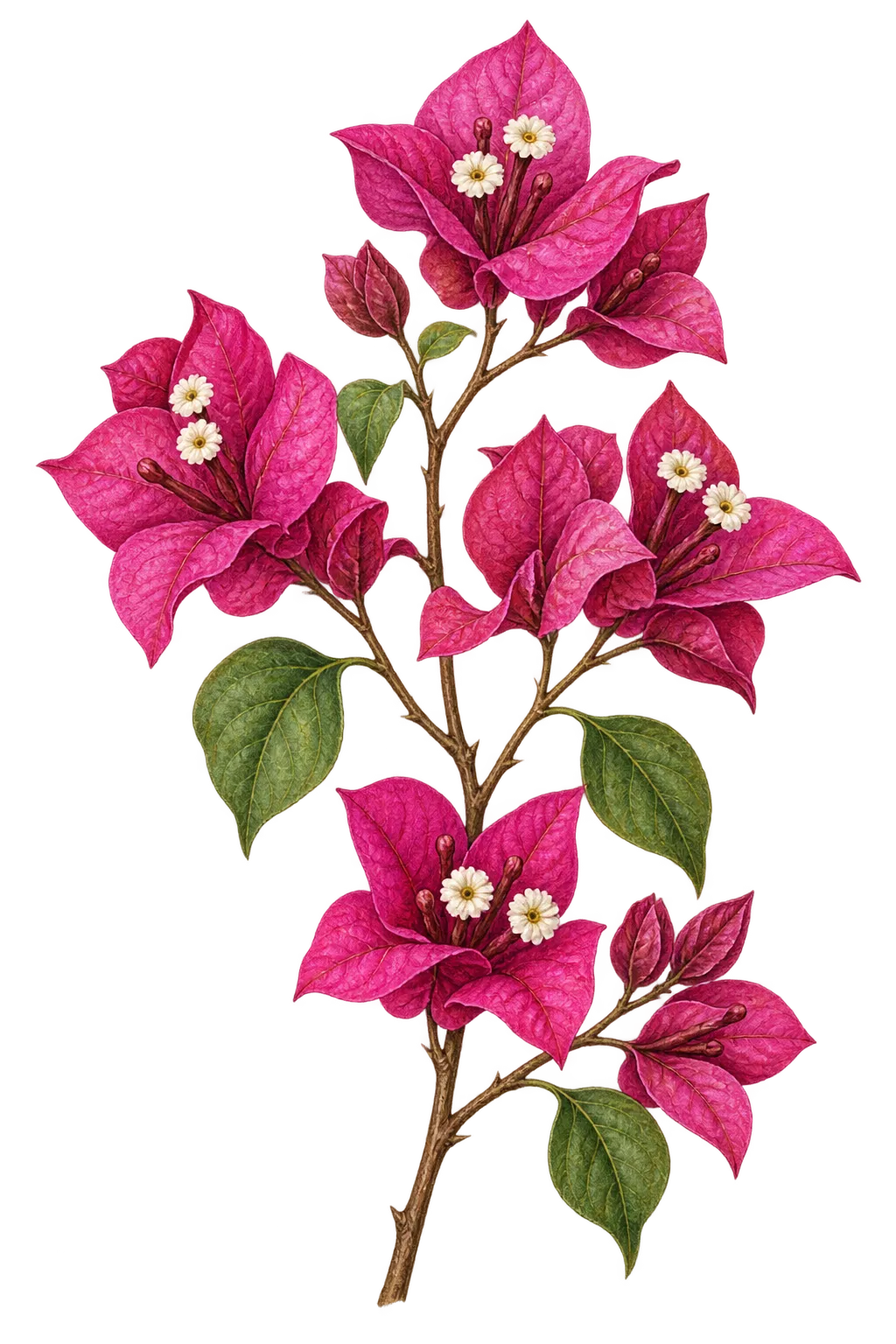
Bougainvillea’s brightest surfaces are coloured bracts, modified leaves surrounding much smaller flowers. In cultivated bougainvilleas, these papery structures form generous trusses around the inconspicuous true flowers. The climbing framework and bright display have made members of the group familiar ornamentals in warm-climate gardens. RHS Bougainvillea guide
Botanical name
The cited authority recognizes Bougainvillea ×buttiana Holttum & Standl. as a hybrid. Kew POWO: Bougainvillea ×buttiana
Recognizing the plant
Bougainvillea ×buttiana includes climbing or shrubby selections with bract colours that vary among cultivars. The RHS describes cultivated bougainvilleas as woody plants whose thorns help them climb. Some garden selections also have variegated foliage, adding leaf pattern to the bract display. Kew POWO: Bougainvillea ×buttianaRHS Bougainvillea guide
Bloom window
United Kingdom cultivation
RHS guidance for British cultivation gives summer-to-autumn flowering, with frost-free protection over winter. Its advice covers cultivated bougainvilleas, including selections of this hybrid. RHS Bougainvillea cultivation
Native range
Kew identifies this cultivated hybrid as Bougainvillea glabra × B. peruviana. Its recorded history begins with a garden plant in Cartagena, Colombia, taken to Trinidad in 1910 as ‘Mrs. Butt’. The name was later formally described from material cultivated at Singapore Botanic Gardens, linking the hybrid’s botanical identity to a sequence of tropical gardens. Kew POWO: Bougainvillea ×buttianaPhylogeny and Taxonomic Synopsis of Bougainvillea
Botanical sources
- Kew POWO: Bougainvillea ×buttiana
- Phylogeny and Taxonomic Synopsis of Bougainvillea
- RHS Bougainvillea guide
- RHS Bougainvillea cultivation
Reviewed 2026-10-11. Seasonal development varies with location and growing conditions.