briar root
Erica arborea L.
Tree heath can become a substantial shrub or small tree. In tropical East Africa it sometimes dominates a belt above mountain forest, and also occurs in open woodland, bamboo, grassland and rocky upland moors. The regional flora records plants from about thirty centimetres to seven and a half metres high. Kew POWO and Flora of Tropical East Africa: Erica arborea
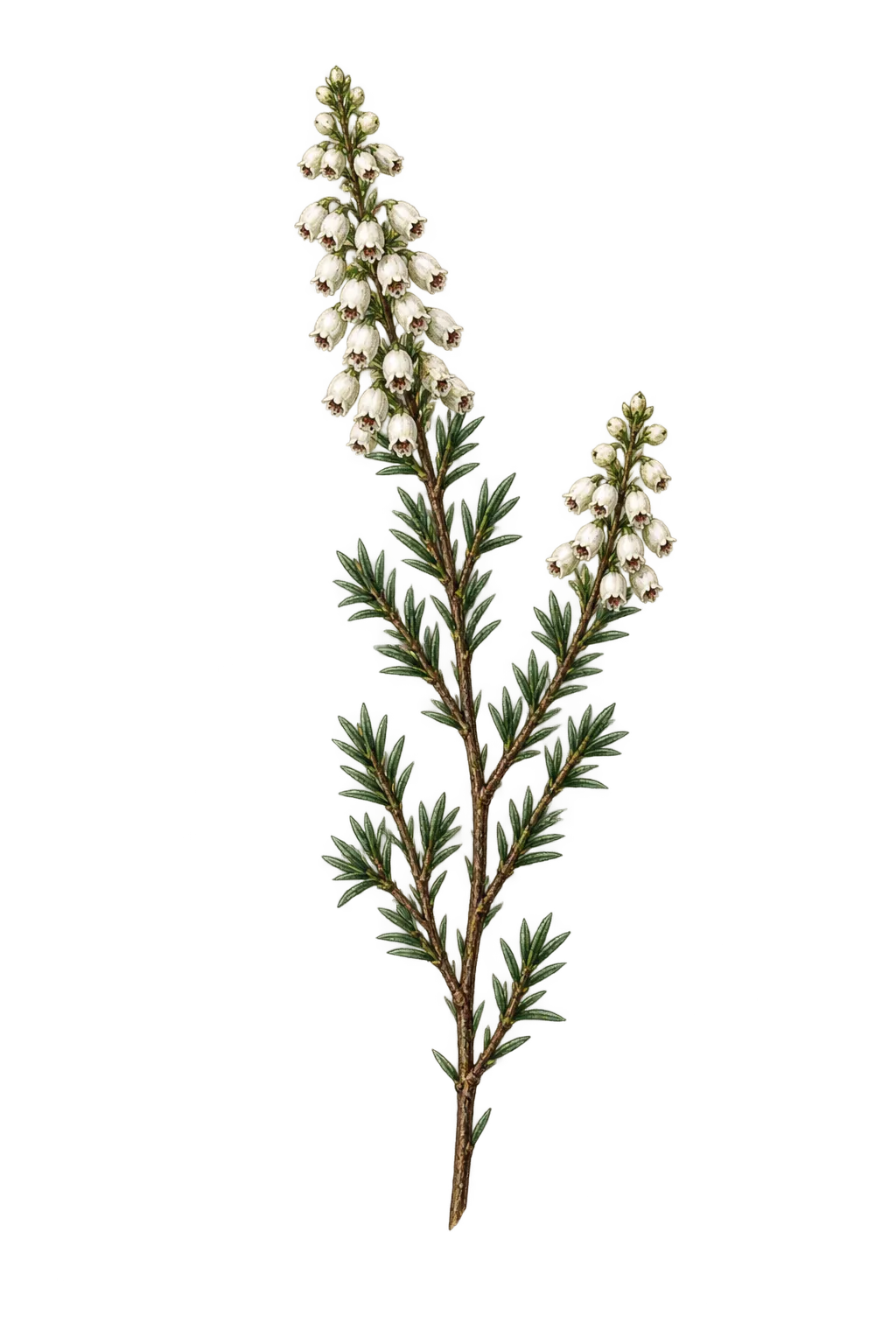
Botanical name
Erica arborea L. is accepted by Kew in Ericaceae, matching the catalog’s species. Kew POWO and Flora of Tropical East Africa: Erica arborea
Recognizing the plant
The branches carry short, needle-like leaves in whorls of three or four. Their edges roll tightly inward; in the New Zealand description they conceal the underside completely. Young shoots are conspicuously hairy. Small hanging flowers crowd short side branches, often merging visually into a dense spray. The white bells are only a few millimetres long, with the stamens held inside and the style projecting beyond them. Small dry capsules follow. Flora of New Zealand: Erica arborea
Bloom window
New Zealand, introduced populations
The New Zealand flora records flowers from July through December, spanning the local winter and spring into early summer. Flora of New Zealand: Erica arborea
Native range
Its native range runs from the Mediterranean to western Transcaucasia, and includes mountains of tropical Africa and the Arabian Peninsula. Kew records introduced populations in Britain, New Zealand and Tasmania. Kew POWO: Erica arborea distribution
Botanical sources
- Kew POWO and Flora of Tropical East Africa: Erica arborea
- Flora of New Zealand: Erica arborea
- Kew POWO: Erica arborea distribution
Reviewed 2026-10-11. Seasonal development varies with location and growing conditions.