broccoli
Brassica oleracea var. botrytis L.
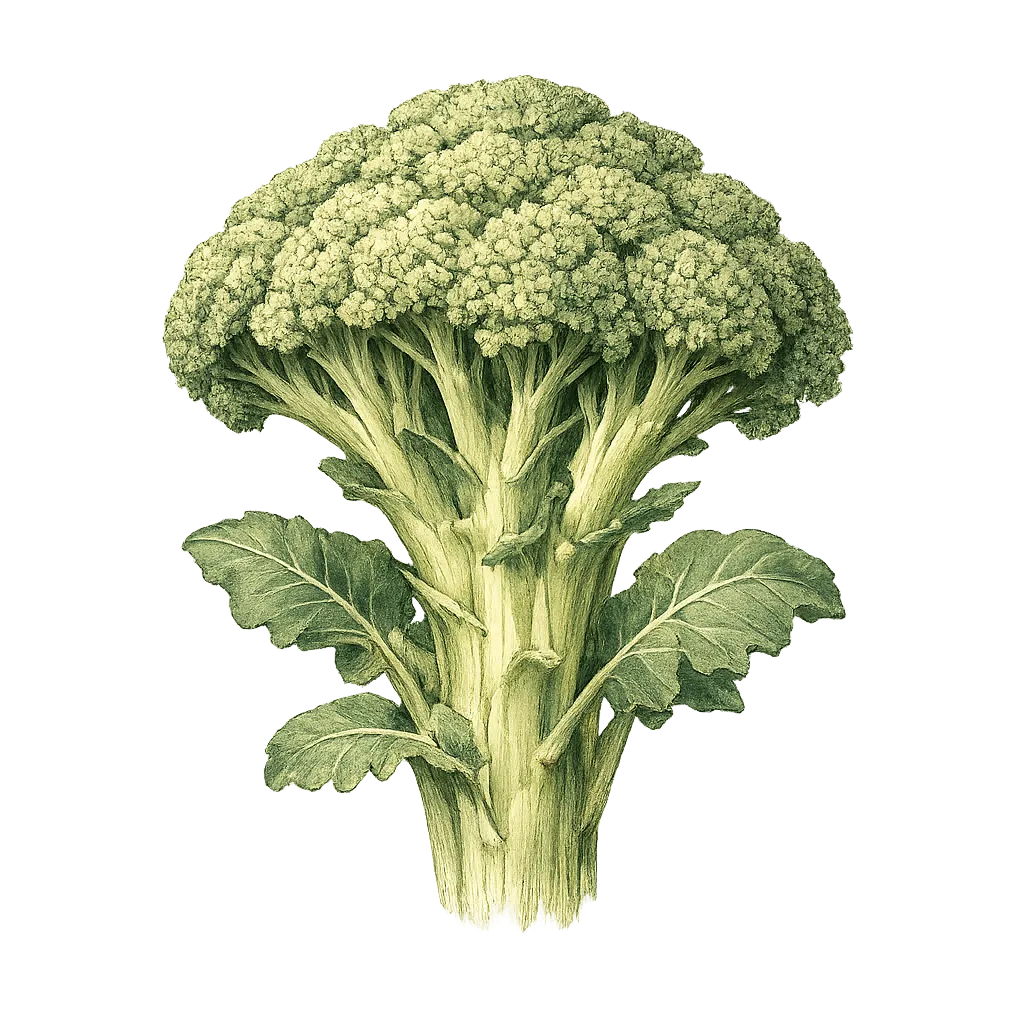
Broccoli belongs to a remarkably varied crop species that also includes cabbage, kale and Brussels sprouts. In Kew’s broad Botrytis Group, edible flower clusters are gathered into compact heads. These cultivated forms belong to a vegetable lineage grown for at least two thousand years. Kew POWO: Brassica oleracea L., Kew Species Profiles
Botanical name
Kew treats var. botrytis L. as a synonym of Brassica oleracea. Its Botrytis Group includes broccoli and cauliflower; Delaware Extension also names broccoli var. botrytis. Kew POWO: Brassica oleracea var. botrytis L.Kew POWO: Brassica oleracea L., Kew Species ProfilesUniversity of Delaware Cooperative Extension: Broccoli (October 2024)
Recognizing the plant
The underlying Brassica oleracea plant has fleshy, hairless, blue-green leaves and a smooth stem that can become somewhat woody. Its lower leaves are stalked and often have wavy edges. Fully opened flowers have four pale-yellow petals and six stamens, with two shorter than the other four. The resulting slender, short-beaked pods can reach ten centimetres in length. Kew POWO: Brassica oleracea L., Kew Species Profiles
Native range
Kew places the wild species along the Atlantic coasts of Great Britain, France and Spain, where coastal cliffs provide habitat. Broccoli itself is a cultivated crop, rather than a separate wild coastal species. Kew POWO: Brassica oleracea L., Kew Species Profiles
A growing note
University of Delaware Extension recommends fertile, well-drained soil rich in organic matter and steady moisture. Full sun is preferred; light shade can delay maturity. University of Delaware Cooperative Extension: Broccoli (October 2024)
Botanical sources
- Kew POWO: Brassica oleracea var. botrytis L.
- Kew POWO: Brassica oleracea L., Kew Species Profiles
- University of Delaware Cooperative Extension: Broccoli (October 2024)
Reviewed 2026-10-11. Seasonal development varies with location and growing conditions.