catnip
Nepeta camphorata Boiss. & Heldr.
This Greek catmint has a strong camphor scent, a character emphasized in Boissier and Heldreich’s original description. Many stems arise from a woody base. The lower stems lie along the ground and branch, while their flowering shoots turn upward. Curled, spreading hairs give the plant a somewhat woolly surface and can be slightly sticky. Boissier and Heldreich (1846), Diagnoses Plantarum Orientalium Novarum 7: Nepeta camphorata
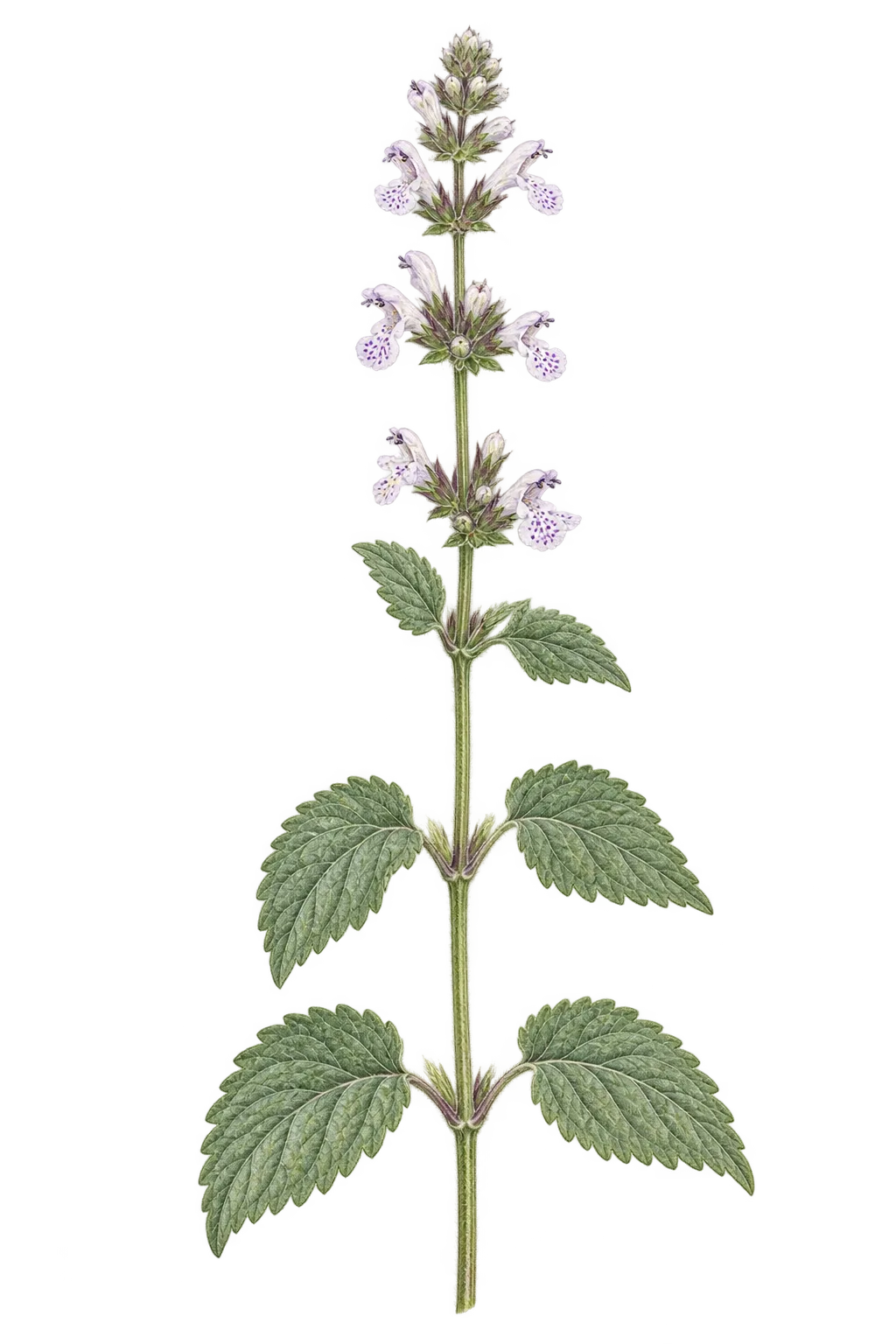
Botanical name
Nepeta camphorata Boiss. & Heldr. is accepted in Lamiaceae. Kew recognizes two varieties within the species. Kew Plants of the World Online: Nepeta camphorata
Recognizing the plant
The short-stalked leaves are triangular to egg-shaped with heart-shaped bases. Their upper surfaces are wrinkled and pale green; the undersides are grayish, and the edges finely scalloped. Numerous small flower whorls form long, loose clusters, becoming more crowded toward the tips. White flowers have a curved, projecting tube, a very hairy upper lip and purple dots in the throat. The lower lip’s central lobe is bearded near its base. Boissier and Heldreich (1846), Diagnoses Plantarum Orientalium Novarum 7: Nepeta camphorata
Native range
The accepted species is native to southern Greece. The original collections came from torrent or stream beds within the fir-forest belt of Mount Taygetos, placing this aromatic perennial in a mountain woodland setting. Kew Plants of the World Online: Nepeta camphorataBoissier and Heldreich (1846), Diagnoses Plantarum Orientalium Novarum 7: Nepeta camphorata
Botanical sources
- Kew Plants of the World Online: Nepeta camphorata
- Boissier and Heldreich (1846), Diagnoses Plantarum Orientalium Novarum 7: Nepeta camphorata
Reviewed 2026-10-11. Seasonal development varies with location and growing conditions.