chenille pricklypear
Opuntia aciculata Griffiths
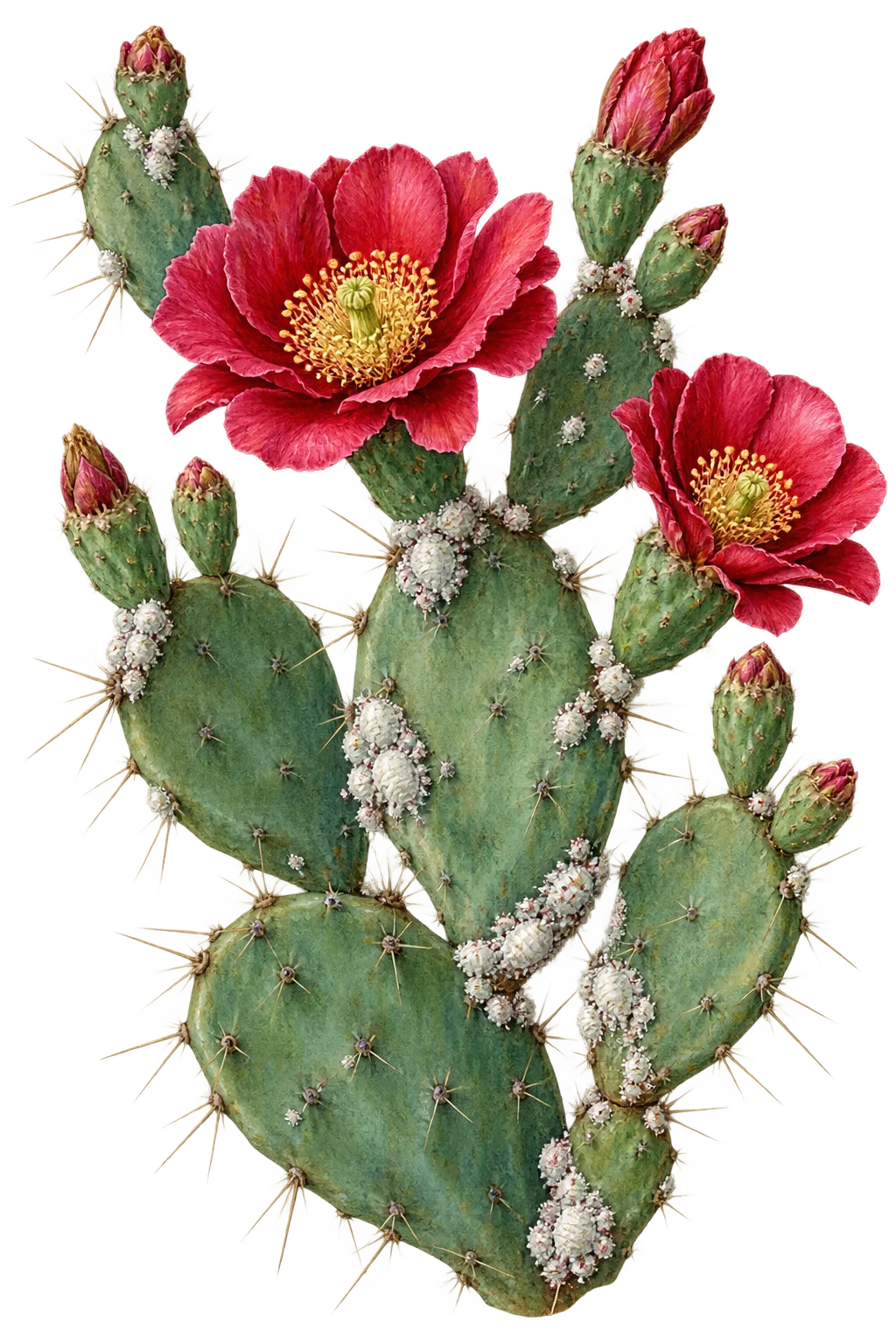
Chenille pricklypear draws attention to the small spine-bearing cushions on its pads. Their reddish-brown glochids radiate widely and evenly, creating a star-like or pincushion pattern. Flora of North America describes a spreading shrub reaching about 1.2 metres, with deep-green pads that remain attached rather than readily breaking away. Flora of North America, volume4 p.134: Opuntia aciculata
Botanical name
Kew accepts Opuntia aciculata Griffiths. Older combinations under O. engelmannii and O. lindheimeri refer to this same taxon. Kew POWO: Opuntia aciculata
Recognizing the plant
The flattened pads are nearly circular to broader toward their tips. Long spines may be absent, or several can arise from each cushion and point downward. These are yellow or brown, sometimes mottled, and differ from the shorter, conspicuous glochids. Flowers vary from yellow through orange to deep red, with dark-green stigma lobes. The juicy fruits become purplish-red and are egg-shaped to pear-shaped, with no large spines. Flora of North America, volume4 p.134: Opuntia aciculata
Bloom window
Texas, Flora of North America account
Spring flowering is recorded in April and May. Flora of North America, volume4 p.134: Opuntia aciculata
Native range
Kew places the native range from southwestern Texas to Nuevo León in Mexico. The North American flora describes gravelly hills and rangeland scrub along the Rio Grande, while noting uncertainty over whether its restricted Texas occurrence is native. Kew POWO: Opuntia aciculataFlora of North America, volume4 p.134: Opuntia aciculata
Botanical sources
Reviewed 2026-10-11. Seasonal development varies with location and growing conditions.