Christmas fern
Polystichum acrostichoides (Michx.) Schott
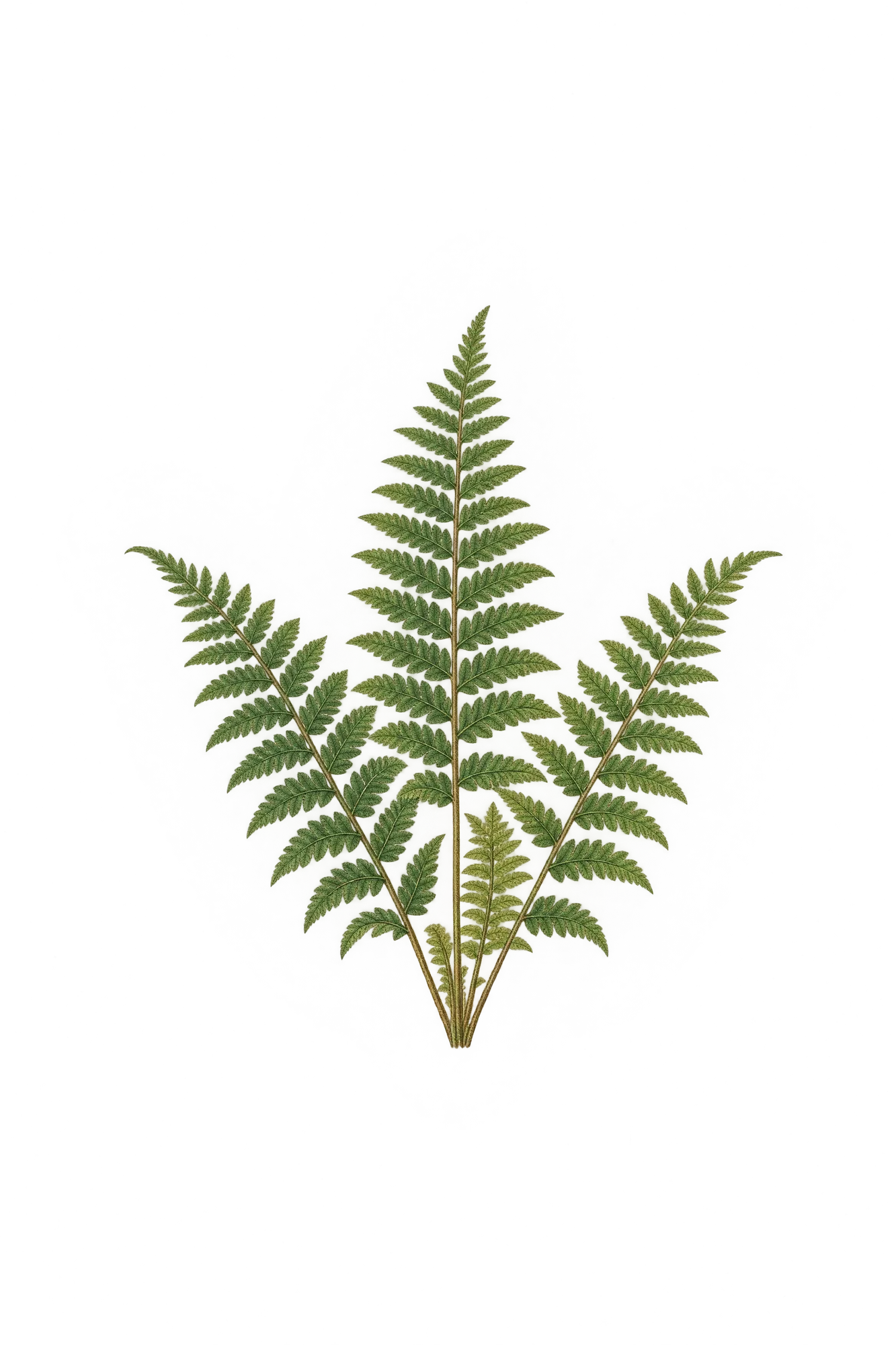
Christmas fern keeps a green presence near the woodland floor during winter. It forms circular clumps of arching fronds, slowly enlarging from a scaly rhizome. Its common name reflects the persistence of the sterile foliage around Christmas, while the taller fertile fronds follow a different seasonal pattern. NC State Extension: Christmas fern
Botanical name
Kew accepts Polystichum acrostichoides (Michx.) Schott, matching the catalog’s name and authorship. Kew POWO: Polystichum acrostichoides
Recognizing the plant
Each leathery, lance-shaped frond is divided once into many pairs of leaflets. A small ear-like projection at each leaflet base produces the characteristic stocking-shaped outline. The stalk and central axis carry chaffy scales. Fertile fronds stand more upright and narrow toward the tip, where reduced leaflets bear the spore-producing structures on their undersides. There are no flowers or fruits. NC State Extension: Christmas fern
Seasonal development
North Carolina
Silvery, scaled fiddleheads emerge in spring. Sterile fronds remain evergreen, while fertile fronds die back in winter. NC State Extension: Christmas fern
Native range
Kew records it from eastern Canada through the United States to northeastern Mexico, including Nuevo León and Tamaulipas. Regional accounts place it in rocky woods, along stream banks and in thickets. Kew POWO: Polystichum acrostichoidesNC State Extension: Christmas fern
Ecological relationships
Songbirds use its near-ground winter cover and gather plant parts and scale-like hairs for nest construction. NC State Extension: Christmas fern
Botanical sources
Reviewed 2026-10-11. Seasonal development varies with location and growing conditions.