common boneset
Eupatorium perfoliatum L.
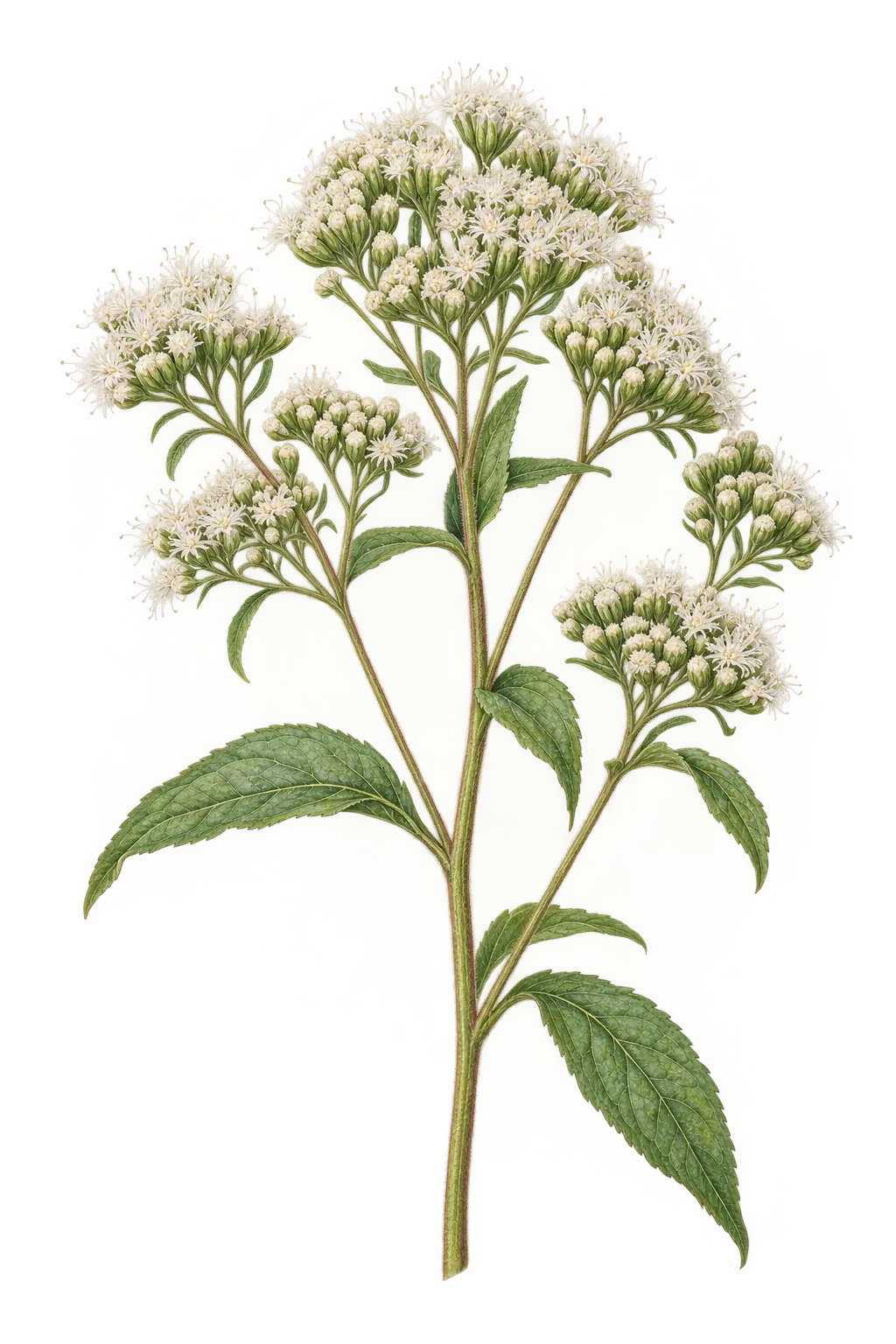
Common boneset is a colony-forming perennial of wet ground. Its paired leaves join around the stem, creating the impression that the stem passes through a single blade. This feature gives the epithet perfoliatum its meaning. Underground rhizomes support spreading clumps that can reach four to six feet in height. NC State Extension: Common Boneset
Botanical name
Kew accepts Eupatorium perfoliatum L. as a species in Asteraceae, matching the catalog. Kew POWO: Eupatorium perfoliatum
Recognizing the plant
The long, lance-shaped leaves have fine teeth, prominent veins and a wrinkled surface. White hairs cover the stems, and the leaf undersides are also hairy. Numerous small heads gather into broad clusters at the stem tips and upper leaf axils. Each contains tubular white disk florets, with no surrounding ring of strap-shaped rays. The fruits later carry pale tufts that aid dispersal by wind. NC State Extension: Common BonesetNorth Carolina Division of Water Resources: Common Boneset
Seasonal development
North Carolina
The state wetland guide records flowers and fruits from August through October. North Carolina Division of Water Resources: Common Boneset
Native range
It is native to eastern and central Canada and the United States, extending west to Manitoba, the Dakotas and Texas. In North Carolina it occurs statewide in sunny marshes, wet pastures, swamp openings and mountain seepage bogs. Kew POWO: Eupatorium perfoliatumNorth Carolina Division of Water Resources: Common Boneset
Ecological relationships
The flowers attract bees and butterflies, according to North Carolina’s extension account. NC State Extension: Common Boneset
The same account identifies boneset as a host for various moths, without naming particular species. NC State Extension: Common Boneset
Botanical sources
- Kew POWO: Eupatorium perfoliatum
- NC State Extension: Common Boneset
- North Carolina Division of Water Resources: Common Boneset
Reviewed 2026-10-11. Seasonal development varies with location and growing conditions.