common sneezeweed
Helenium autumnale L.
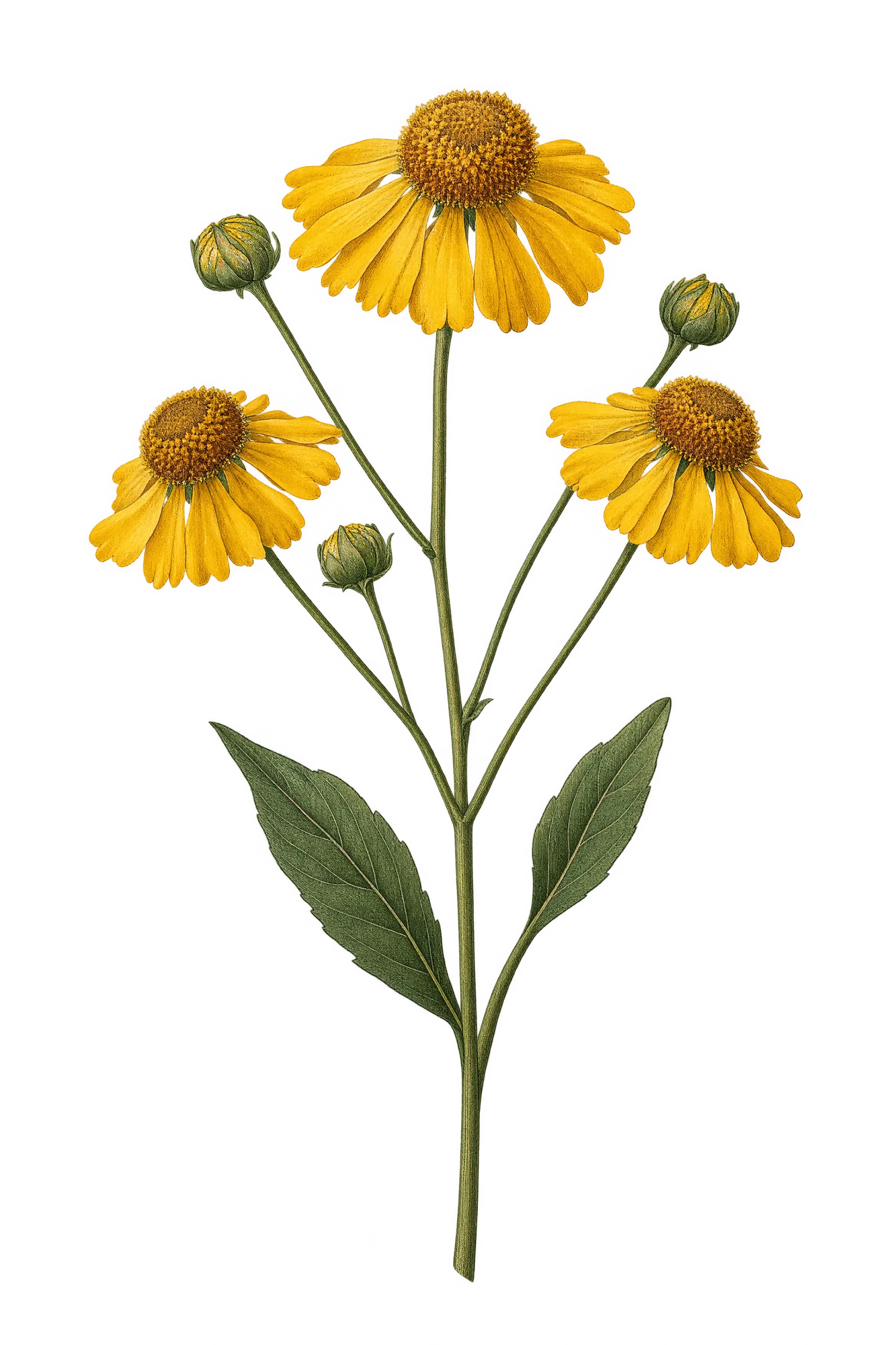
Common sneezeweed is an upright, clump-forming perennial that commonly reaches 3–5 feet tall. Its flowering branches carry numerous yellow heads rather than one oversized bloom. Narrow, leaf-like wings run down the stems, providing a useful recognition feature even before the flower clusters become conspicuous. NC State Extension: Helenium autumnale
Botanical name
Helenium autumnale L. is an accepted species in Asteraceae. This profile describes common sneezeweed rather than transferring colors and habits from selected garden cultivars. Kew Plants of the World Online: Helenium autumnale
Recognizing the plant
The dark-green leaves are alternate, stalkless and usually toothed, with an oblong to lance-shaped outline. Individual flower heads have a raised, rounded central disk surrounded by wedge-shaped yellow rays. Each ray ends in three small lobes and often droops away from the center. This scalloped outline distinguishes the heads from many superficially similar yellow daisies. The leaves can reach about 6 inches long, while the heads are generally much smaller, around 1–3 inches across. NC State Extension: Helenium autumnale
Bloom window
Missouri and North Carolina, United States
Missouri Botanical Garden gives an August–October bloom period. North Carolina Extension likewise places the display in late summer and autumn. NC State Extension: Helenium autumnaleMissouri Botanical Garden: Helenium autumnale
Native range
The native distribution spans much of North America, from subarctic Canada through the United States. It is associated with wet ground: stream and pond margins, swamps and damp meadows. Missouri populations also occur in spring-fed meadows, prairie and moist ditches. Kew Plants of the World Online: Helenium autumnaleNC State Extension: Helenium autumnaleMissouri Botanical Garden: Helenium autumnale
Botanical sources
- Kew Plants of the World Online: Helenium autumnale
- NC State Extension: Helenium autumnale
- Missouri Botanical Garden: Helenium autumnale
Reviewed 2026-10-11. Seasonal development varies with location and growing conditions.