common winterberry
Ilex verticillata (L.) A.Gray
Common winterberry is a deciduous holly of stream edges, pond margins, swamps and low woodland. In consistently moist ground, root suckers allow it to form colonies or thickets, giving the shrub a spreading presence along wetland edges. Clemson Extension: Rain Garden Plants, Winterberry (Ilex verticillata)
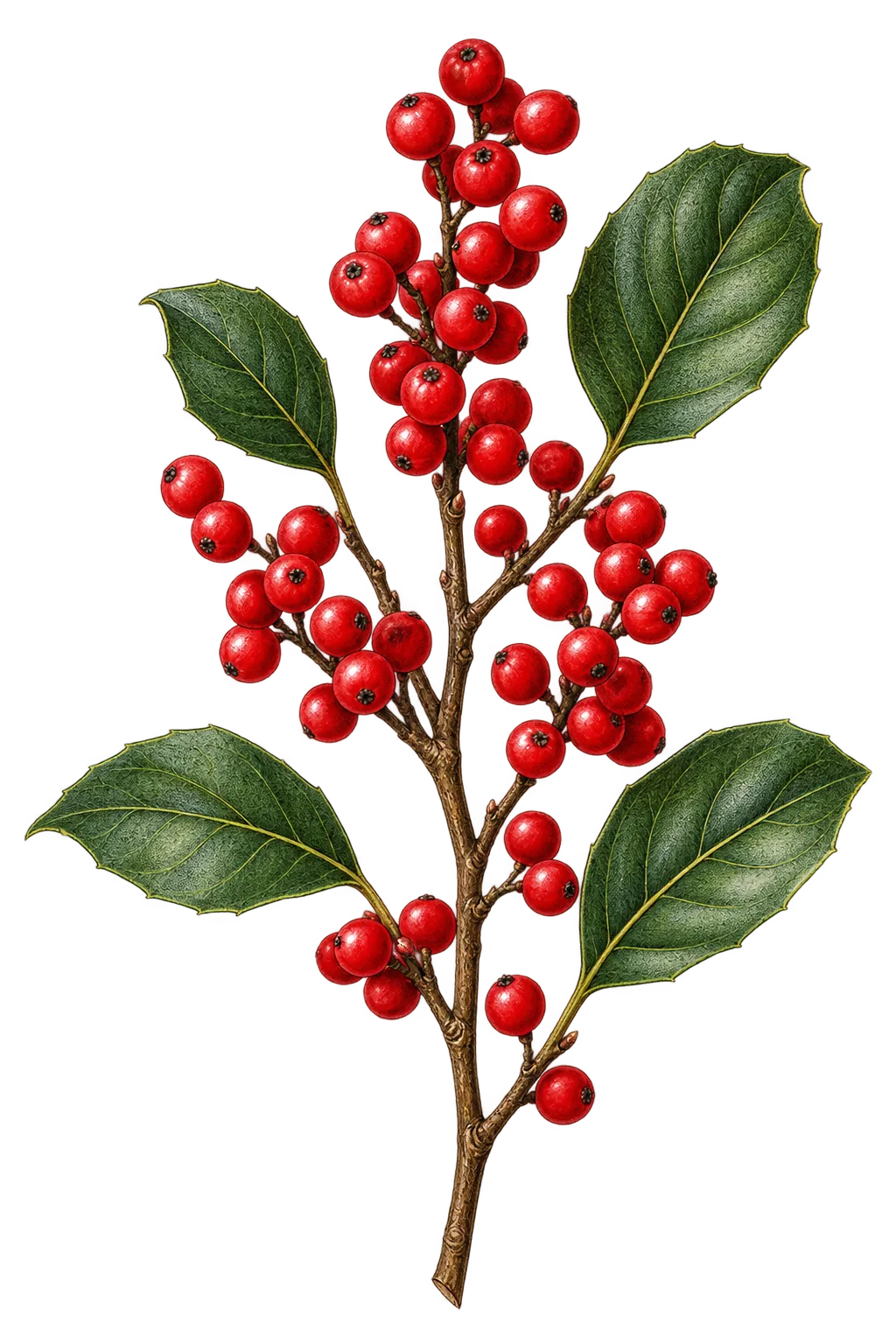
Botanical name
Kew accepts Ilex verticillata (L.) A.Gray in Aquifoliaceae. The manifest’s A. Gray author spacing is retained in databaseScientificName; the source-standard accepted name uses A.Gray. Kew Plants of the World Online: Ilex verticillata
Recognizing the plant
Its leaves alternate along the shoots and have toothed edges, pointed tips and hairs on the veins beneath. Small greenish-white flowers sit in the leaf axils. Female plants carry red, berry-like fruits that become especially conspicuous after leaf fall. NC State Extension Gardener Plant Toolbox: Ilex verticillata
Seasonal development
North Carolina, United States
In North Carolina, flowering occurs from April through June. Fruits ripen from late summer into autumn, and the bright clusters may remain attached well into winter. NC State Extension Gardener Plant Toolbox: Ilex verticillata
Native range
Its native range reaches from eastern Canada into the central and eastern United States, spanning a large portion of temperate eastern North America. Kew Plants of the World Online: Ilex verticillata
Ecological relationships
Bees pollinate the flowers. Fruit production depends on pollen reaching female plants from a male whose flowering period overlaps theirs. Clemson Extension: Rain Garden Plants, Winterberry (Ilex verticillata)
The shrub is also a larval food plant for Henry’s elfin butterfly. NC State Extension Gardener Plant Toolbox: Ilex verticillata
Cedar waxwings and many other birds eat the fruits, as do small mammals. NC State Extension Gardener Plant Toolbox: Ilex verticillata
Adult butterflies can feed on nectar from its flowers, a separate use from caterpillars feeding on the plant. University of Georgia Extension, Bulletin 1483: Selecting Trees and Shrubs as Resources for Pollinators
A growing note
Plant it in acidic soil with reliable moisture. Alkaline conditions can cause yellowing foliage, and a suitable male companion is needed when a winter fruit display is the goal. Clemson Extension: Rain Garden Plants, Winterberry (Ilex verticillata)
Botanical sources
- Kew Plants of the World Online: Ilex verticillata
- NC State Extension Gardener Plant Toolbox: Ilex verticillata
- Clemson Extension: Rain Garden Plants, Winterberry (Ilex verticillata)
- University of Georgia Extension, Bulletin 1483: Selecting Trees and Shrubs as Resources for Pollinators
Reviewed 2026-10-11. Seasonal development varies with location and growing conditions.