dense blazing star
Liatris spicata (L.) Martyn
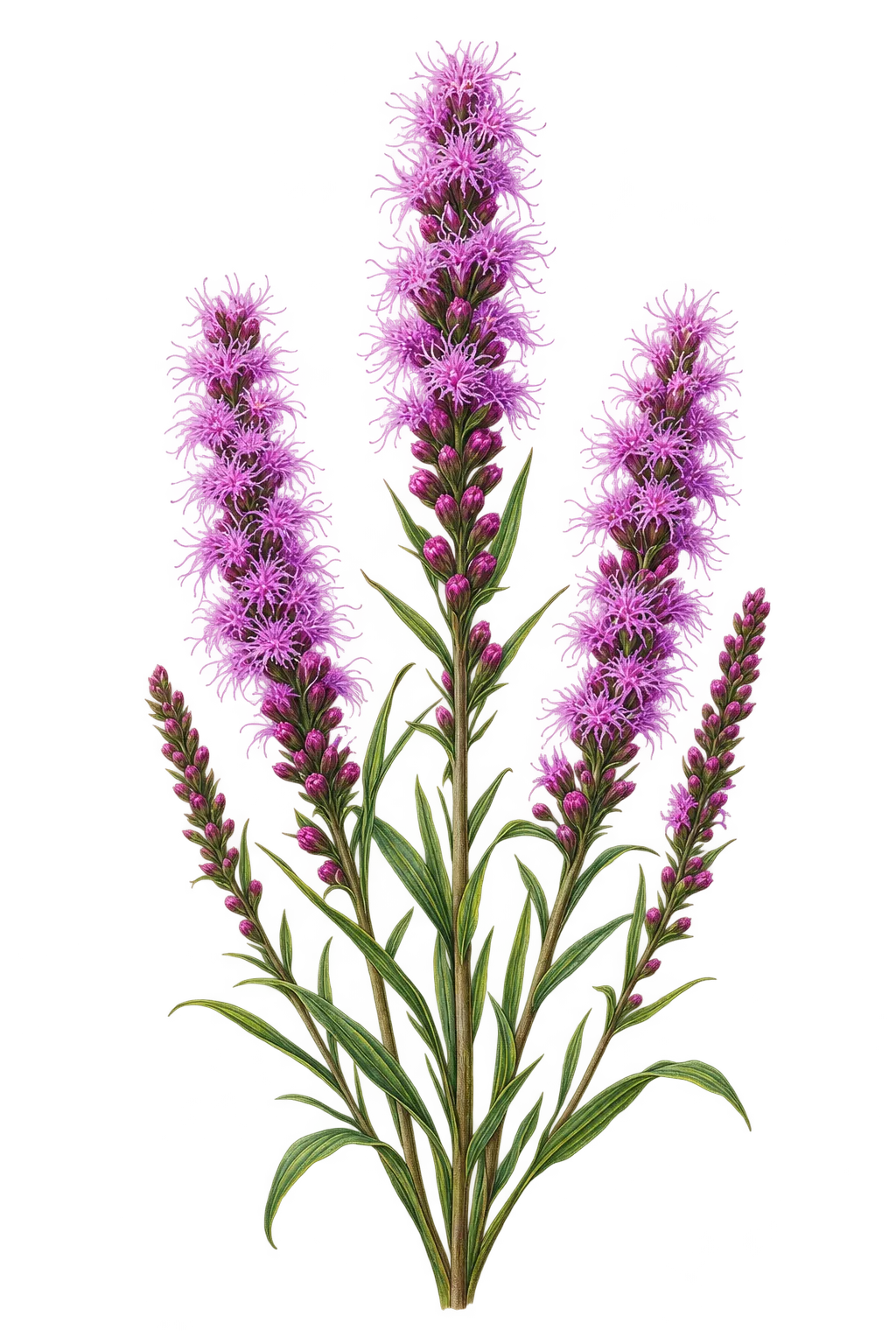
Dense blazing star reverses the usual upward progression of a flower spike: its heads open from the top downward. It is a perennial that grows in clumps from underground corms with shallow fibrous roots. North Carolina’s extension account describes plants reaching three to six feet, with grasslike foliage gathered around their bases. NC State Extension: Liatris spicata
Botanical name
Kew accepts Liatris spicata (L.) Martyn; its medicinal-name crosswalk explicitly links the catalog’s (L.) Willd. author form to this same species. Kew POWO: Liatris spicataKew MPNS: Liatris spicata name crosswalk
Recognizing the plant
The narrow leaves have a strong central vein and become smaller up the flowering stem. Closely packed, stalkless heads create spikes six to twelve inches long. Each head contains tubular disk florets without a surrounding ring of ray florets. Purple, pink and white forms occur in cultivation. The small dry fruits carry stiff, light-brown bristles. NC State Extension: Liatris spicata
Bloom window
North Carolina extension account
The principal display is in midsummer. NC State Extension: Liatris spicata
Native range
Its native range lies in central and eastern North America. In North Carolina it is found in the Coastal Plain and Piedmont, particularly in moist ground and meadows. Kew POWO: Liatris spicataNC State Extension: Liatris spicata
Ecological relationships
Liatris flower moth larvae (Schinia sanguinea) eat the flowers and seeds; Liatris borer moth larvae (Carmenta anthracipennis) feed on the stems. NC State Extension: Liatris spicata
Botanical sources
- Kew POWO: Liatris spicata
- Kew MPNS: Liatris spicata name crosswalk
- NC State Extension: Liatris spicata
Reviewed 2026-10-11. Seasonal development varies with location and growing conditions.