depressed clearweed
Pilea depressa (Sw.) Blume
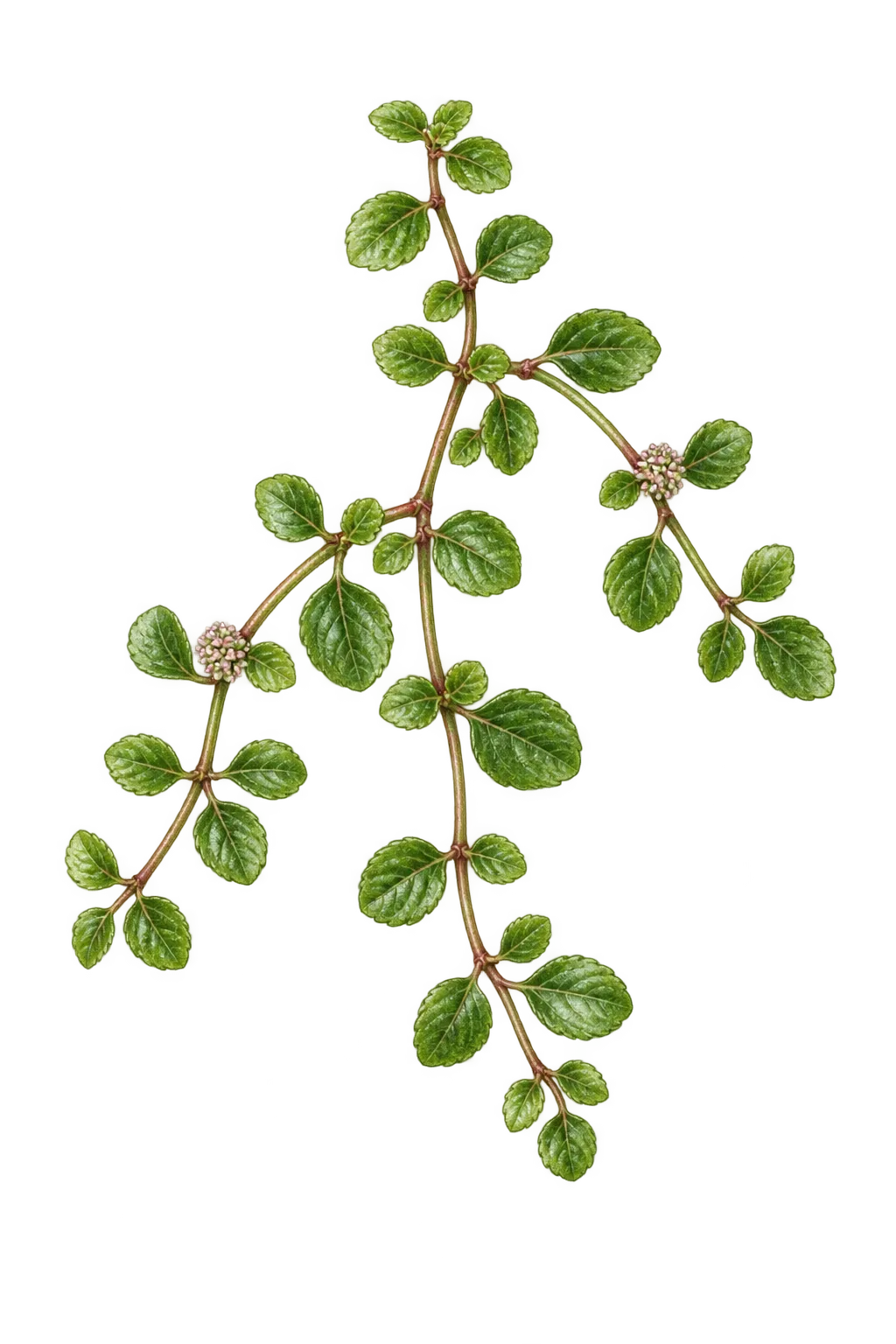
Depressed clearweed spreads as a low mat or trails over the edge of a container. Its small leaves cover slender stems in opposite pairs, giving the plant a close-textured surface. Kwantlen Polytechnic University describes cultivated plants under 10 cm high but capable of spreading much farther sideways. Kwantlen Polytechnic University Plant Database: Pilea depressaSingapore NParks: Pilea depressa
Botanical name
Pilea depressa (Sw.) Blume is accepted in Urticaceae. Kew recognizes a Caribbean native range, rather than the much broader origins sometimes given in horticultural databases. Kew Plants of the World Online: Pilea depressa
Recognizing the plant
Leaves are rounded to broadly spoon-shaped, commonly about 5–20 mm long and 3–17 mm wide. The blades are bright green and relatively thick, with scalloping most evident toward their tips. Their surfaces can look subtly wrinkled. The small, pale flowers occur in clusters and are far less conspicuous than the foliage. Brown, dry fruits are achenes, though they seldom develop on indoor plants. Kwantlen Polytechnic University Plant Database: Pilea depressa
Bloom window
Indoor cultivation, Kwantlen Polytechnic University, British Columbia
Kwantlen’s indoor-plant account records possible flowering in any month; this is a cultivation observation, not a wild Caribbean flowering calendar. Kwantlen Polytechnic University Plant Database: Pilea depressa
Native range
The species is native to Cuba and Hispaniola, including Haiti and the Dominican Republic, in the wet tropical biome. It has been introduced to other Caribbean islands, parts of Central America and several Pacific island groups. Kew Plants of the World Online: Pilea depressa
Botanical sources
- Kew Plants of the World Online: Pilea depressa
- Kwantlen Polytechnic University Plant Database: Pilea depressa
- Singapore NParks: Pilea depressa
Reviewed 2026-10-11. Seasonal development varies with location and growing conditions.