desert date
Balanites aegyptiaca (L.) Delile
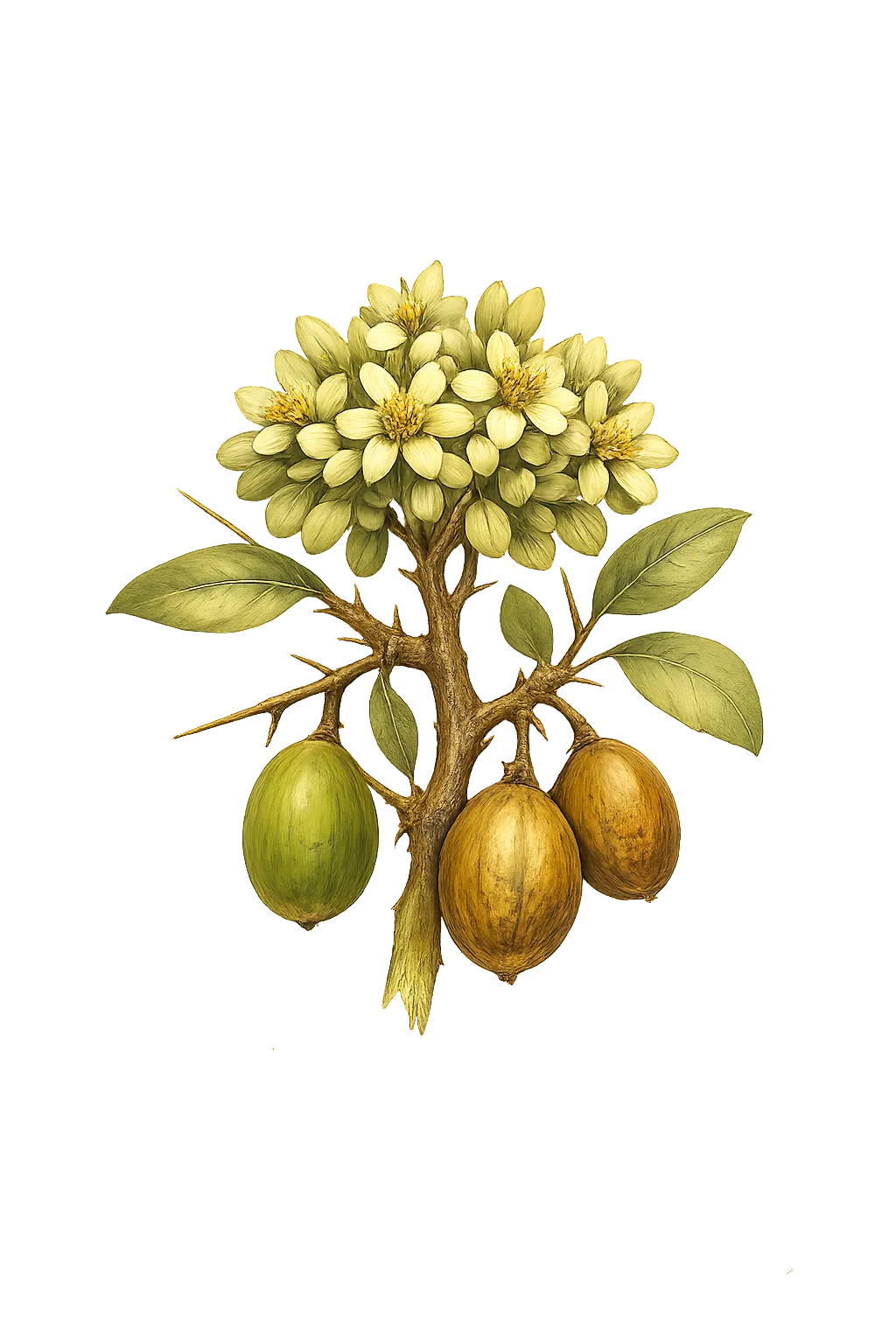
Desert date combines thorny branches with leaves divided into two leathery leaflets. It can remain a many-branched shrub or grow into a tree with a rounded crown. Mature bark is grey and deeply fissured lengthwise, while the foliage follows a spiral arrangement along the shoots. Kew: Balanites aegyptiaca, Flora of Tropical East AfricaWorld Agroforestry: Balanites aegyptiaca
Botanical name
ITIS accepts supplied Balanites aegyptiacus and explicitly links B. aegyptiaca; Kew accepts the latter spelling for the same species. ITIS: Balanites aegyptiacusKew POWO: Balanites aegyptiaca
Recognizing the plant
The leaflets vary considerably in size and outline, but their edges are smooth. Small, sweet-scented flowers appear in clusters near the leaf-bearing shoots. Their petals range from greenish to pale yellow or cream, surrounding ten stamens. Oval fruits change from green to brown as they ripen, developing a brittle outer covering and fibrous or sticky flesh around a hard woody stone. Kew: Balanites aegyptiaca, Flora of Tropical East AfricaWorld Agroforestry: Balanites aegyptiaca
Native range
Native across much of Africa and into the eastern Mediterranean and Arabian Peninsula, the species is associated with dry landscapes. World Agroforestry records its strongest growth on deep alluvial soils with reliable access to water, including valley floors and riverbanks. Beyond the seedling stage, it needs open conditions and regenerates in woodland or savannah. Kew POWO: Balanites aegyptiacaWorld Agroforestry: Balanites aegyptiaca
Botanical sources
- ITIS: Balanites aegyptiacus
- Kew POWO: Balanites aegyptiaca
- Kew: Balanites aegyptiaca, Flora of Tropical East Africa
- World Agroforestry: Balanites aegyptiaca
Reviewed 2026-10-11. Seasonal development varies with location and growing conditions.