dieffenbachia
Dieffenbachia Schott
A genus overview; characteristics vary between its species.
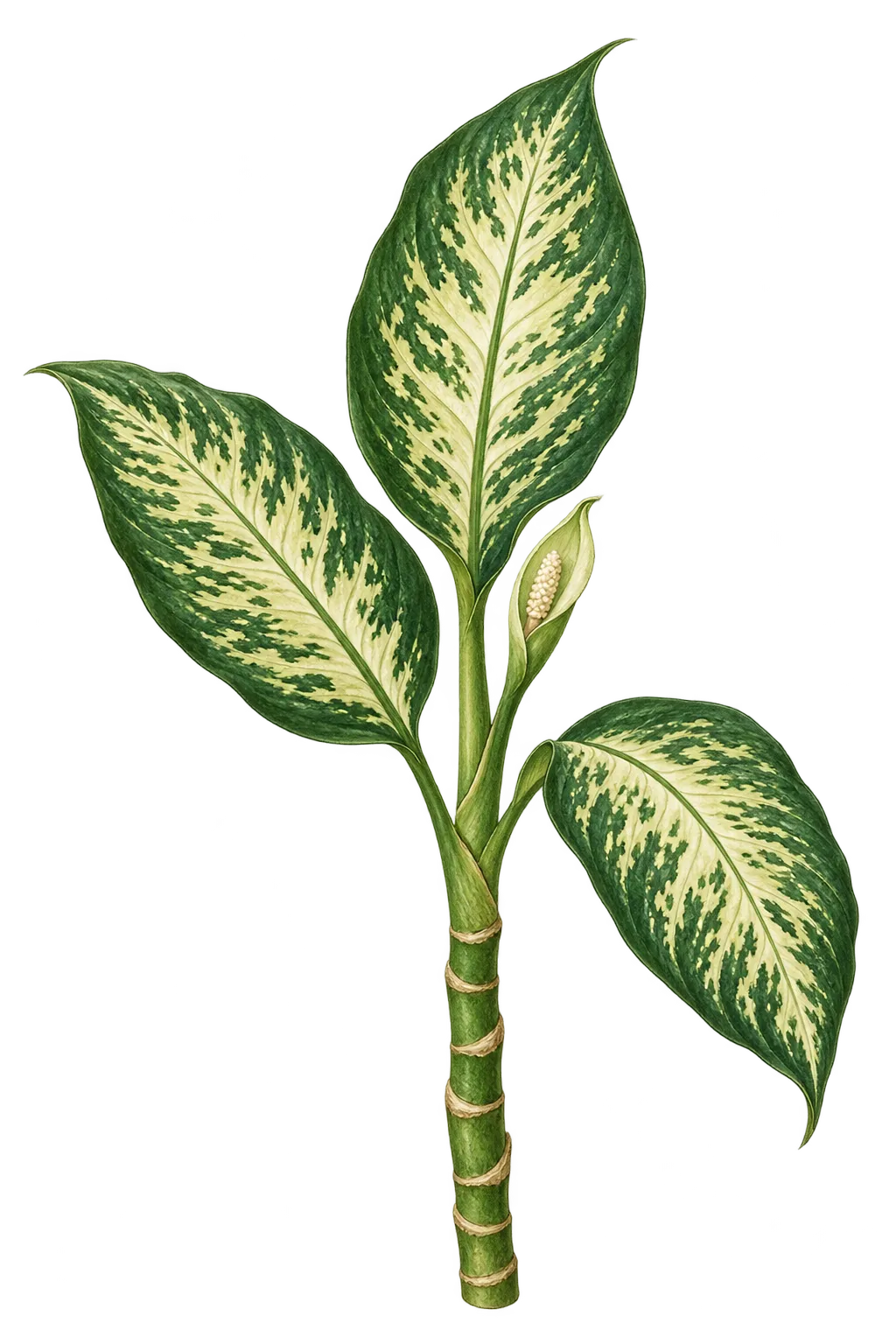
Dieffenbachia combines bold foliage with the specialized flowering structure of the arum family. Members are evergreen herbs, sometimes robust enough to look shrubby, with thick stems and large leaves concentrated toward their growing tips. Some stems remain upright while others lie down and root along their older portions. CATE Araceae via Kew: Dieffenbachia
Botanical name
Kew accepts Dieffenbachia as a genus of Araceae. This record covers the genus rather than a particular species or cultivated selection. Plants of the World Online: Dieffenbachia
Recognizing the plant
Leaf blades range from oval to elongated or broader toward the tip. They may be plain green or patterned with lighter green, cream, yellow or silvery areas. A strong midrib and spreading side veins organize the blade, while the leaf stalk usually carries a long sheath. The flowers themselves are tiny and crowded on a cylindrical spadix, enclosed by a persistent, partly tubular spathe. Male and female flowers occupy different regions of that structure. After fertilization, clusters of berries develop; the surrounding spathe eventually opens to expose them. CATE Araceae via Kew: DieffenbachiaFlora of Pakistan: Dieffenbachia
Native range
The genus is native to Mexico and tropical America. Kew’s aroid treatment places its species in humid tropical and subtropical forests, including stream margins, wet places and forest-floor leaf litter. These varied habitats belong to different species across the genus. Plants of the World Online: DieffenbachiaCATE Araceae via Kew: Dieffenbachia
Botanical sources
- Plants of the World Online: Dieffenbachia
- CATE Araceae via Kew: Dieffenbachia
- Flora of Pakistan: Dieffenbachia
Reviewed 2026-10-11. Seasonal development varies with location and growing conditions.