Eaton's thistle
Cirsium eatonii (A.Gray) B.L.Rob.
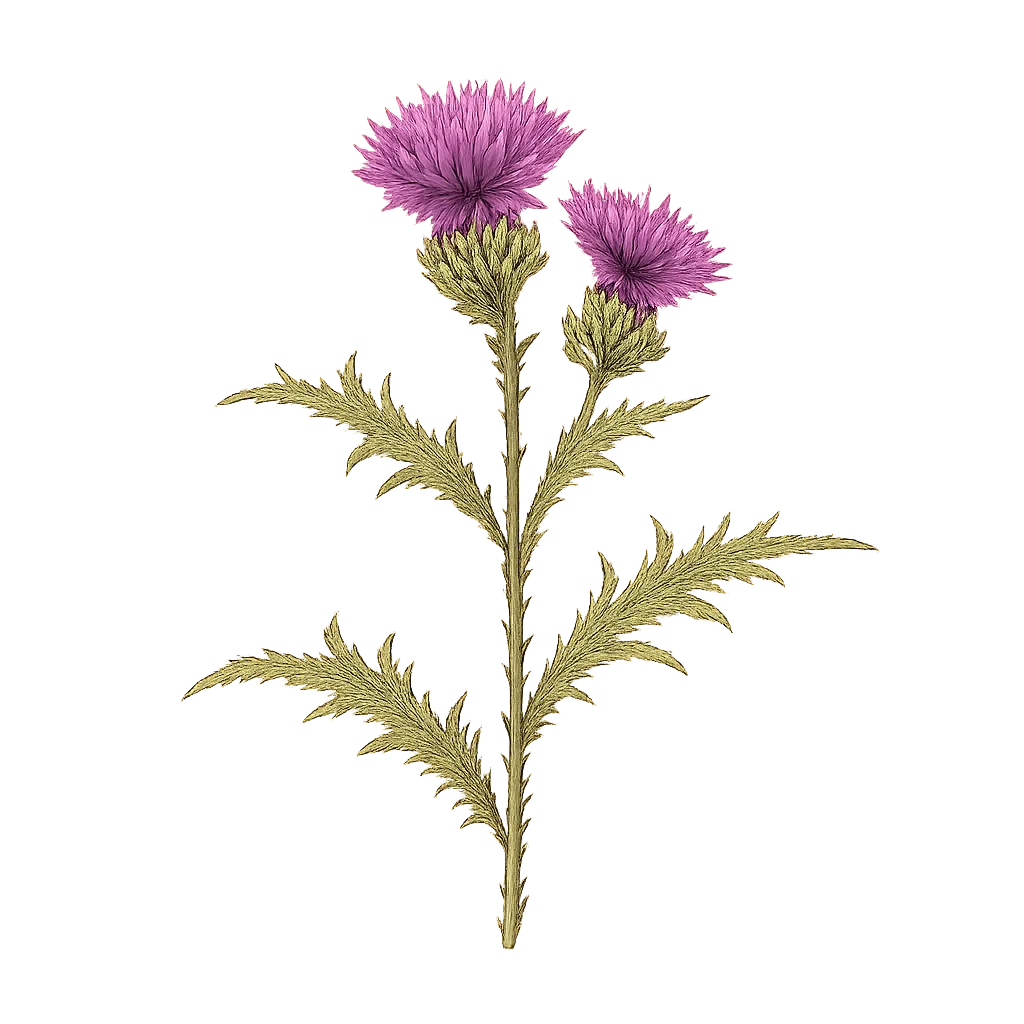
Eaton’s thistle belongs to the mountain landscapes of the Great Basin. In the core Nevada–Utah treatment, its relatively slender stems carry purple flower heads in short, upright arrays. Some of the surrounding bracts are also tinged dark purple, while their projecting spines add a second, sharply defined outline around the flowers. Flora of North America: Cirsium eatonii var. eatonii
Botanical name
Kew accepts Cirsium eatonii with its Cnicus eatonii basionym. This profile uses the Nevada–Utah core corresponding to the older flora’s nominotypical variety, not the entire historical complex. Kew POWO: Cirsium eatoniiAckerfield et al. 2020: Thistle be a mess
Recognizing the plant
The perennial grows from a taprooted base. Its leaves are elongated and armed with spines along toothed or divided margins, and the core form has little or no hair on the leaf surfaces. Heads are usually held on short stalks; the surrounding bracts remain individually visible beneath a thin covering of cobwebby hairs or on nearly hairless surfaces. These characters distinguish its core portrait from the heavily woolly mountain thistles once included under the same broad name. Flora of North America: Cirsium eatonii var. eatoniiFlora of North America: Cirsium eatonii broad treatment
Bloom window
Nevada and Utah, core regional flora treatment
The regional flora records flowering from July through September in these western mountain populations. Flora of North America: Cirsium eatonii var. eatonii
Native range
Kew restricts the species to Nevada and Utah. The corresponding regional flora account spans rocky slopes, canyons, woodland, montane and subalpine forest, and exposed alpine sites at roughly 2,100–3,500 meters. Kew POWO: Cirsium eatoniiFlora of North America: Cirsium eatonii var. eatonii
Botanical sources
- Kew POWO: Cirsium eatonii
- Flora of North America: Cirsium eatonii var. eatonii
- Flora of North America: Cirsium eatonii broad treatment
- Ackerfield et al. 2020: Thistle be a mess
Reviewed 2026-10-11. Seasonal development varies with location and growing conditions.