echeveria
Echeveria DC.
A genus overview; characteristics vary between its species.
Echeveria commemorates Atanasio Echeverría y Godoy, a Mexican botanical artist active around the turn of the nineteenth century. The genus contains perennial herbs and shrubs whose fleshy foliage commonly gathers into rosettes. Some plants are hairy and others smooth, so the familiar polished-looking garden rosette represents only part of the genus. Flora of North America: Echeveria
Botanical name
Echeveria DC. is an accepted genus in Crassulaceae. This genus-level profile follows the circumscription used by Kew and does not identify a particular garden species or hybrid. Kew Plants of the World Online: Echeveria
Recognizing the plant
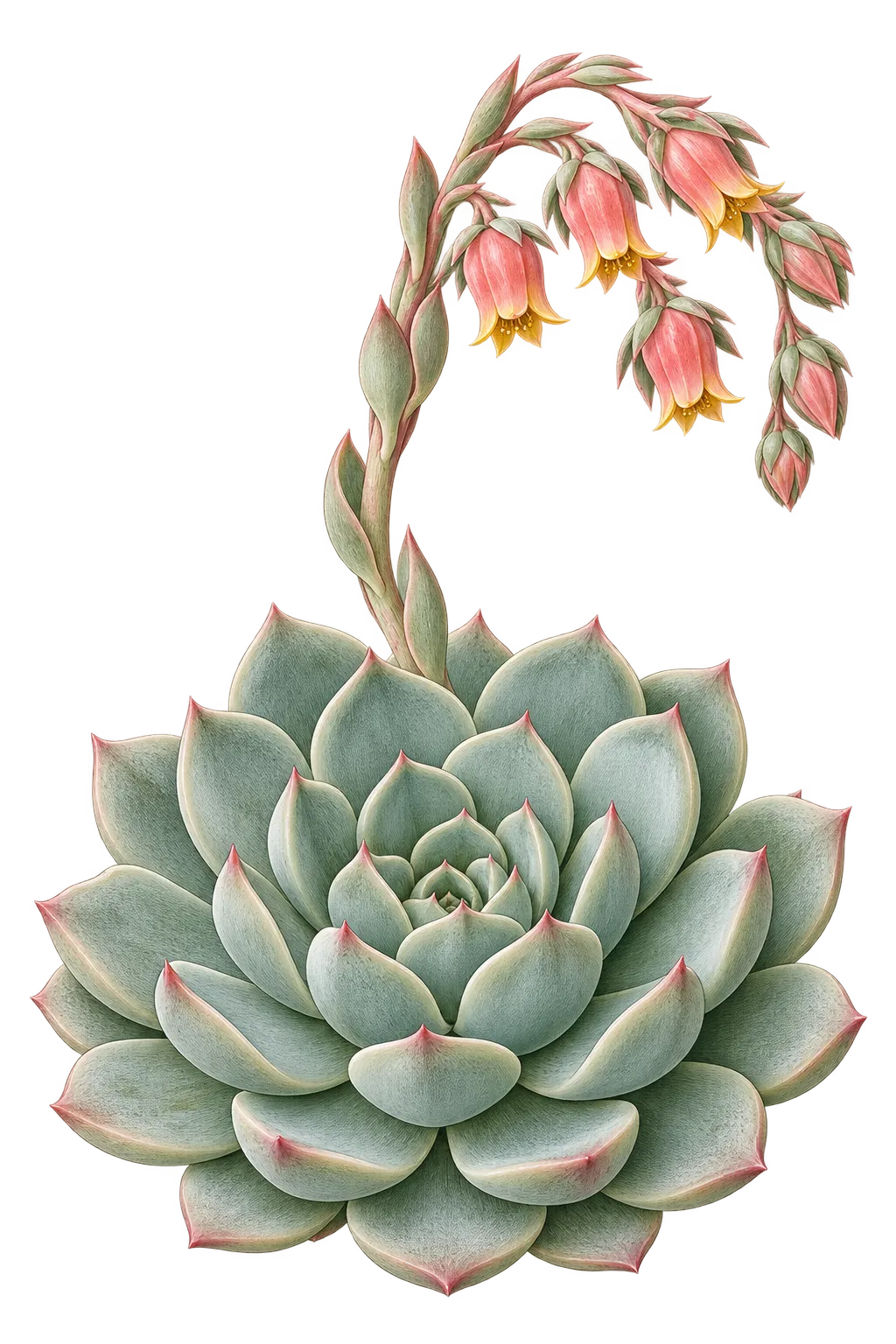
The leaves lack stalks and are arranged alternately, often crowded tightly together; older leaves fall away as they die. Flowering shoots arise from leaf axils, carry smaller scattered leaves, and extend above the main rosette. The flowers follow a five-parted plan. Their sepals may differ noticeably in size, while the petals join at the base to make an angular, five-sided tube. Ten stamens surround the central reproductive structures. The flowers also have short, broad nectar-producing scales, and the small, egg-shaped seeds have a net-like surface pattern. Flora of North America: Echeveria
Native range
Echeveria is native to the Americas, from southern Texas through Mexico and Central America into the Andes, reaching northwestern Argentina. The genus therefore spans both North and South America rather than belonging solely to the Mexican flora. Kew Plants of the World Online: EcheveriaFlora of North America: Echeveria
Botanical sources
Reviewed 2026-10-11. Seasonal development varies with location and growing conditions.