fall phlox
Phlox paniculata L.
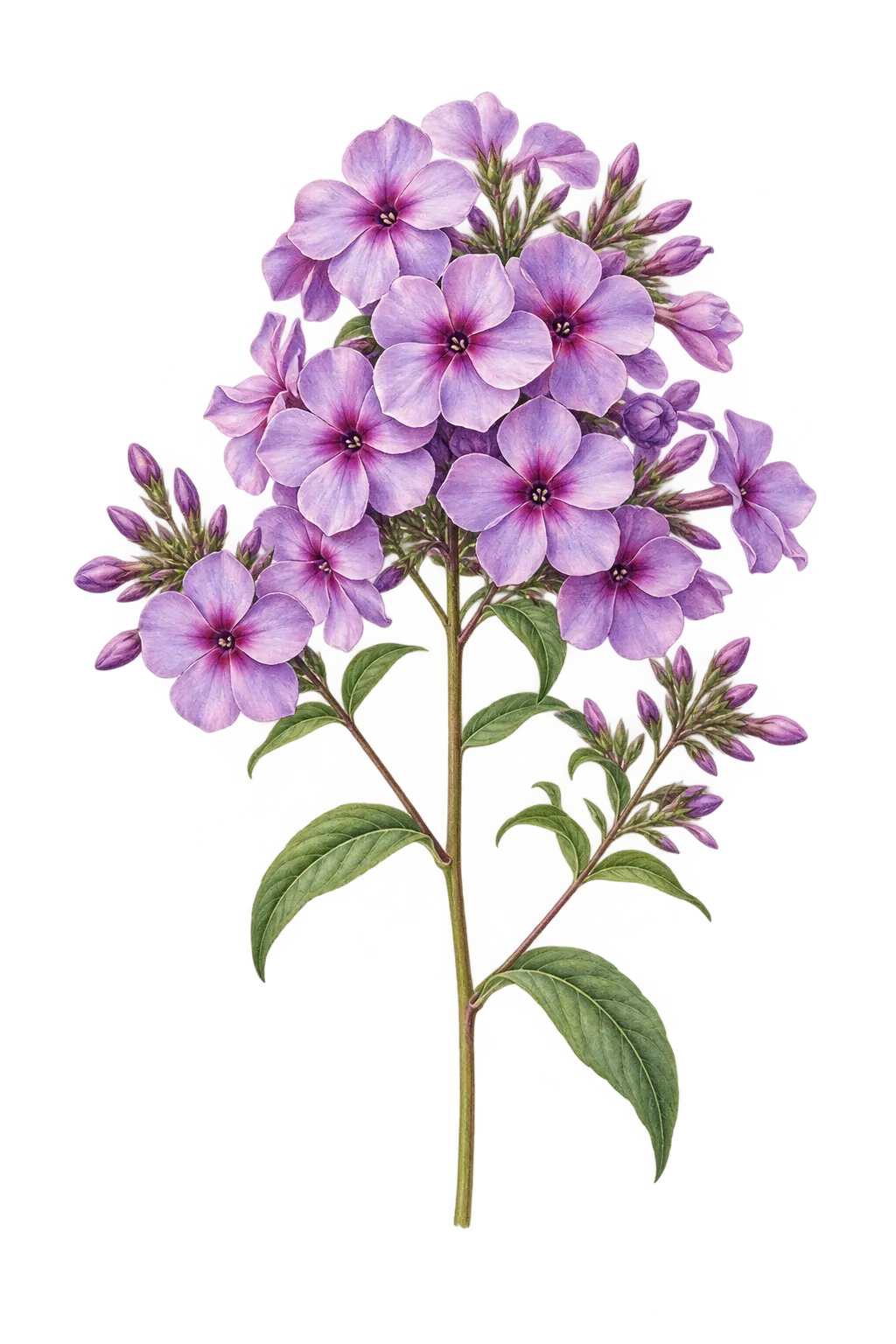
Fall phlox rises in leafy clumps, usually about 2–4 feet tall, topped by broad clusters of fragrant flowers. Wild plants commonly have magenta-pink blooms. Garden cultivars expand that palette to white, lavender, red and patterned combinations, making flower color alone a poor way to distinguish the species. NC State Extension: Phlox paniculataChicago Botanic Garden, Plant Evaluation Notes 35: Phlox paniculata
Botanical name
Phlox paniculata L. is accepted in Polemoniaceae. The profile covers the species; cultivated flower colors are identified separately. Kew Plants of the World Online: Phlox paniculata
Recognizing the plant
Leaves are opposite, pointed and usually smooth, with conspicuous side veins that curve toward the edge and join into a connecting vein. Upper leaves have little stalk and may clasp the stem. Each small flower has a long, narrow tube opening into five flat lobes. Many such flowers are packed into tiered, rounded clusters at the stem tips. NC State Extension: Phlox paniculata
Bloom window
North Carolina cultivation
North Carolina Extension describes flowering from midsummer into mid-autumn, with timing varying among cultivated selections. NC State Extension: Phlox paniculata
Native range
The species is native chiefly to the central and eastern United States. In Missouri it grows in moist woods, thickets, alluvial ground and stream margins. Garden escapes have extended its distribution beyond the original range. Kew Plants of the World Online: Phlox paniculataNC State Extension: Phlox paniculataMissouri Botanical Garden: Phlox paniculata
Botanical sources
- Kew Plants of the World Online: Phlox paniculata
- NC State Extension: Phlox paniculata
- Chicago Botanic Garden, Plant Evaluation Notes 35: Phlox paniculata
- Missouri Botanical Garden: Phlox paniculata
Reviewed 2026-10-11. Seasonal development varies with location and growing conditions.