feather reed grass
Calamagrostis × acutiflora (Schrad.) DC.
Feather reed grass is a perennial hybrid between Calamagrostis arundinacea and Calamagrostis epigejos. Its name records a cross between two grasses rather than a single wild species. In cultivation, the combination produces a strongly upright plant used for vertical accents and for fresh or dried arrangements. The flowering stems stand well above the lower mass of foliage. Kew POWO: Calamagrostis × acutifloraNC State Extension: Feather Reed Grass
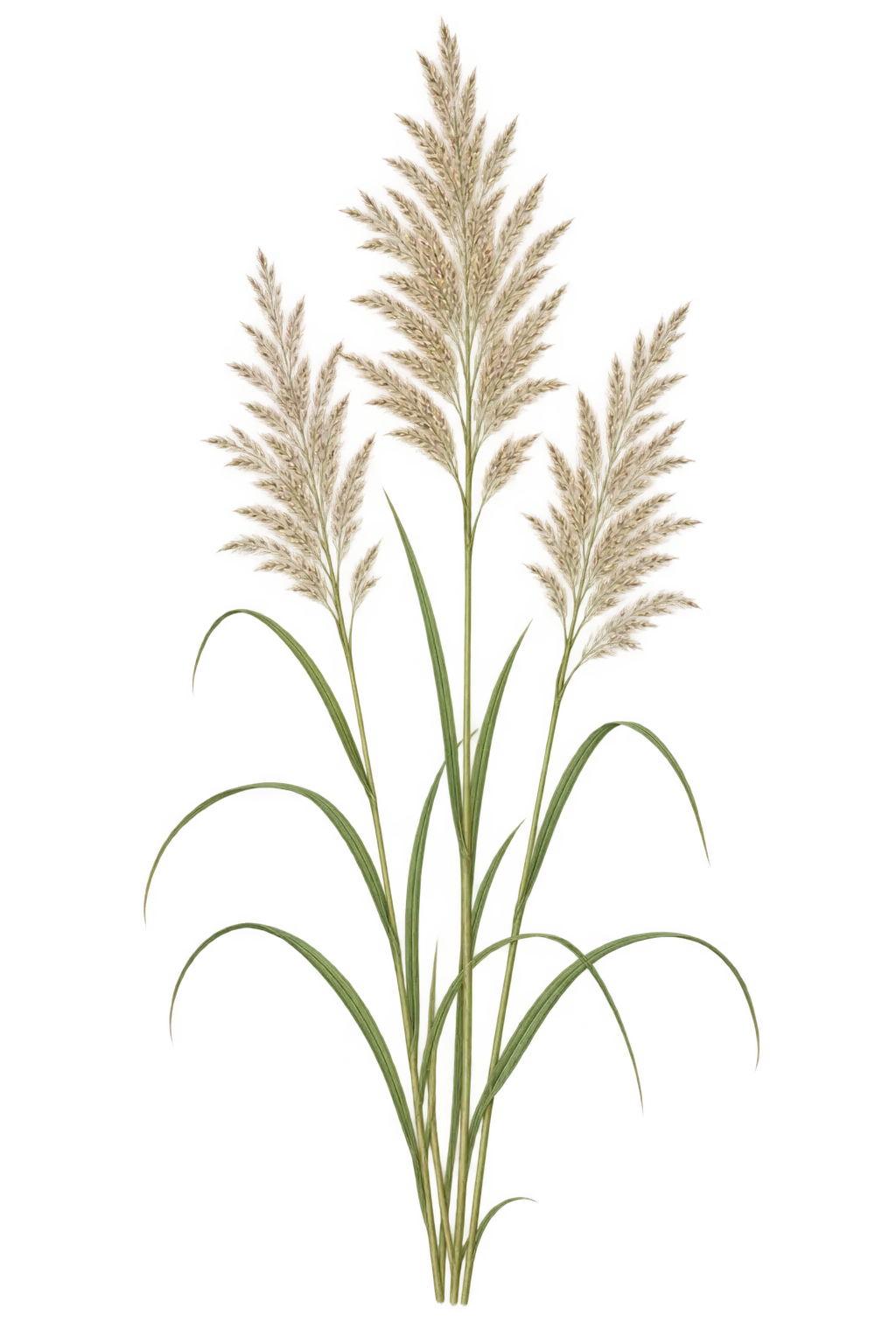
Botanical name
GBIF explicitly lists supplied (Schrad.) Rchb. under accepted (Schrad.) DC.; Kew confirms same hybrid and parents. Verified name: Calamagrostis × acutiflora (Schrad.) DC.. Kew POWO: Calamagrostis × acutifloraGBIF Backbone: Calamagrostis ×acutiflora
Recognizing the plant
The green leaf blades are narrow, flattened and hairless, gathered into a dense erect clump. North Carolina Extension describes the foliage as eighteen to thirty-six inches tall, while the stiff flowering stems can reach five feet. Mature clumps are usually about one to two feet wide. Those proportions create a tall, relatively narrow outline rather than a broad spreading mound. NC State Extension: Feather Reed Grass
Seasonal development
North Carolina, United States
In North Carolina’s garden account, loose purplish plumes emerge in early summer, narrowing and becoming buff by late summer. The dried inflorescences can remain standing and attractive through much of winter. NC State Extension: Feather Reed Grass
Native range
Kew records the naturally occurring hybrid from Europe eastward to the Russian Far East. Its Eurasian distribution is distinct from its extensive cultivated use. Kew POWO: Calamagrostis × acutiflora
Botanical sources
- NC State Extension: Feather Reed Grass
- Kew POWO: Calamagrostis × acutiflora
- GBIF Backbone: Calamagrostis ×acutiflora
Reviewed 2026-10-11. Seasonal development varies with location and growing conditions.