foreign fountaingrass
Cenchrus × cupreus (Thorpe) Govaerts
Foreign fountaingrass owes its origin to cultivation. It is a perennial tuft-forming grass, although cold temperate climates often limit it to a single growing season. The familiar purple-leaved plants have also been sold as Pennisetum setaceum “Rubrum,” despite their distinct hybrid identity. Faccenda: Hawaiian grass records, Bishop Museum Occasional Papers 148
Botanical name
Kew and the Bishop Museum treatment explicitly place Pennisetum advena Wipff & Veldkamp in synonymy under Cenchrus × cupreus, a cultivated hybrid of C. elegans and C. setaceus. Kew: Cenchrus × cupreusFaccenda: Hawaiian grass records, Bishop Museum Occasional Papers 148
Recognizing the plant
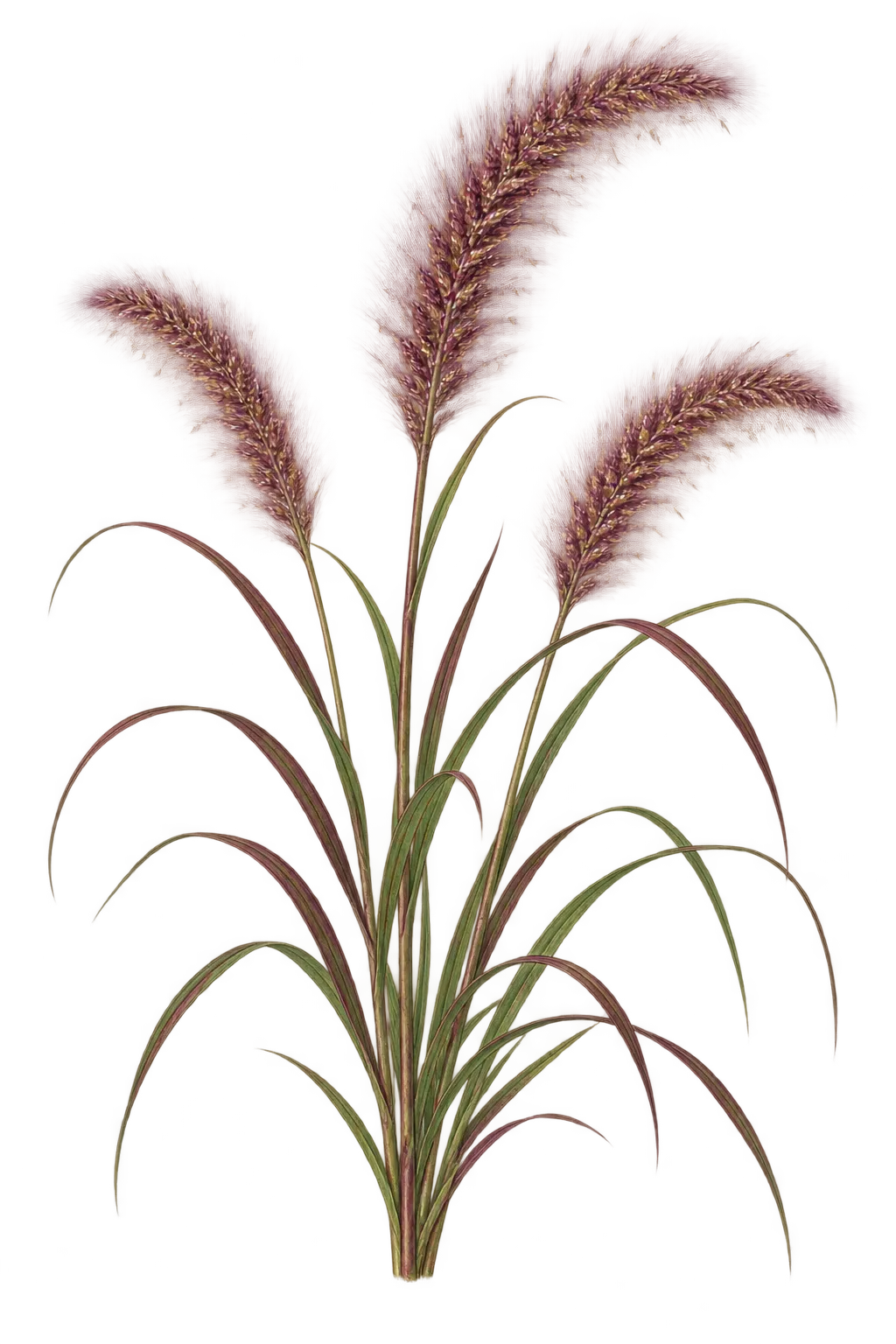
Erect stems commonly reach one to one and a half meters. Flat leaf blades are usually burgundy, occasionally green, and about 6–11 mm wide. The flower panicles bend into flexible, drooping plumes, often roughly 23–32 cm long. Each small group of spikelets is surrounded by numerous bristles. Some inner bristles bear long, fine hairs, and one primary bristle projects conspicuously beyond the others. These structures are useful for distinguishing the hybrid from similar cultivated grasses; the narrower leaves also separate it from typical Cenchrus elegans. Faccenda: Hawaiian grass records, Bishop Museum Occasional Papers 148
Native range
As a horticultural hybrid, it has no ordinary wild native range. Introduced records include California, Florida, Texas and Hawaii. On Maui, herbarium-backed observations document spreading plants associated with former plantings. Kew: Cenchrus × cupreusFaccenda: Hawaiian grass records, Bishop Museum Occasional Papers 148
Botanical sources
Reviewed 2026-10-11. Seasonal development varies with location and growing conditions.