German iris
Iris ×germanica L.
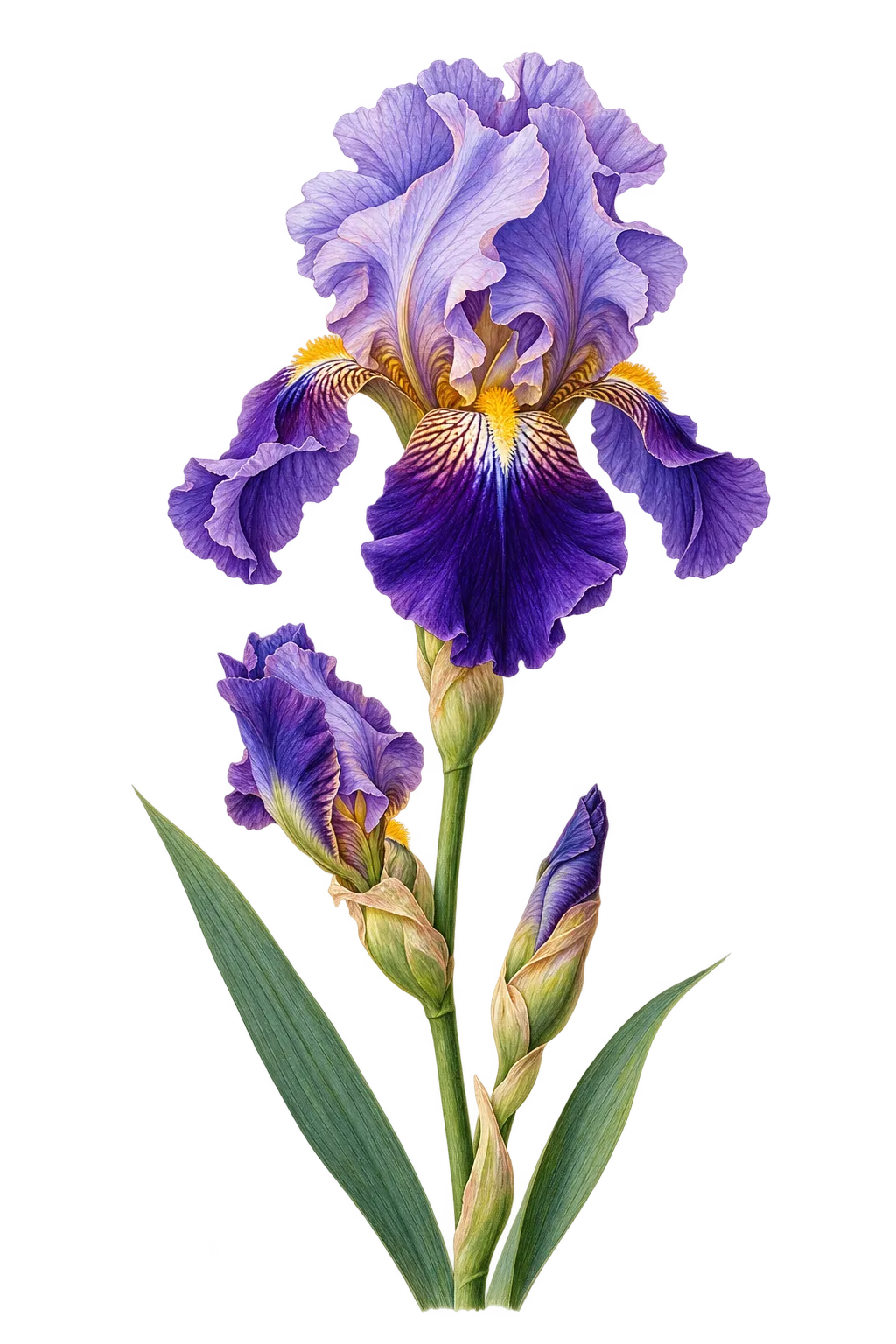
German iris grows from branching rhizomes into fans of sword-shaped leaves. Its floral architecture combines upright inner petals with spreading or drooping outer sepals. A white or yellow beard runs along the middle of the outer segments, giving this familiar garden iris its bearded appearance. Flora of North America, volume 26, pages 373–376: Iris germanica
Botanical name
Kew accepts Iris ×germanica L. as the hybrid I. pallida × I. variegata. Flora of North America uses Iris germanica L. for the same naturally hybrid-derived plant. Kew Plants of the World Online: Iris ×germanicaFlora of North America, volume 26, pages 373–376: Iris germanica
Recognizing the plant
The foliage has a blue-grey bloom, and flowering stems usually rise about sixty centimetres to 1.2 metres. Flowers vary among blue-violet, yellow, brown and white, often with darker patterns. The green flower bracts may have purplish bases and dry, papery margins. Capsules are rounded and three-lobed, enclosing wrinkled red-brown seeds. Flora of North America, volume 26, pages 373–376: Iris germanica
Bloom window
Introduced and cultivated North American populations
Flora of North America records flowering from mid-April to mid-June, and notes that plants may persist after cultivation. Flora of North America, volume 26, pages 373–376: Iris germanica
Native range
Kew locates the hybrid’s native range in the northwestern Balkan Peninsula. It is a temperate, rhizomatous perennial, derived from crosses between Iris pallida and Iris variegata. Kew Plants of the World Online: Iris ×germanica
Ecological relationships
Bearded iris supports iris-borer moth larvae, which tunnel through leaves and then feed inside the rhizomes. Chicago Botanic Garden: Iris Borer
Botanical sources
- Kew Plants of the World Online: Iris ×germanica
- Flora of North America, volume 26, pages 373–376: Iris germanica
- Chicago Botanic Garden: Iris Borer
Reviewed 2026-10-11. Seasonal development varies with location and growing conditions.