giant swordfern
Nephrolepis biserrata (Sw.) Schott
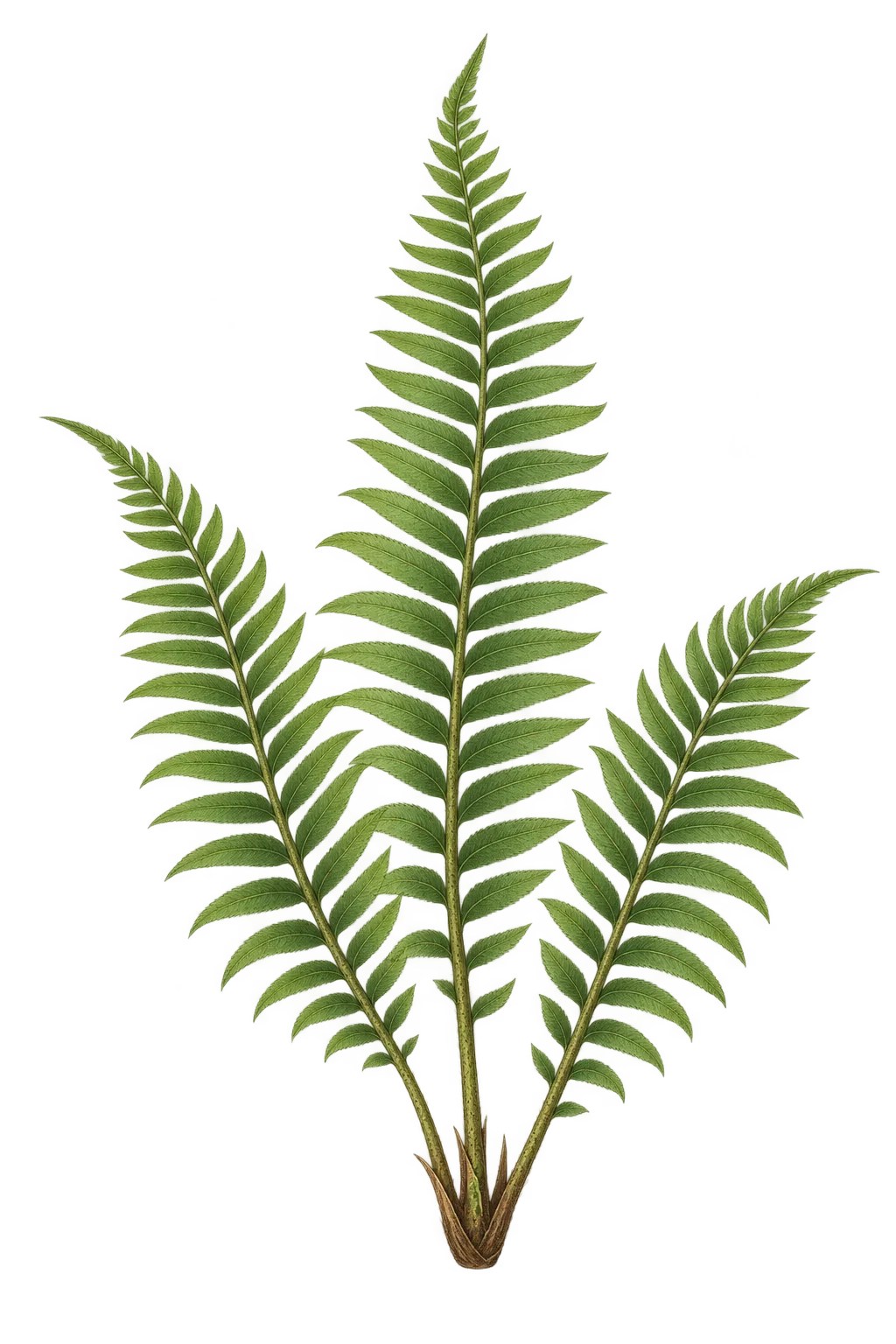
Giant swordfern builds its outline from long, feather-like fronds that rise and arch from the base. Singapore’s National Parks Board describes blades about 1–1.5 m long and 30–40 cm wide, with stalks adding another 40–60 cm. The blade narrows toward both its tip and base. Singapore NParks: Nephrolepis biserrata
Botanical name
Nephrolepis biserrata (Sw.) Schott is accepted. Kew places it in a broadly circumscribed Polypodiaceae; other current treatments use Nephrolepidaceae. Kew Plants of the World Online: Nephrolepis biserrataSingapore NParks: Nephrolepis biserrata
Recognizing the plant
Individual leaflets taper to slender tips and have finely toothed to doubly toothed edges. Their surfaces may be smooth or hairy, so hairiness alone is unreliable for recognition. The stalk scales are usually reddish to light brown. Underground tubers are absent. On fertile fronds, round sori form a row near each leaflet margin; small protective indusia cover these spore-bearing structures. Singapore NParks: Nephrolepis biserrataUniversity of Florida BioGator: Nephrolepis biserrata, Flora of North America treatment
Native range
The species ranges through tropical and subtropical parts of the Americas, Africa, Asia and the Pacific. It is native to Singapore and Florida. In Florida it occupies wet hammocks and swamps, usually growing on the ground but sometimes perched on trees. The wider flora also records thickets, roadsides and clearings. Kew Plants of the World Online: Nephrolepis biserrataSingapore NParks: Nephrolepis biserrataUniversity of Florida BioGator: Nephrolepis biserrata, Flora of North America treatmentUniversity of Florida IFAS: Nephrolepis biserrata
Botanical sources
- Kew Plants of the World Online: Nephrolepis biserrata
- Singapore NParks: Nephrolepis biserrata
- University of Florida BioGator: Nephrolepis biserrata, Flora of North America treatment
- University of Florida IFAS: Nephrolepis biserrata
Reviewed 2026-10-11. Seasonal development varies with location and growing conditions.