gladiolus
Gladiolus Tourn. ex L.
A genus overview; characteristics vary between its species.
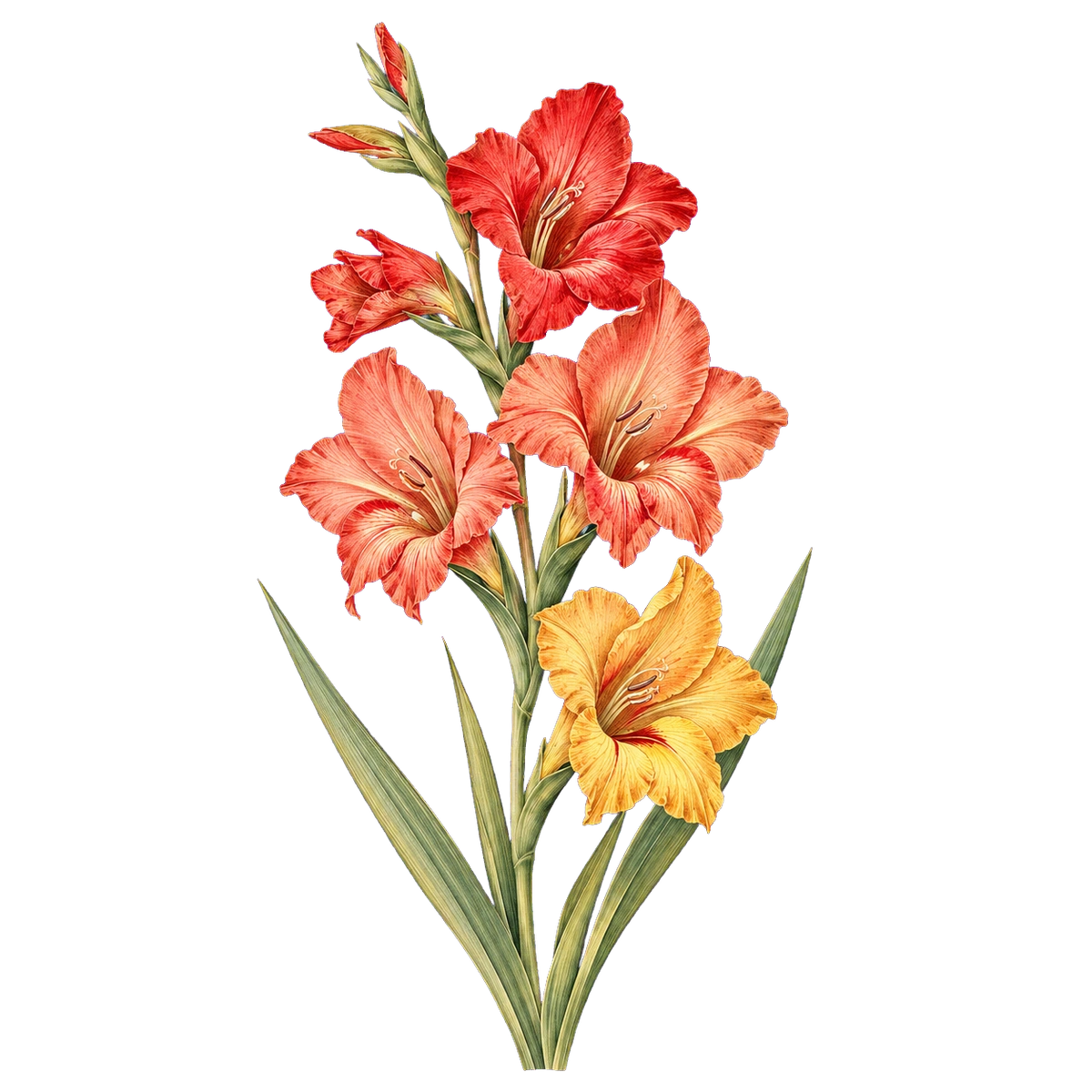
The name Gladiolus means “small sword,” referring to the narrow, sword-like leaves found in many species. These perennial herbs survive between growing seasons as underground corms, enclosed by tough or fibrous tunics. Flowering stems may be simple or branched; some species have thread-like rather than flat foliage. Kew Plants of the World Online: Gladiolus; Flora of Tropical East Africa and Flora of OmanSANBI PlantZAfrica: Gladiolus aureus, genus background
Botanical name
Gladiolus Tourn. ex L. is the accepted fuller citation of the supplied genus name. Kew Plants of the World Online: Gladiolus; Flora of Tropical East Africa and Flora of Oman
Recognizing the plant
Flowers usually face one side of a spike, though a few species arrange them in two rows. The petal-like segments unite into a tube, sometimes exceptionally long. In many species the upper segment arches over the stamens like a hood, while the lower three differ in width or length. Some species instead have more radially symmetrical flowers. Large, slightly inflated capsules follow, containing numerous seeds that are commonly surrounded by a thin, broad wing. Kew Plants of the World Online: Gladiolus; Flora of Tropical East Africa and Flora of Oman
Native range
The native distribution extends through Africa and Madagascar, the Arabian Peninsula, and parts of Europe and western Asia as far as Iran. Southern Africa is the main center of diversity, with a particularly strong concentration in the southwestern Cape. Kew Plants of the World Online: Gladiolus; Flora of Tropical East Africa and Flora of OmanSANBI PlantZAfrica: Gladiolus aureus, genus background
Botanical sources
- Kew Plants of the World Online: Gladiolus; Flora of Tropical East Africa and Flora of Oman
- SANBI PlantZAfrica: Gladiolus aureus, genus background
Reviewed 2026-10-11. Seasonal development varies with location and growing conditions.