grape
Vitis × doaniana Munson ex Viala
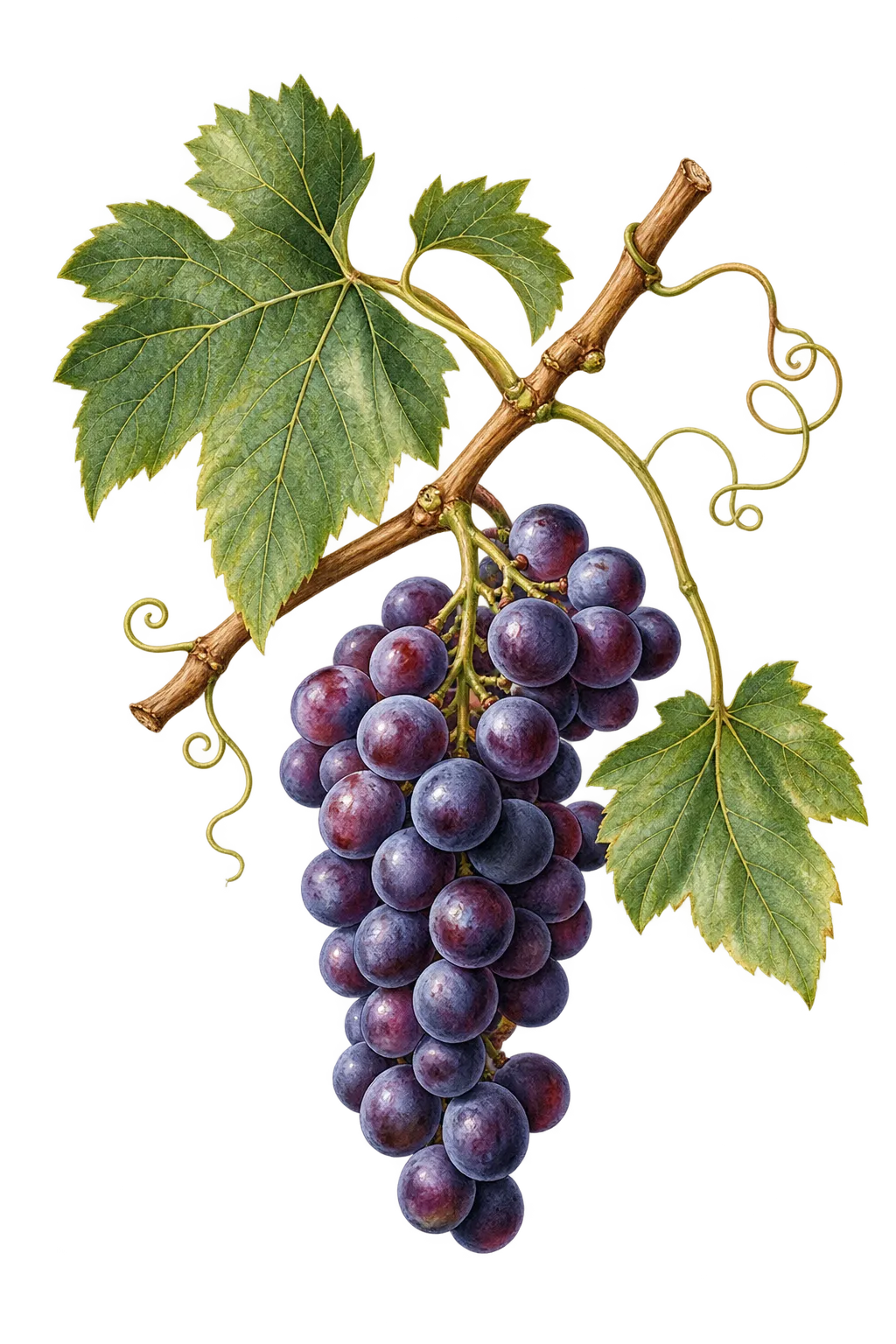
Doan’s grape is a natural meeting of two North American grape species. Kew identifies its parents as Vitis acerifolia and Vitis mustangensis. Flora of North America describes a climber that can rise high on support but becomes a sprawling, sparsely branched shrub where support is absent. Kew POWO: Vitis × doanianaFlora of North America: Vitis × doaniana
Botanical name
Kew accepts Vitis × doaniana Munson ex Viala as the natural hybrid V. acerifolia × V. mustangensis. The catalog’s “pro sp.” notation records its original description as a species. Kew POWO: Vitis × doaniana
Recognizing the plant
Young branches are woolly, becoming smoother with age. The heart-shaped leaves are shallowly three-lobed and retain cobwebby hairs, especially beneath. Branched tendrils occur at two successive nodes, followed by a node without one. Ripe berries are black beneath a heavy waxy bloom and measure at least about twelve millimetres across. The skin separates readily from the pulp. Flora of North America: Vitis × doaniana
Seasonal development
Native Oklahoma and Texas range
Flora of North America records flowering in April–May and fruiting in July–August. Flora of North America: Vitis × doaniana
Native range
The hybrid occurs naturally in southern Oklahoma and north-central Texas. The North American flora associates it with well-drained soils in the Rolling Plains and Cross Timbers and Prairies, at roughly 200–400 metres. Its name honours Judge J. Doan of Wilbarger County, Texas. Kew POWO: Vitis × doanianaFlora of North America: Vitis × doaniana
Botanical sources
Reviewed 2026-10-11. Seasonal development varies with location and growing conditions.