hollyleaved barberry
Berberis aquifolium Pursh
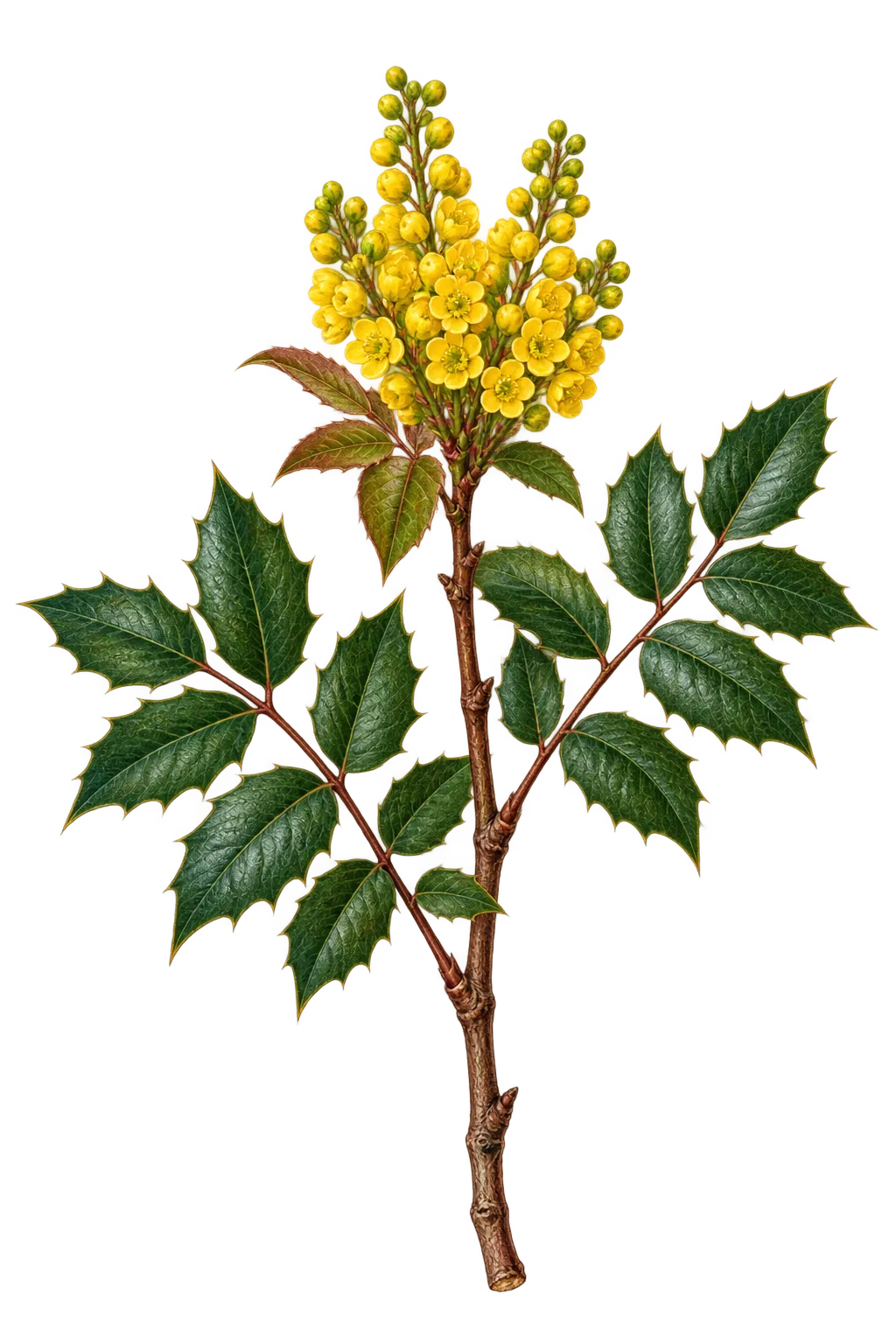
Oregon grape is an evergreen shrub with a distinctly leathery texture. Its leaflets resemble holly leaves, a likeness reflected in the epithet aquifolium. Oregon State University describes an upright plant that can become rather open-legged, although some forms stay low and broad. It is Oregon’s state flower. Oregon State University Landscape Plants: Mahonia aquifolium
Botanical name
Kew accepts Berberis aquifolium Pursh and lists Mahonia aquifolium (Pursh) Nutt. as a homotypic synonym. The catalog name refers to the same species. Kew POWO: Berberis aquifolium
Recognizing the plant
Leaves alternate along the shoots and are divided into several leaflets arranged on either side of a central stalk. The leaflets are stiff, glossy above and armed with sharp tips along their wavy margins. Short clusters of bright yellow flowers appear at the ends of shoots. Rounded blue-black berries follow, carrying a pale, waxy bloom. Mature stems become grey-brown, with yellow inner bark. Oregon State University Landscape Plants: Mahonia aquifoliumNC State Extension: Berberis aquifolium
Seasonal development
Oregon State University regional account
Flowers appear in early spring and berries in midsummer. Cold, sunny winter conditions can turn the foliage bronze or reddish-purple. Oregon State University Landscape Plants: Mahonia aquifolium
Native range
Its native range extends from southwestern Canada to northern California. It grows as a forest-understorey shrub; established plants can send up suckers and develop into colonies. Kew POWO: Berberis aquifoliumNC State Extension: Berberis aquifolium
Ecological relationships
The berries attract birds, as recorded by North Carolina’s extension account. NC State Extension: Berberis aquifolium
Botanical sources
- Kew POWO: Berberis aquifolium
- Oregon State University Landscape Plants: Mahonia aquifolium
- NC State Extension: Berberis aquifolium
Reviewed 2026-10-11. Seasonal development varies with location and growing conditions.