houseleek
Sempervivum L.
A genus overview; characteristics vary between its species.
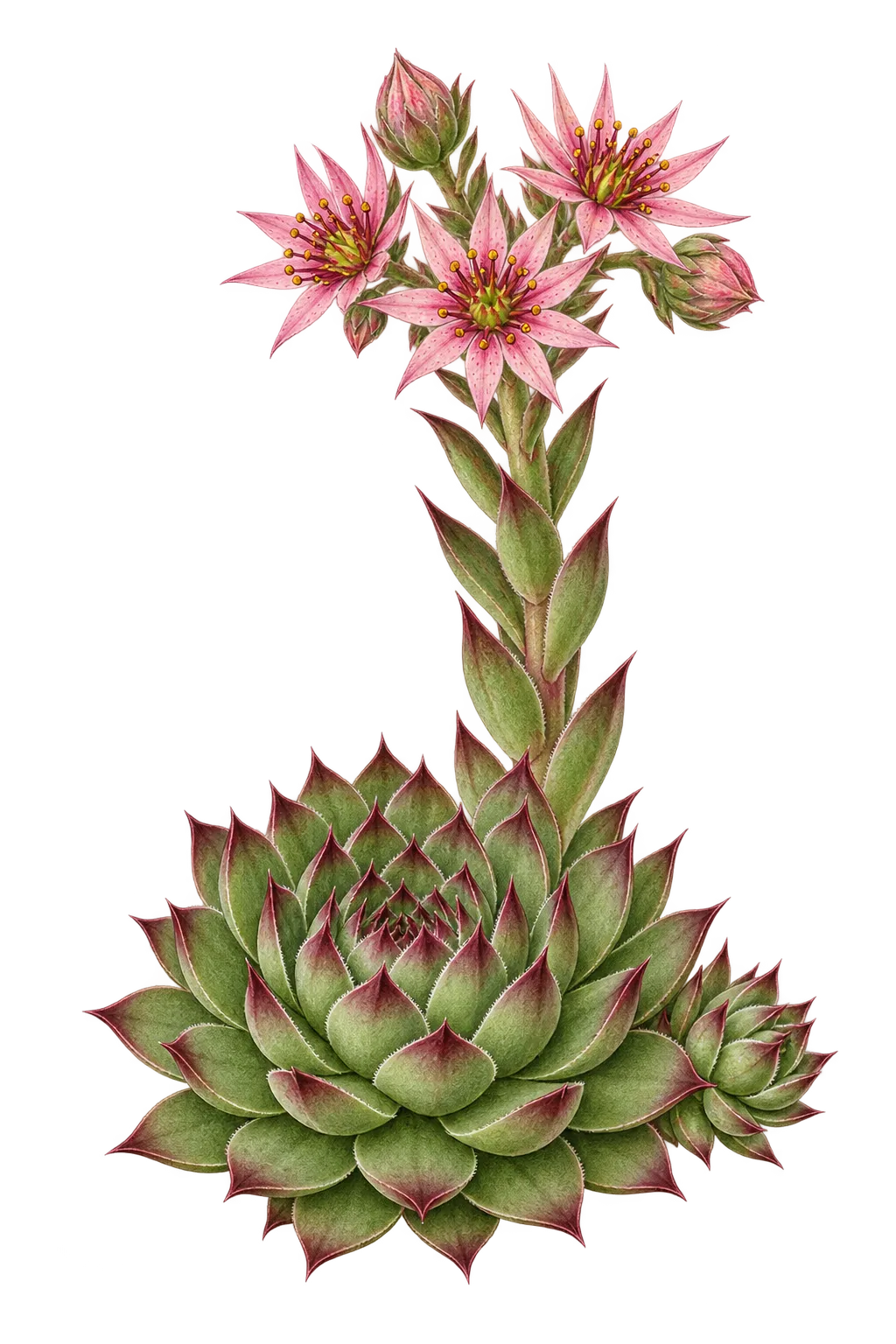
Houseleeks build colonies from compact rosettes and their smaller offsets. The young rosettes often arise along spreading stolons, giving rise to the familiar name hens and chicks. Rosettes can persist for years before flowering. NC State Extension: Sempervivum
Botanical name
Sempervivum L. is an accepted genus in Crassulaceae. Kew includes Jovibarba within it; the catalog’s genus rank is retained. Kew POWO: Sempervivum
Recognizing the plant
Leaves are thick and pointed, packed closely around each rosette’s centre. Depending on the species, their surfaces or margins may carry fine hairs, and some forms develop a cobweb-like covering. Green foliage may be edged or suffused with red or purple. The centre elongates at flowering and carries a branched cluster of flowers, often star-shaped and with numerous petals. Small dry fruits contain the seeds. NC State Extension: Sempervivum
Seasonality across the genus
North Carolina cultivation account
Summer flowering is reported for cultivated houseleeks. The flowering rosette dies afterward, while its offsets can continue growing and renewing the colony. NC State Extension: Sempervivum
Native range
Kew records the genus as native from Europe eastward to Iran and also in Morocco. It is also cultivated beyond this range. Cultivated forms suit sunny, well-drained rocky settings; many tolerate cold. Kew POWO: SempervivumNC State Extension: Sempervivum
Botanical sources
Reviewed 2026-10-11. Seasonal development varies with location and growing conditions.