hydrangea
Hydrangea Gronov. ex L.
A genus overview; characteristics vary between its species.
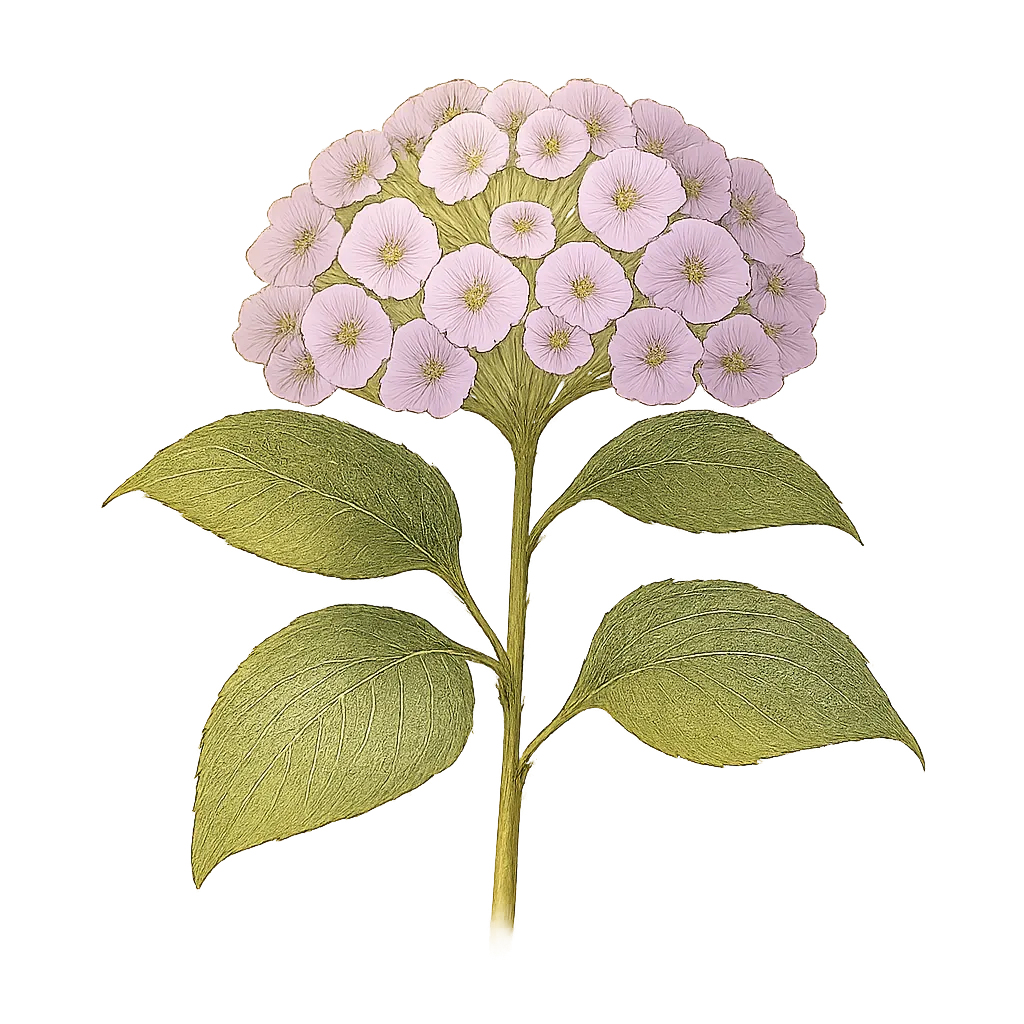
Hydrangea includes upright shrubs and climbing forms, with foliage that may be shed seasonally or remain on the plant. Its flower clusters vary from flat-topped arrangements to branching, pyramid-shaped sprays, and some species carry only fertile flowers. Royal Botanic Gardens Sydney, PlantNET: genus Hydrangea
Botanical name
The manifest’s Hydrangea L. identifies the genus published in Species Plantarum, page 397, in 1753. Kew accepts the fuller author citation Hydrangea Gronov. ex L.; NZOR uses Hydrangea L. for that same publication. Kew Plants of the World Online: Hydrangea Gronov. ex L.New Zealand Organisms Register: Hydrangea L.
Recognizing the plant
The leaves usually occur in opposite pairs and may have smooth, toothed or lobed edges. In familiar showy forms, the broad, petal-like structures are enlarged sepals of sterile flowers. Smaller fertile flowers develop into capsules containing numerous seeds. Royal Botanic Gardens Sydney, PlantNET: genus Hydrangea
Seasonality across the genus
Mid-Atlantic United States; named examples Hydrangea arborescens, H. cinerea and H. radiata
In the Mid-Atlantic United States, Hydrangea arborescens, H. cinerea and H. radiata flower in June and July on new growth. Their ageing flower heads can persist decoratively into winter. Mt. Cuba Center: Wild Hydrangea for the Mid-Atlantic, 2017–2021 trial
Native range
The genus has a broad native distribution through eastern and tropical Asia, the Hawaiian Islands, and the Americas. Its American range extends from the north-central and eastern United States through Central America into South America. Kew Plants of the World Online: Hydrangea Gronov. ex L.
Ecological relationships
In Mt. Cuba Center’s Delaware trial of these three species, insects visited lacecap flower heads more frequently than most mopheads. Lacecaps generally offered many fertile flowers, while mopheads were dominated by enlarged sterile flowers. Mt. Cuba Center: Lacecap Hydrangeas Take Top Marks
A growing note
Pruning depends on the species: bigleaf hydrangea, Hydrangea macrophylla, carries buds on older growth and is generally pruned after flowering, while other garden hydrangeas permit late-winter pruning. NC State Extension Gardener Plant Toolbox: Hydrangea
Botanical sources
- Kew Plants of the World Online: Hydrangea Gronov. ex L.
- New Zealand Organisms Register: Hydrangea L.
- Royal Botanic Gardens Sydney, PlantNET: genus Hydrangea
- NC State Extension Gardener Plant Toolbox: Hydrangea
- Mt. Cuba Center: Wild Hydrangea for the Mid-Atlantic, 2017–2021 trial
- Mt. Cuba Center: Lacecap Hydrangeas Take Top Marks
Reviewed 2026-10-11. Seasonal development varies with location and growing conditions.