iguanatail
Dracaena hyacinthoides (L.) Mabb.
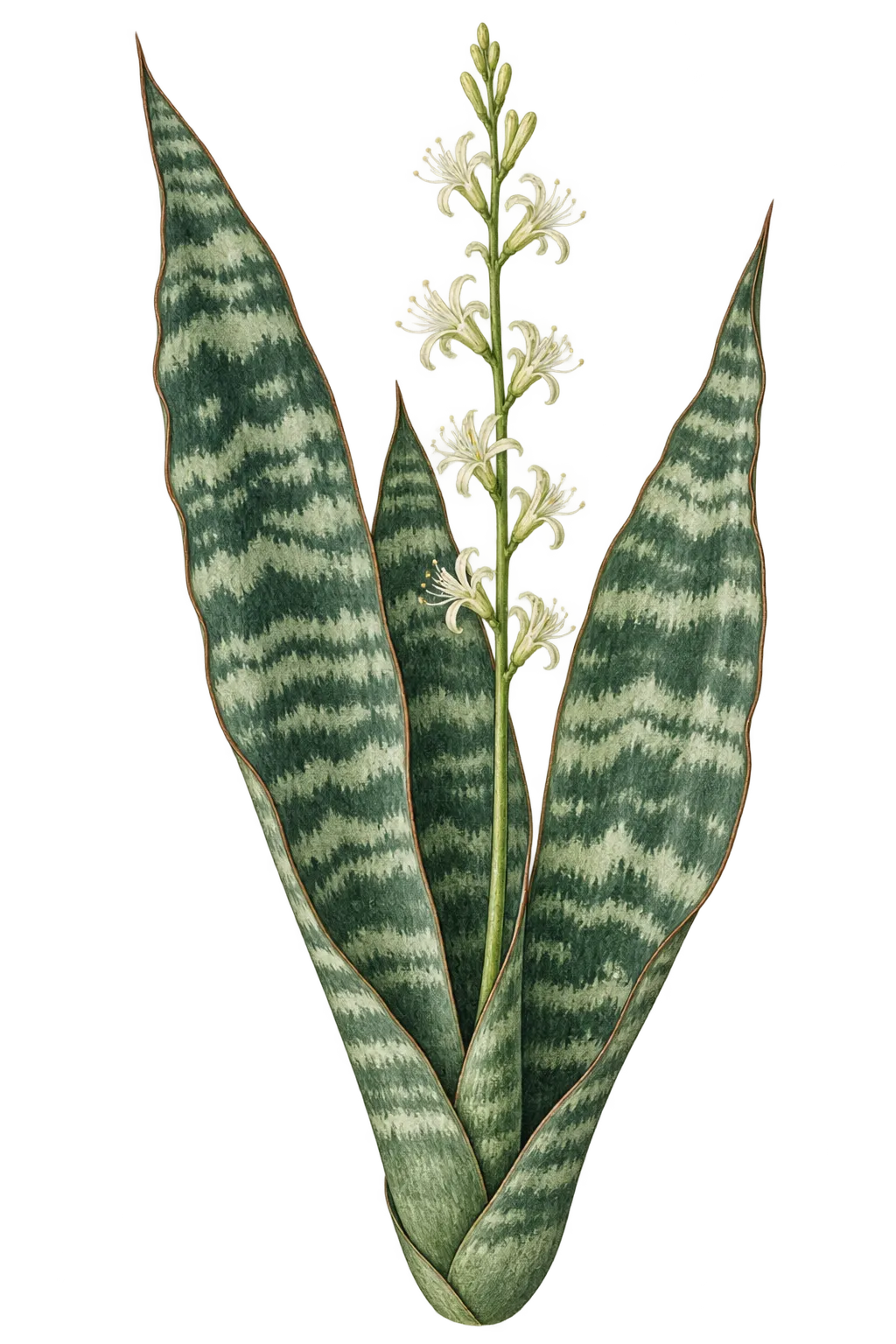
Iguanatail grows in clumps of stiff, upright foliage from sturdy underground rhizomes. The South African account describes these rhizomes as bright orange and fibrous. Above ground, the broad leaves retain their green colour year-round, making the plant conspicuous even when no flower stalk is present. SANBI PlantZAfrica: Sansevieria hyacinthoides
Botanical name
Kew accepts Dracaena hyacinthoides (L.) Mabb.; the catalog’s Sansevieria hyacinthoides (L.) Druce is a synonym of the same species. Kew POWO: Dracaena hyacinthoidesKew POWO: Sansevieria hyacinthoides
Recognizing the plant
Leaves are dark green with paler markings and a narrow red margin, a useful character for recognising the species. They are flat and broadly lance-shaped, reaching about sixty centimetres in the SANBI description. A tall, many-flowered raceme carries clusters of scented flowers in white, cream, greenish white or pale mauve. Rounded orange berries follow the flowers. SANBI PlantZAfrica: Sansevieria hyacinthoides
Bloom window
South Africa
SANBI records flowering from September to May. Individual flowers open at night. SANBI PlantZAfrica: Sansevieria hyacinthoides
Native range
Kew places its native range from Kenya to South Africa, mainly in seasonally dry tropical environments. In southern Africa it occurs among rocks beneath trees, in bushveld, along wooded streams and in sheltered ravines. Kew POWO: Dracaena hyacinthoidesSANBI PlantZAfrica: Sansevieria hyacinthoides
Ecological relationships
Weaver birds use fibres from the leaves to construct their nests. SANBI PlantZAfrica: Sansevieria hyacinthoides
Botanical sources
- Kew POWO: Dracaena hyacinthoides
- Kew POWO: Sansevieria hyacinthoides
- SANBI PlantZAfrica: Sansevieria hyacinthoides
Reviewed 2026-10-11. Seasonal development varies with location and growing conditions.