llerenes
Goeppertia allouia (Aubl.) Borchs. & S.Suárez
Llerenes is a tropical American root crop with a long history in home gardens and agroforestry. The harvested swollen roots and the planting material are different parts: growers divide the rhizomes to produce new plants. FAO describes centuries of garden cultivation, linking this arrowroot-family perennial to traditional systems in which useful plants are grown together rather than in single-crop fields. FAO: Neglected crops, Guinea arrowroot chapter pp. 239–242
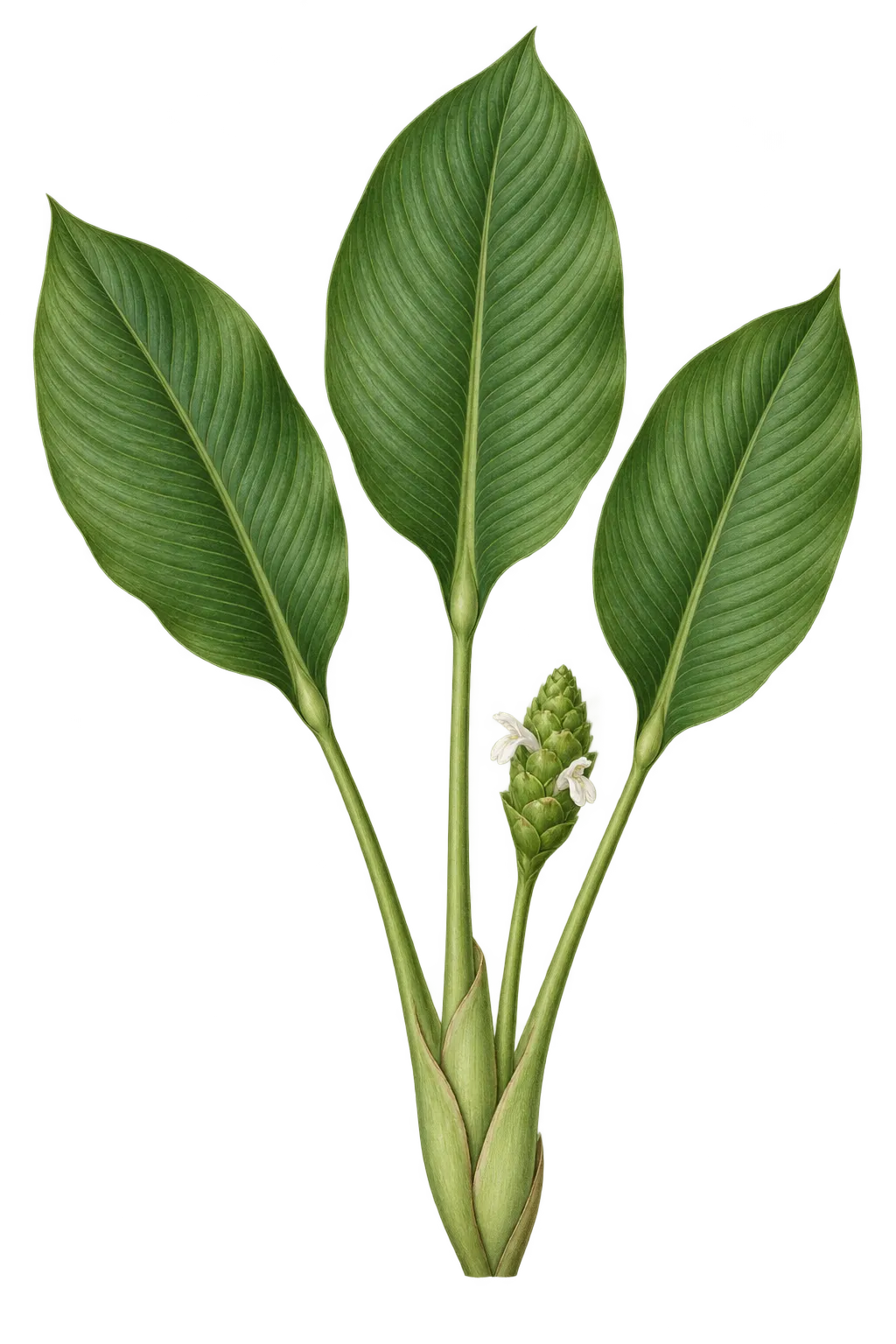
Botanical name
Kew explicitly synonymizes Calathea allouia (Aubl.) Lindl. with Goeppertia allouia (Aubl.) Borchs. & S.Suárez. Verified name: Goeppertia allouia (Aubl.) Borchs. & S.Suárez. Kew POWO: Calathea allouiaKew POWO: Goeppertia allouia
Recognizing the plant
Clumps reach about a metre high. Long, ridged stalks carry elliptical leaf blades twenty to sixty centimetres long, and the sheathing leaf bases form short pseudostems. The swollen roots are oval to cylindrical, two to eight centimetres long. White flowers measure about two to five centimetres. In the cited Manaus collection, only about two percent of plants flowered and none produced viable seed; this is a collection-specific observation. FAO: Neglected crops, Guinea arrowroot chapter pp. 239–242
Native range
Kew records its native range in the Caribbean and from parts of Mexico through tropical South America. It is a wet-tropical species. FAO also records introductions to several South and Southeast Asian countries, including India and Indonesia. Kew POWO: Goeppertia allouiaFAO: Neglected crops, Guinea arrowroot chapter pp. 239–242
Botanical sources
- FAO: Neglected crops, Guinea arrowroot chapter pp. 239–242
- Kew POWO: Calathea allouia
- Kew POWO: Goeppertia allouia
Reviewed 2026-10-11. Seasonal development varies with location and growing conditions.