New York ironweed
Vernonia noveboracensis (L.) Michx.
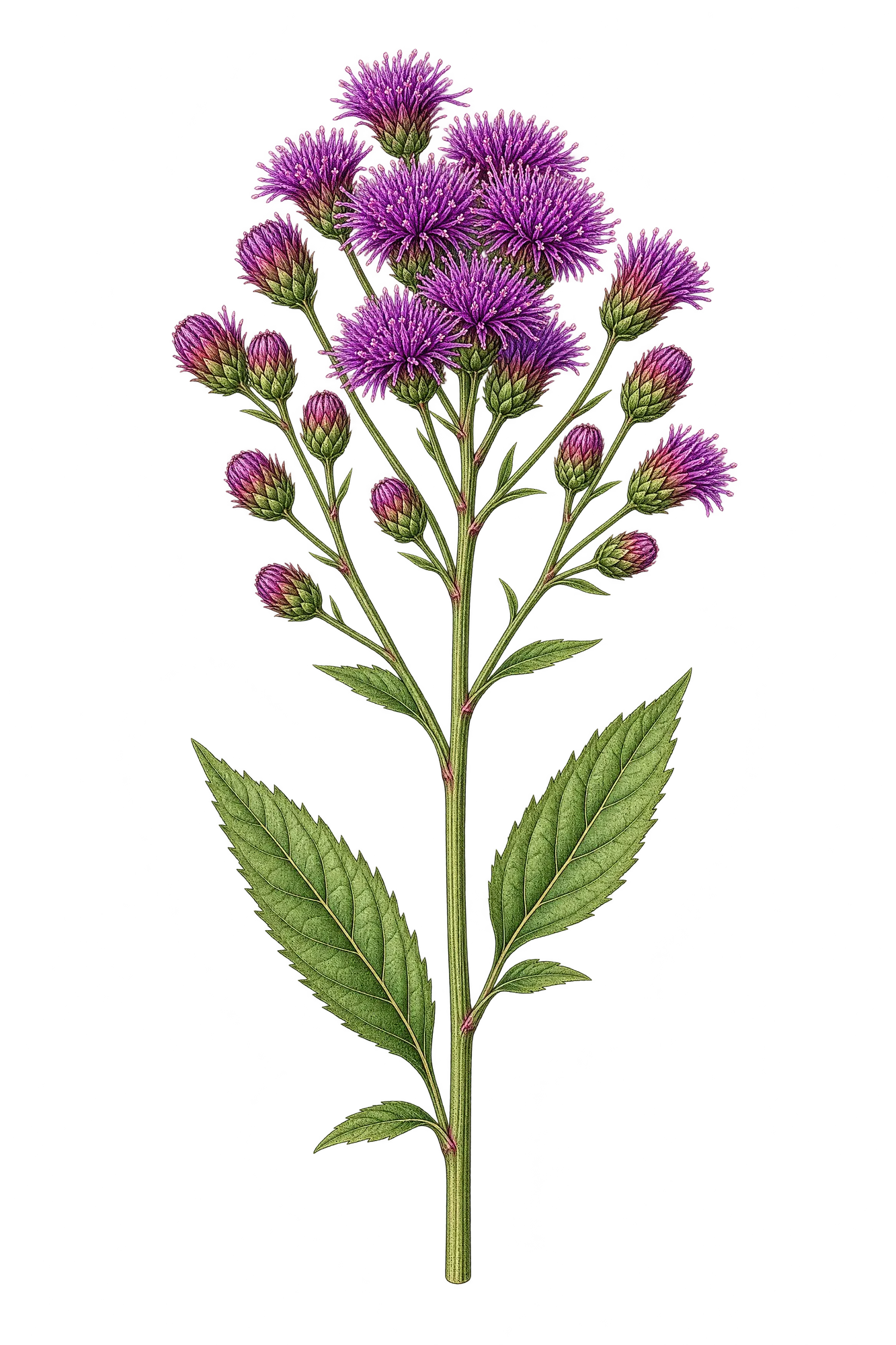
New York ironweed raises deep-purple flower clusters above strong, upright stems. The North Carolina extension account describes a perennial commonly reaching five to eight feet, making it a conspicuous plant among lower meadow vegetation. It favours moist, acidic soil and flowers best in full sun. NC State Extension: Vernonia noveboracensis
Botanical name
Kew accepts Vernonia noveboracensis (L.) Michx. in Asteraceae, matching the catalog’s species identity. Kew POWO: Vernonia noveboracensis
Recognizing the plant
Its lance-shaped leaves have finely toothed margins, pointed tips and paler, downy undersides. Small flower heads form loose, branching clusters at the stem tops. Each head contains tubular disc florets, without the strap-shaped ray florets seen around many familiar daisies. Rust-coloured seed heads extend the display after the purple flowers have faded. NC State Extension: Vernonia noveboracensis
Bloom window
North Carolina extension account
Flowering is recorded from July through September. NC State Extension: Vernonia noveboracensis
Native range
Kew records its native range in the eastern United States, including coastal and inland states from the Northeast south to Florida and west to Tennessee. North Carolina’s account places it in moist fields, meadows and streamside habitats. Kew POWO: Vernonia noveboracensisNC State Extension: Vernonia noveboracensis
Ecological relationships
Bees and butterflies visit the flowers, while songbirds eat the seeds. NC State Extension: Vernonia noveboracensis
Dead stems can provide nesting sites for bees. NC State Extension: Vernonia noveboracensis
Botanical sources
Reviewed 2026-10-11. Seasonal development varies with location and growing conditions.