Norway spruce
Picea abies (L.) H.Karst.
Norway spruce can become a towering forest tree, reaching 50–60 m under favorable conditions. Its straight trunk and orderly conical crown create a strong outline, with upper branches rising and lower ones drooping. The pale wood has long been used for construction and for the soundboards of musical instruments. European Atlas of Forest Tree Species: Picea abies
Botanical name
Kew accepts Picea abies (L.) H.Karst. in Pinaceae. The supplied Karst. citation is normalized to the fuller author abbreviation. Kew Plants of the World Online: Picea abies
Recognizing the plant
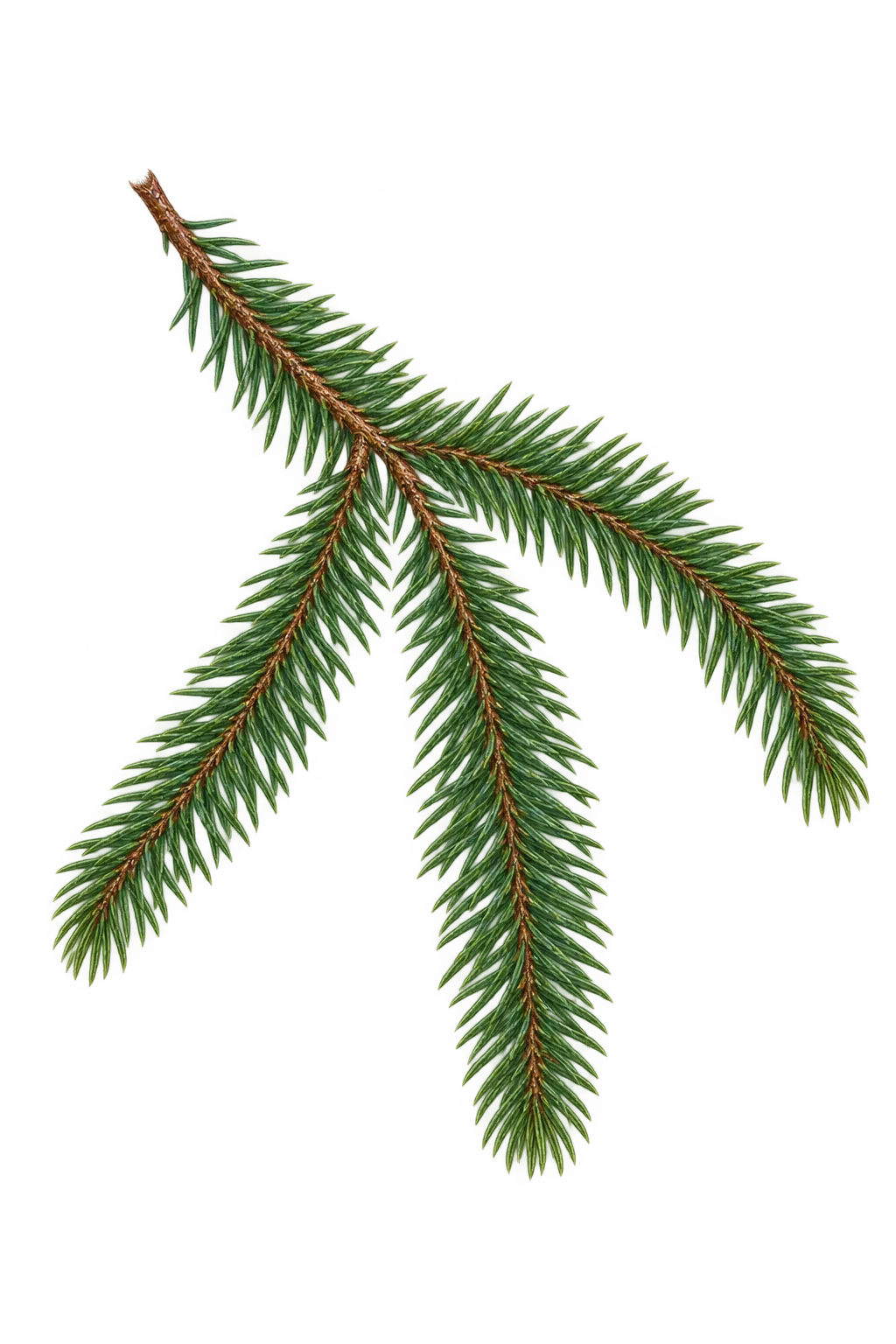
The stiff needles are roughly 1–2.5 cm long and four-angled in cross-section. They attach to small woody pegs along the twigs. Young bark is relatively thin, becoming scaly as the trunk matures. Seed cones are long and cylindrical, hanging below the branches; their thin scales eventually open to release small winged seeds. European Atlas of Forest Tree Species: Picea abiesNC State Extension: Picea abies
Cones and seasonal development
European range
In the European atlas account, seed cones change from green to brown in autumn and open when dry. European Atlas of Forest Tree Species: Picea abies
Native range
Native to Europe, the species is prominent in northern boreal forests and in the Alps and Carpathians. It reaches from low elevations in the north to above 2,400 m in the Alps. It favors cool conditions and soils with reliable moisture. Kew Plants of the World Online: Picea abiesEuropean Atlas of Forest Tree Species: Picea abies
Botanical sources
- Kew Plants of the World Online: Picea abies
- European Atlas of Forest Tree Species: Picea abies
- NC State Extension: Picea abies
Reviewed 2026-10-11. Seasonal development varies with location and growing conditions.