orange daylily
Hemerocallis fulva (L.) L.
Orange daylily makes its display through succession: each flower opens in the morning and closes by evening, while further buds continue the show. It has been cultivated in Britain for centuries. Kew’s historical account notes its presence in John Gerard’s garden in 1597 and John Parkinson’s description in 1629. Kew Species Profile: Orange daylily
Botanical name
Kew accepts Hemerocallis fulva (L.) L. in Asphodelaceae, with several varieties included within the species. Kew POWO: Hemerocallis fulva
Recognizing the plant
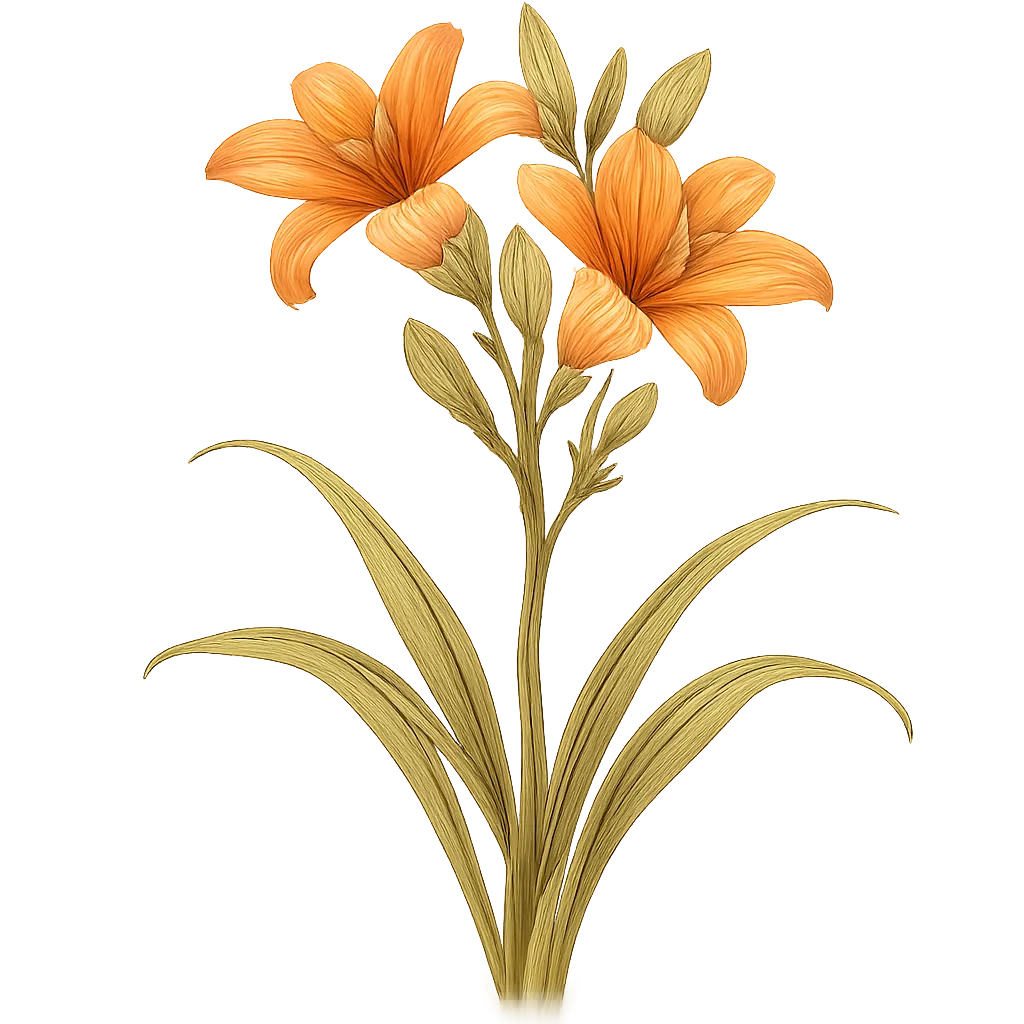
Clumps carry long, narrow green leaves that arch toward the ground. Stiff, leafless flowering stems rise above them, holding large, unscented orange-red funnels. The broad floral segments have wavy edges and a paler central stripe. Underground rhizomes allow the plant to expand into substantial patches. Capsules can form after flowering, although Kew notes that they do not often develop. Kew Species Profile: Orange daylilyNC State Extension: Hemerocallis fulva
Bloom window
North Carolina cultivation account
The extension account records a summer flowering season. NC State Extension: Hemerocallis fulva
Native range
The species is native from China into temperate eastern Asia, including Japan, Korea and Taiwan. It has naturalised across much of Europe and North America, where its vigorous spread can outcompete native vegetation. Kew POWO: Hemerocallis fulvaKew Species Profile: Orange daylily
Ecological relationships
North Carolina’s extension account lists butterflies and hummingbirds among the animals attracted to its flowers. NC State Extension: Hemerocallis fulva
Botanical sources
- Kew POWO: Hemerocallis fulva
- Kew Species Profile: Orange daylily
- NC State Extension: Hemerocallis fulva
Reviewed 2026-10-11. Seasonal development varies with location and growing conditions.