oregano
Origanum vulgare L.
Oregano’s aroma is part of a variable living plant, not a fixed flavour. Kew notes that its taste changes with cultivar, growing conditions and season. The species is a woody-based perennial, usually twenty to ninety centimetres tall, and its leaves are widely used in Greek and Italian cooking. Kew Species Profile: Origanum vulgare
Botanical name
Kew accepts Origanum vulgare L. in Lamiaceae, matching the catalog species rather than a particular culinary cultivar. Kew POWO: Origanum vulgare
Recognizing the plant
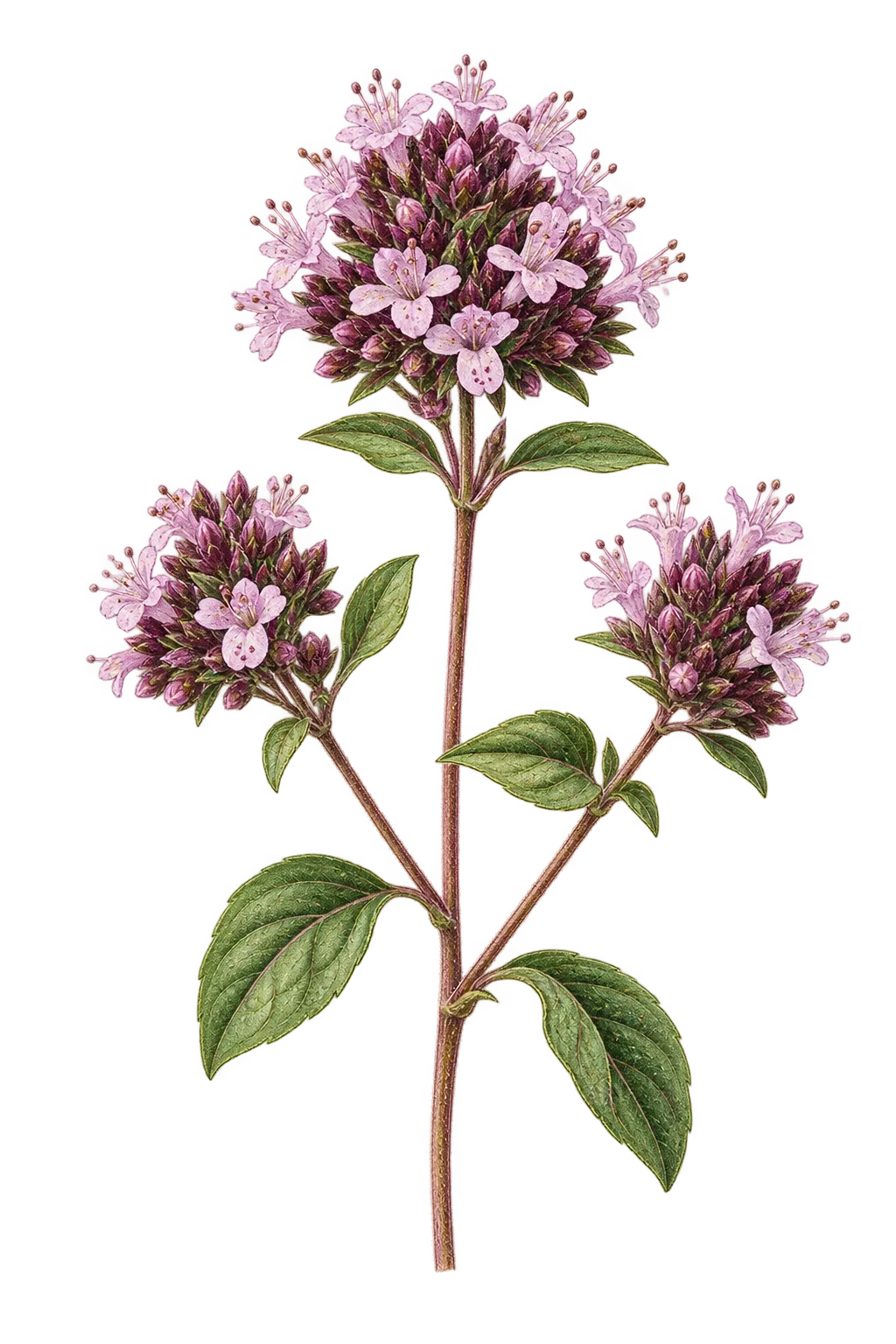
Egg-shaped leaves stand opposite one another on branching stems. Their edges are smooth or shallowly toothed, and their tips range from pointed to rounded. Many small flowers gather into dense, short clusters at the ends and sides of the shoots. Each white-to-purplish corolla forms two lips around four stamens. The calyx has five teeth, and each fruit separates into four small, one-seeded nutlets. Kew Species Profile: Origanum vulgare
Bloom window
North Carolina cultivation account
The extension account records the main flower display in late spring and summer. NC State Extension: Origanum vulgare
Native range
Its native range extends from Macaronesia across Europe and the Mediterranean region into Asia as far as China. Kew describes wild habitats including grassland and open scrub, often on rocky ground and limestone-rich soils. It is widely cultivated beyond that range. Kew POWO: Origanum vulgareKew Species Profile: Origanum vulgare
Ecological relationships
Its flowers attract bees, butterflies and moths, according to the extension account. NC State Extension: Origanum vulgare
Botanical sources
Reviewed 2026-10-11. Seasonal development varies with location and growing conditions.