paleyellow touch-me-not
Impatiens aurella Rydb.
This touch-me-not uses two ways of producing seeds. Early flowers remain closed and self-pollinate; later flowers open their petals. Ripe capsules from the open flowers burst and throw seeds away from the parent, while capsules from the closed flowers remain non-explosive and contain smaller seeds. British Columbia Ministry of Forests: Orange Touch-me-not, February 2015
Botanical name
Kew accepts Impatiens aurella Rydb. as a species. Kew Plants of the World Online: Impatiens aurella
Recognizing the plant
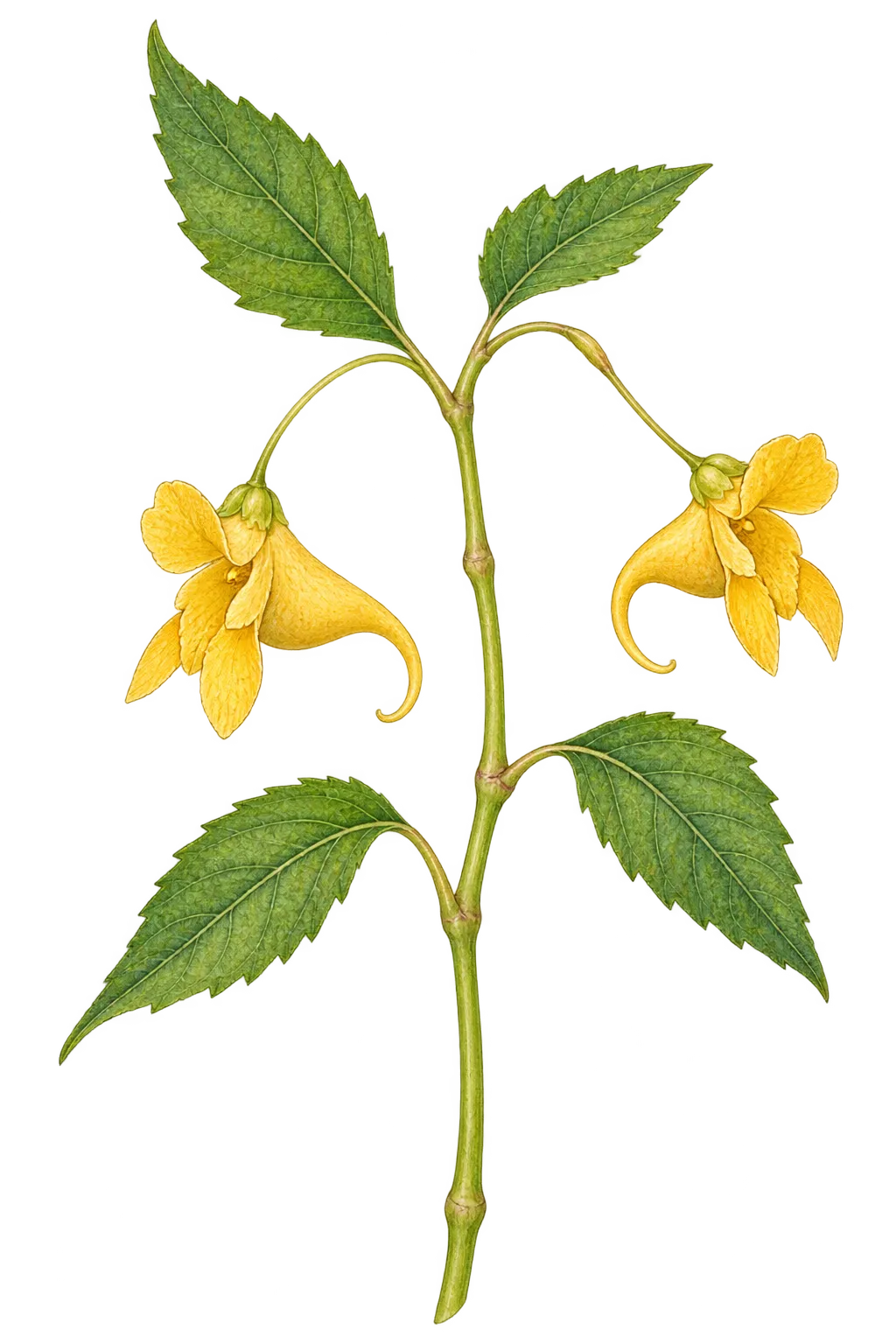
The succulent annual has hairless, upright or ascending stems, often branched, and alternate leaves with coarse teeth. Plants commonly reach half a metre to one metre tall. Its leaves are egg-shaped to elliptic and about 2–8 centimetres long. Small orange flowers arise from the leaf axils, with a pouch-like sepal extended into a curved spur. University of British Columbia, E-Flora BC: Impatiens aurella
Seasonal development
British Columbia, Canada
In British Columbia, flowers and seed capsules occur from July through September. British Columbia Ministry of Forests: Orange Touch-me-not, February 2015
Native range
Its native range comprises British Columbia and the northwestern United States, including Washington, Idaho and Montana. British Columbian populations occupy moist streambanks and meadows in lower mountain and steppe settings. Kew Plants of the World Online: Impatiens aurellaUniversity of British Columbia, E-Flora BC: Impatiens aurella
Ecological relationships
The later, open flowers attract insect and hummingbird pollinators for cross-pollination. British Columbia Ministry of Forests: Orange Touch-me-not, February 2015
Botanical sources
- Kew Plants of the World Online: Impatiens aurella
- British Columbia Ministry of Forests: Orange Touch-me-not, February 2015
- University of British Columbia, E-Flora BC: Impatiens aurella
Reviewed 2026-10-11. Seasonal development varies with location and growing conditions.