petunia
Petunia × atkinsiana (Sweet) D.Don ex W.H.Baxter
Garden petunia is a hybrid shaped by horticulture. Its cultivated forms offer an extensive range of flower colors and patterns, but the Flora of North America found mainly white or pale pink flowers among specimens representing naturalized populations. Fertile plants can produce seed and establish outside gardens, while others remain temporary escapes. Flora of North America: Petunia × atkinsiana
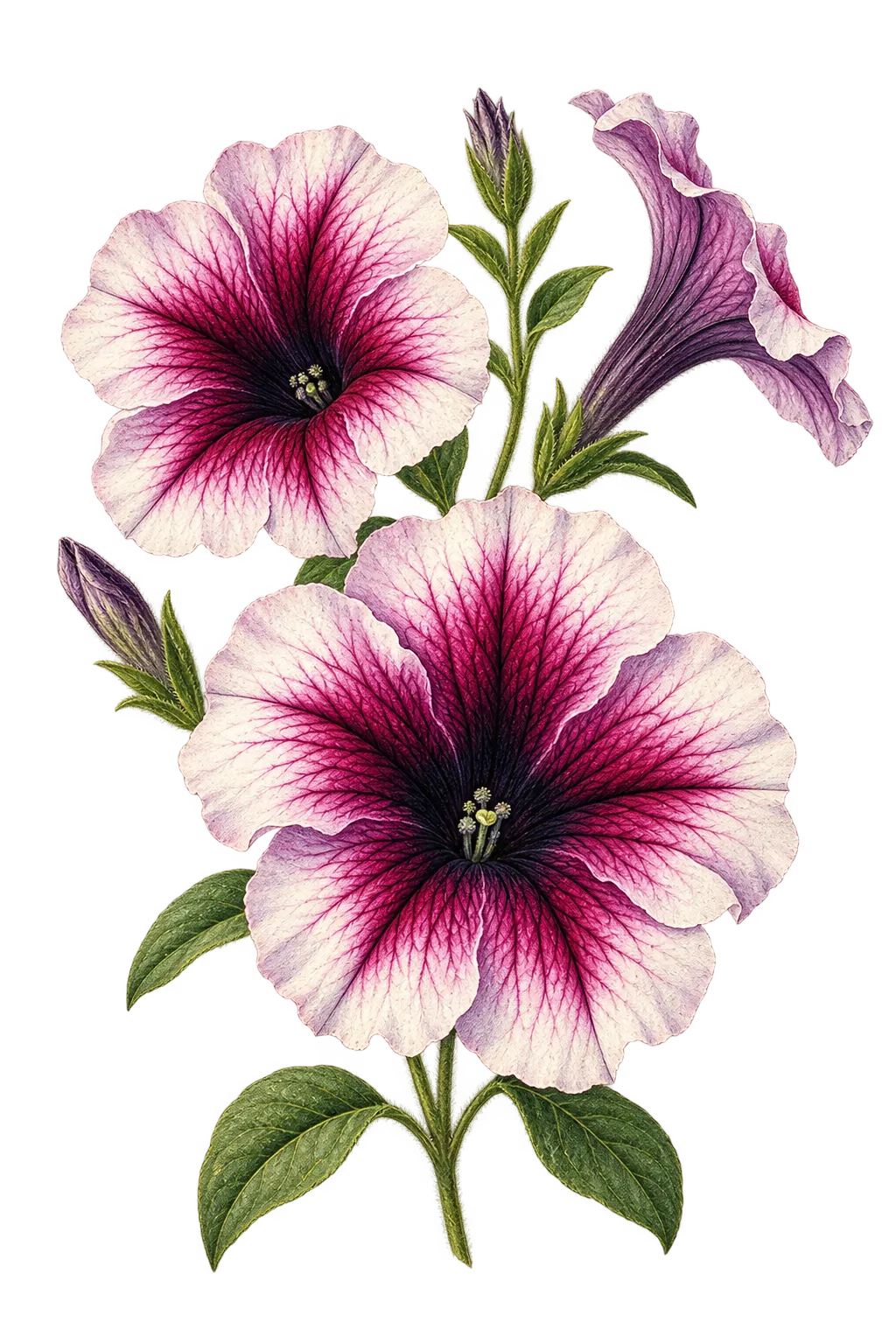
Botanical name
The supplied D.Don ex Loudon attribution and the accepted Baxter attribution refer to the combination published in Loudon’s Hortus Britannicus, page 655, in 1839, based on Nierembergia × atkinsiana Sweet. Kew: Petunia × atkinsianaIPNI: Nicotiana × atkinsiana nomenclatural links
Recognizing the plant
The leafy stems vary greatly in length. Lower leaves tend to broaden above the middle, whereas upper leaves are more lance-shaped or oval; their margins are smooth. Individual flowers stand on distinct stalks and have a calyx divided into long lobes. The corolla widens from a tube into a flared, funnel-shaped face, sometimes marked with contrasting veins. Five stamens are attached inside the tube. After fertilization, the ovary develops into a small capsule. Flora of North America: Petunia × atkinsiana
Bloom window
North America, escaped populations
The North American flowering record spans April through October, sometimes extending to December. Flora of North America: Petunia × atkinsiana
Native range
This is an artificial garden hybrid rather than a plant with a single native wild range. Escaped populations occur in North America and elsewhere, especially along roads, railways and other disturbed places with gravelly, sandy or poor soils. Kew: Petunia × atkinsianaFlora of North America: Petunia × atkinsiana
Botanical sources
- Kew: Petunia × atkinsiana
- IPNI: Nicotiana × atkinsiana nomenclatural links
- Flora of North America: Petunia × atkinsiana
Reviewed 2026-10-11. Seasonal development varies with location and growing conditions.