philodendron
Philodendron bipinnatifidum Schott ex Endl.
This philodendron develops an imposing crown of deeply divided leaves on thick stems marked by conspicuous, eye-like leaf scars. Young plants can stand upright; older plants may scramble or use support. Roots emerging from stem nodes help anchor them against trunks or other surfaces. Singapore NParks: Thaumatophyllum bipinnatifidum
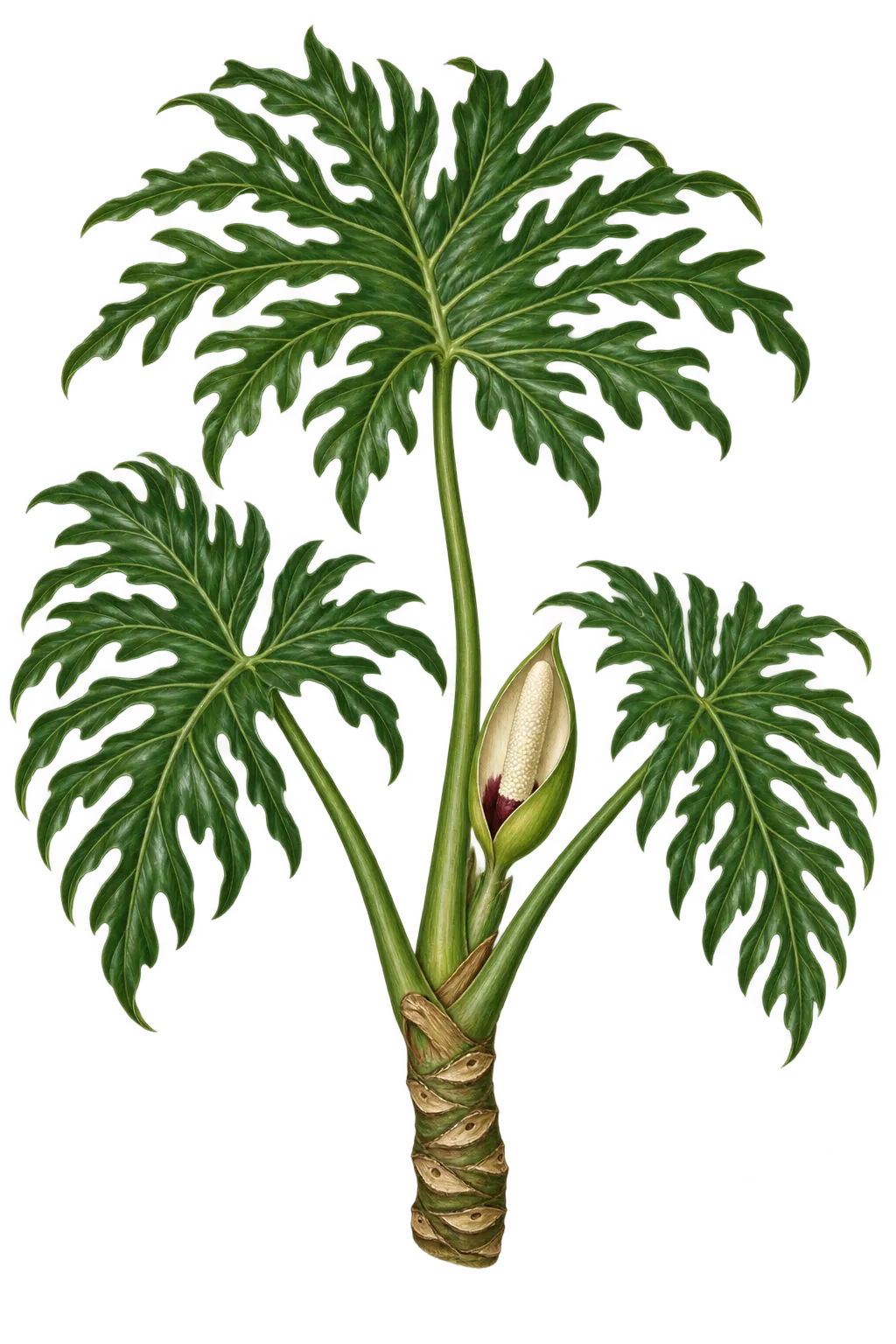
Botanical name
Kew accepts Philodendron bipinnatifidum Schott ex Endl. and treats Thaumatophyllum bipinnatifidum as a synonym. Both names refer to the same species here. Kew Plants of the World Online: Philodendron bipinnatifidum
Recognizing the plant
Mature leaf blades may reach 75–120 cm long, with wavy lobes that are themselves divided. Their upper surfaces are glossy dark green and the undersides paler. Juvenile leaves are less deeply cut. The inflorescence combines a pale spadix with a surrounding spathe that is mostly green outside and creamy within. Female flowers occupy the base of the spadix, sterile male flowers the middle and fertile male flowers the upper part. Singapore NParks: Thaumatophyllum bipinnatifidum
Native range
Native populations extend from eastern Bolivia through southeastern and southern Brazil to northeastern Argentina, including Paraguay. Habitats include gallery forest, seasonal woodland, swampy openings and rocky scrub. Kew Plants of the World Online: Philodendron bipinnatifidumSingapore NParks: Thaumatophyllum bipinnatifidum
Ecological relationships
In its native range, Cyclocephala beetles pollinate the flowers. The inflorescence generates heat over two or three days and releases an insect-attracting scent. Singapore NParks: Thaumatophyllum bipinnatifidum
Botanical sources
- Kew Plants of the World Online: Philodendron bipinnatifidum
- Singapore NParks: Thaumatophyllum bipinnatifidum
Reviewed 2026-10-11. Seasonal development varies with location and growing conditions.